







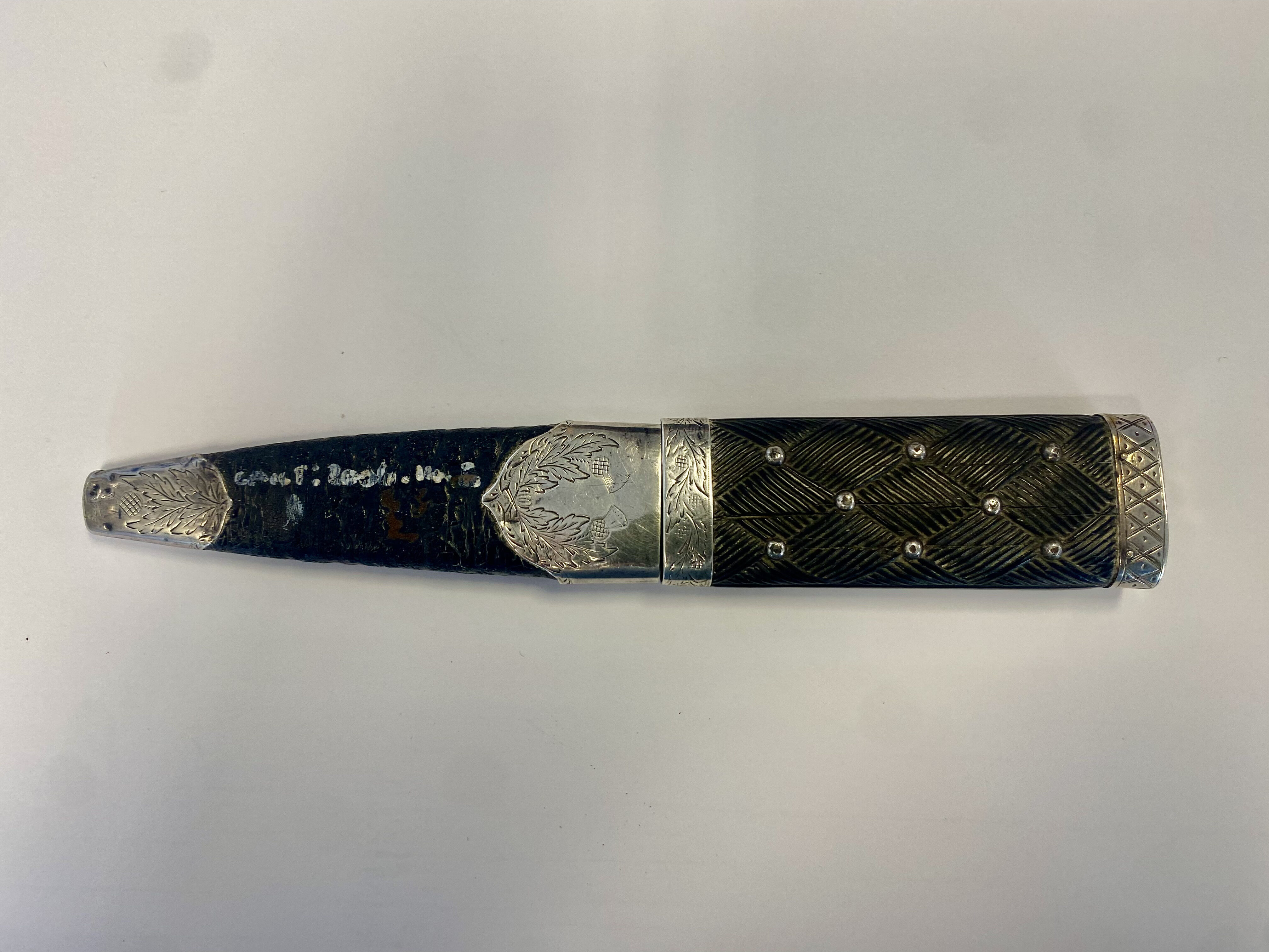
At first glance, this finely decorated knife appears to be a traditional piece of Highland dress. Look more closely, however, and a small inscription transforms it from a decorative object into a reminder of Caithness’s military history.
The sgian-dubh, pronounced roughly *skee-an doo*, is a small, single-edged knife traditionally worn tucked into the top of the kilt hose. Its Gaelic name is commonly translated as “black knife”, although dubh may also carry associations with something dark, hidden or concealed.
The precise origins of the sgian-dubh remain uncertain. It may have developed from the sgian-achlais, or “armpit knife”, a larger blade carried beneath the arm or concealed within a person’s clothing during the 17th and 18th centuries. Another possibility is that it evolved from the small utility and skinning knives carried by Highlanders alongside larger hunting knives and dirks. By the 19th century, however, the sgian-dubh had become a recognisable part of formal Highland dress, worn openly in the stocking with the upper part of its handle visible.
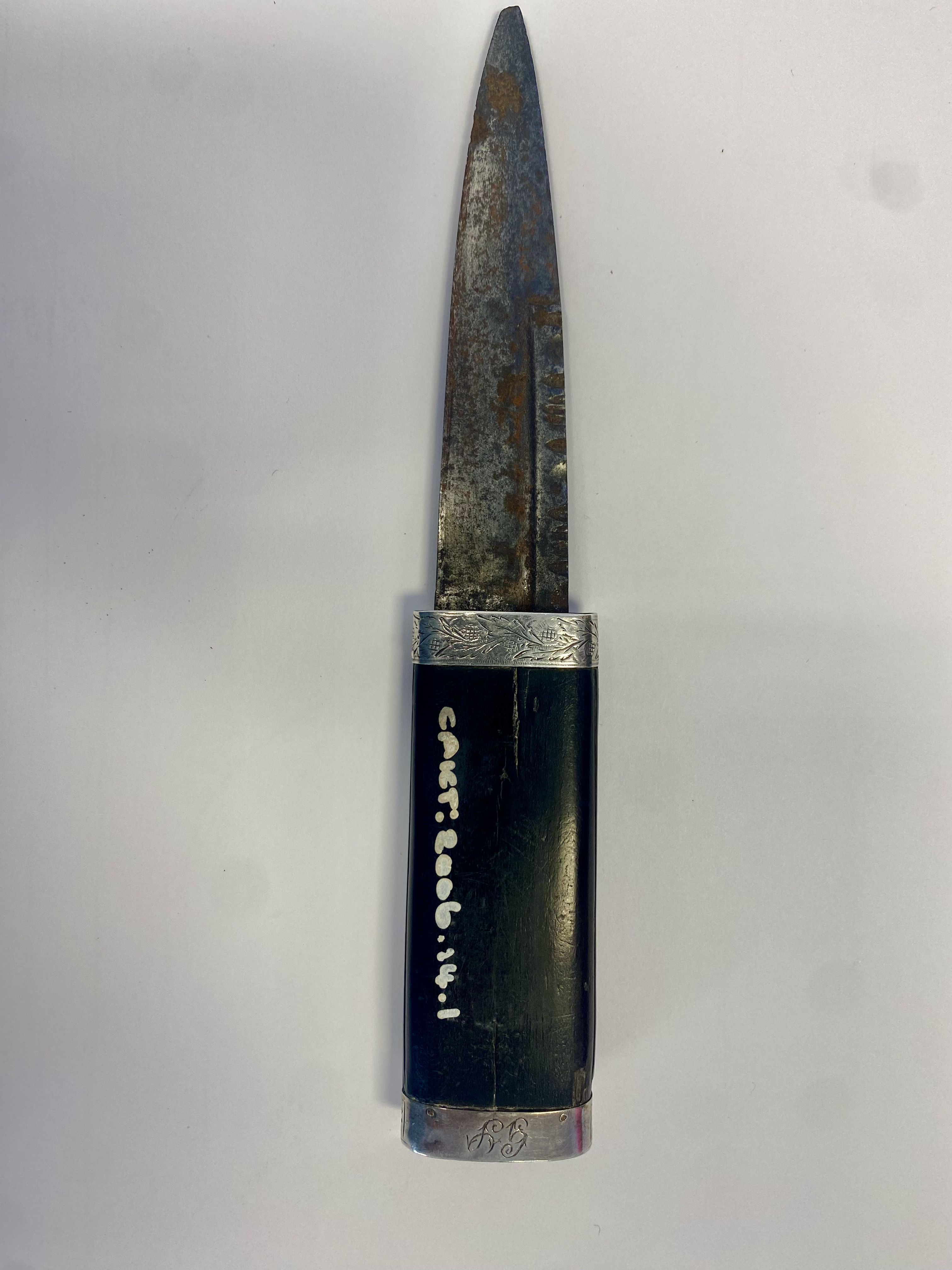
Our example dates from 1877 and is particularly striking. The handmade knife has a dark wooden handle, decorated on the front with a deeply cut diamond pattern. Small raised silver studs mark the points of the diamonds, while engraved silver mounts decorate the top and bottom of the grip. The upper mount bears the initials “GS”, and the lower is ornamented with delicate leaf designs.
Its black leather sheath is similarly embellished. Silver mounts at the top and bottom are engraved with leaves and thistles, combining practical protection with motifs closely associated with Scotland. Inside is a steel blade with one smooth cutting edge and decorative serrated or scalloped work along its back.
The most revealing detail is engraved on the reverse of the sheath:
“Serjt G Sorrie, 1st Css Res Vrs Thurso 1877”
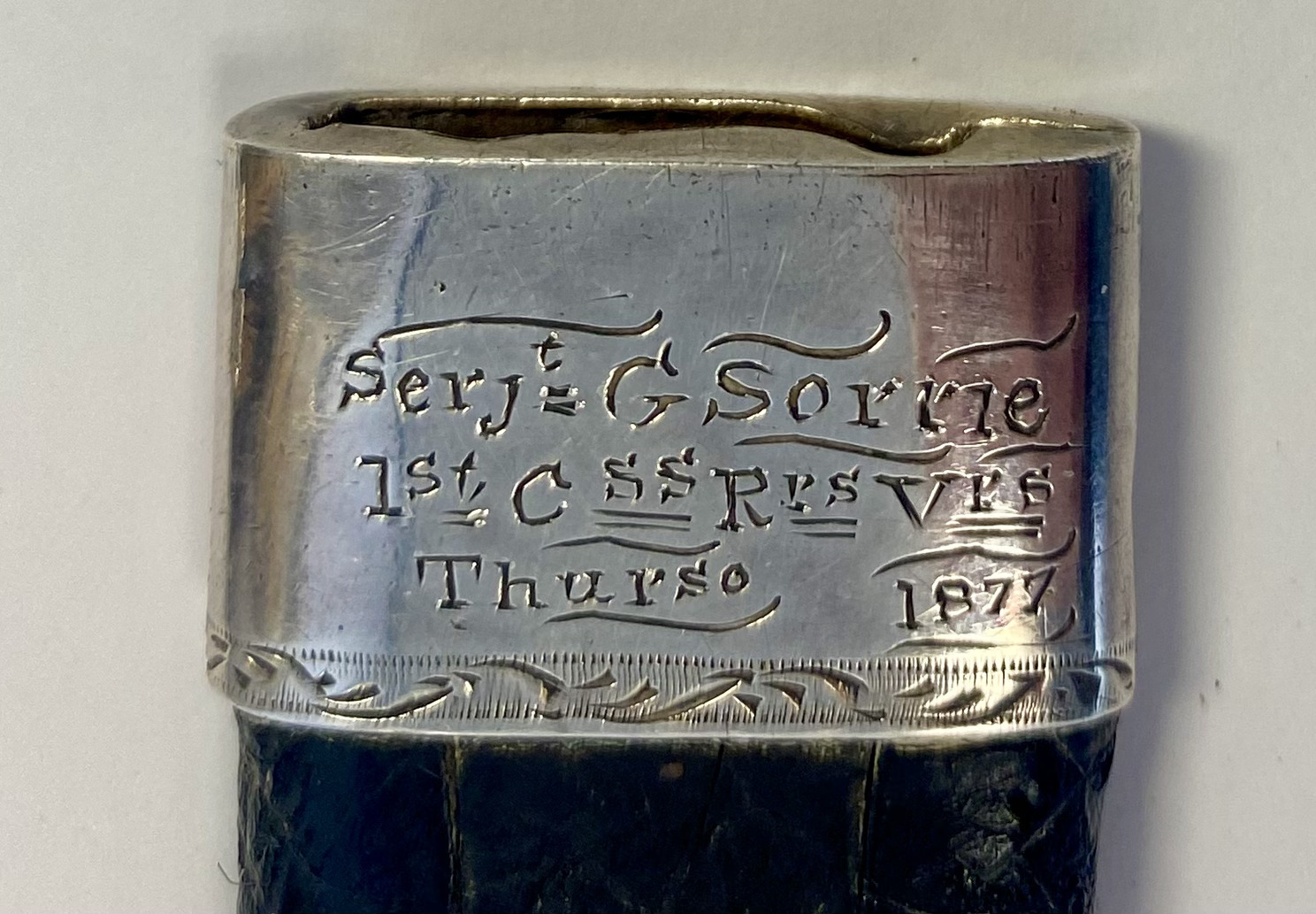
The inscription identifies its owner as Sergeant George Sorrie and appears to refer to the 1st Caithness Rifle Volunteers at Thurso. The Rifle Volunteer movement emerged in Britain during the late 1850s, when local, part-time military companies were established in response to fears of invasion. These units trained regularly in drill and musketry, and rifle-shooting competitions became an important part of Volunteer life.
Sergeant Sorrie served as an instructor with the Thurso company, helping its volunteers develop the discipline and marksmanship expected of them. The sgian-dubh is believed to have been awarded in recognition of his own skill in rifle shooting - a skill undoubtedly strengthened through many years spent training others.
The Caithness Rifle Volunteers later became connected with the Seaforth Highlanders. In 1908, the county’s Volunteer units were incorporated into the newly established Territorial Force as part of the 5th (Sutherland and Caithness Highland) Battalion, Seaforth Highlanders.
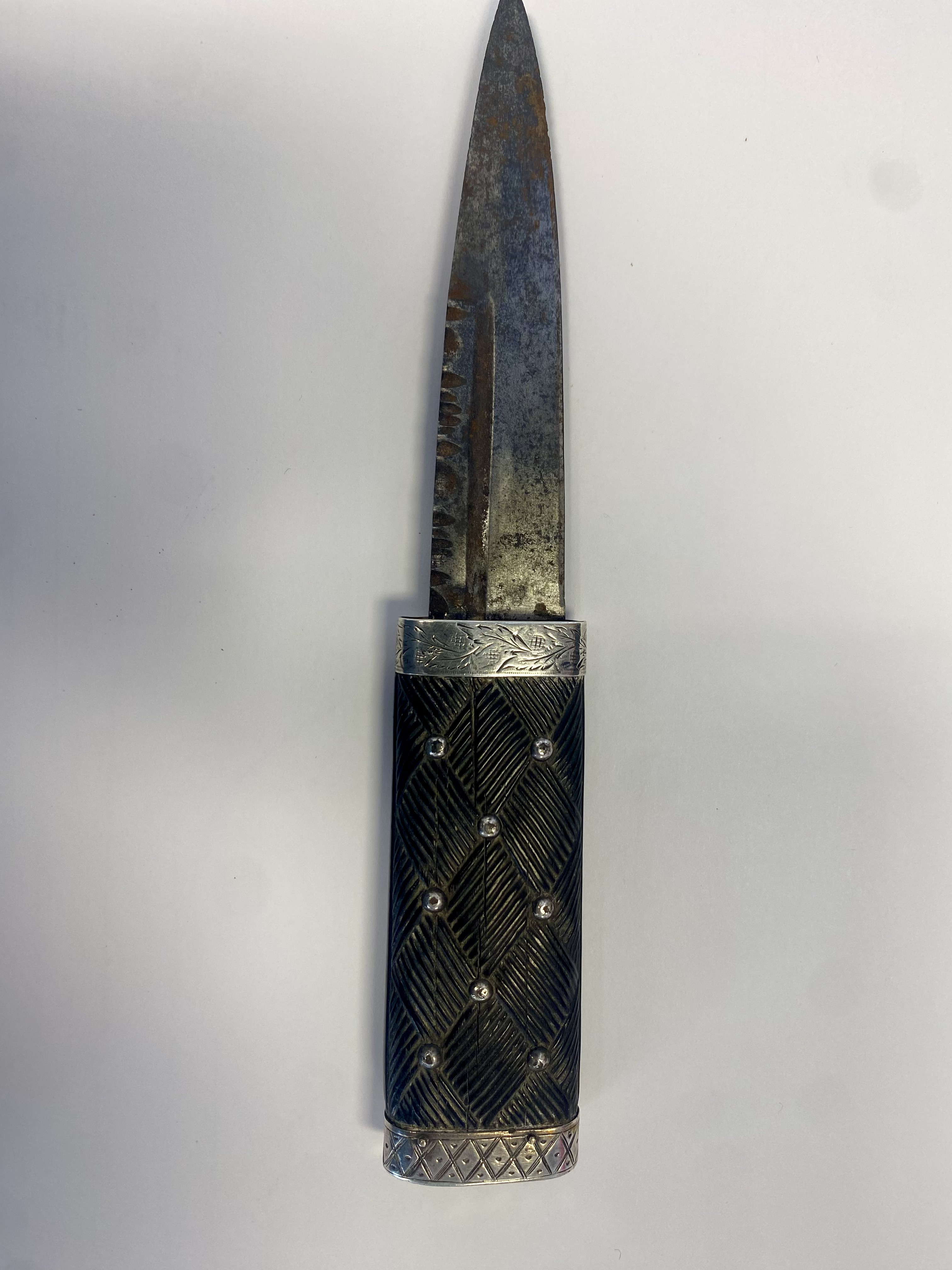
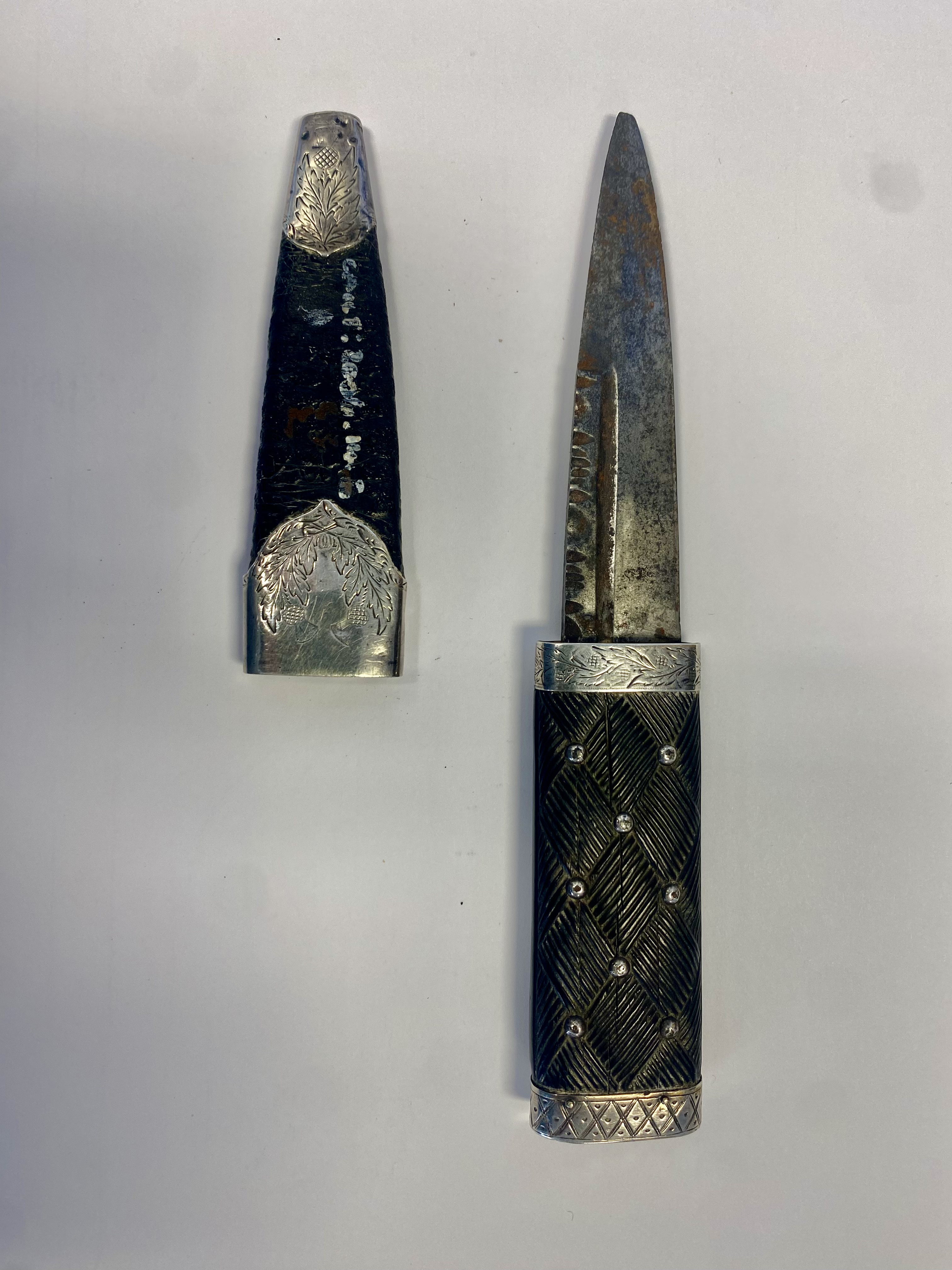
Silver mounts, thistles and patterned handles are all familiar features of Victorian sgian-dubhs. What makes this example special is not simply the quality of its decoration, but the name and date engraved upon it. They allow us to connect the object to an individual, a local military unit and the wider Volunteer movement that flourished across Caithness during the 19th century.
Once a prize celebrating one man’s marksmanship, Sergeant George Sorrie’s sgian-dubh now preserves the story of the people of Thurso who gave their time to train for the defence of their community and country.