





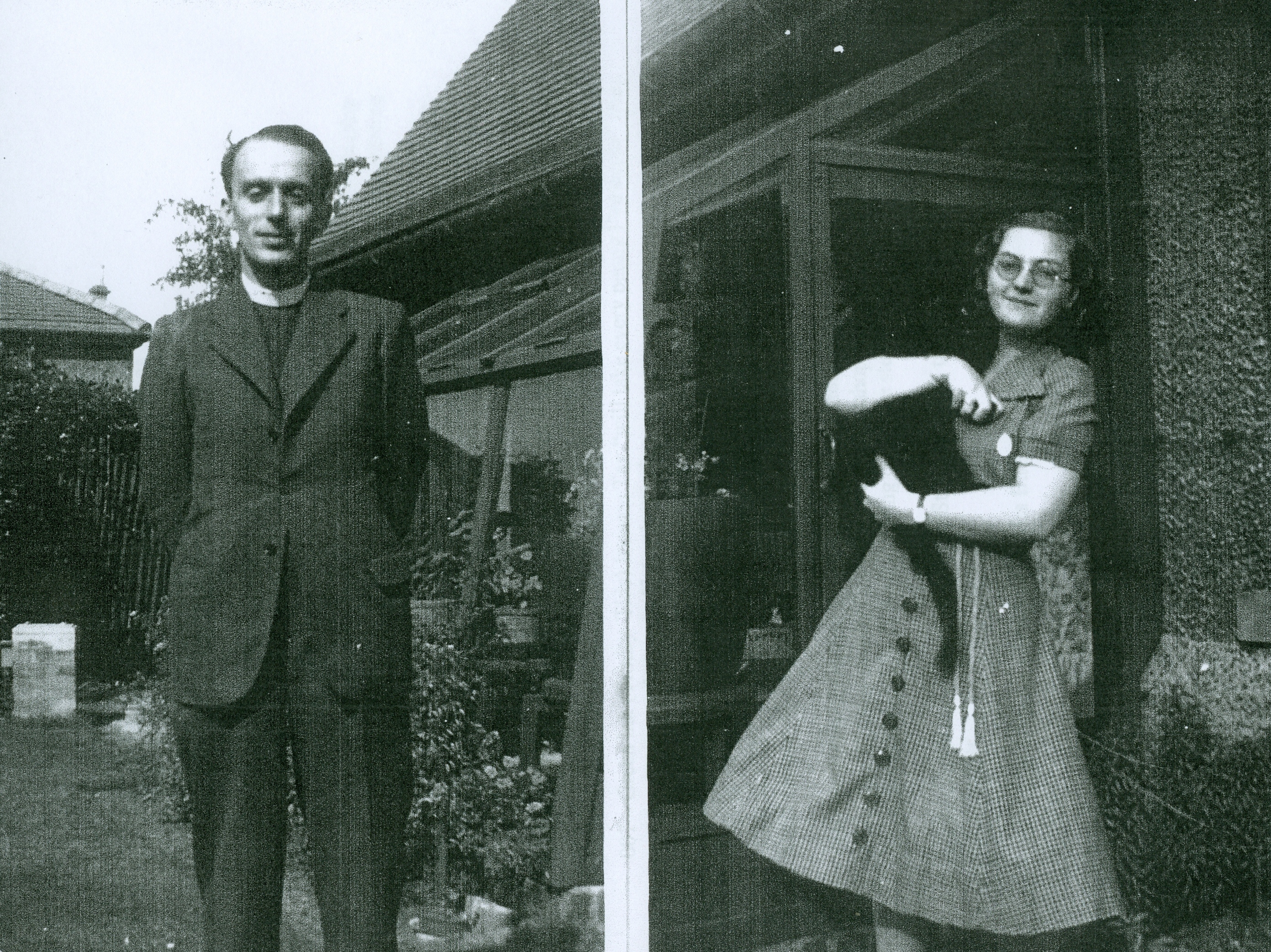
This letter, written on Christmas Eve 1940, is one of a collection of 41 letters written by Reverend Kenneth William Brown (1909 – 1974) to his sweetheart, and later wife, Rosemary Elizabeth Buchan. The letters were written between 1939 to 1941. At the time the Rev. Brown was Curate at St Andrew’s Cathedral in Inverness, whilst Rosemary was training to become a doctor in Edinburgh.
The letters give a compelling insight into life within the Highland Military Zone during World War Two. They are also filled with the yearning of a young man in love, separated by the strictures of wartime from his beloved. During the War, access to parts of the Highlands was restricted and local people, as well as military personnel, required special passes to enter the region.
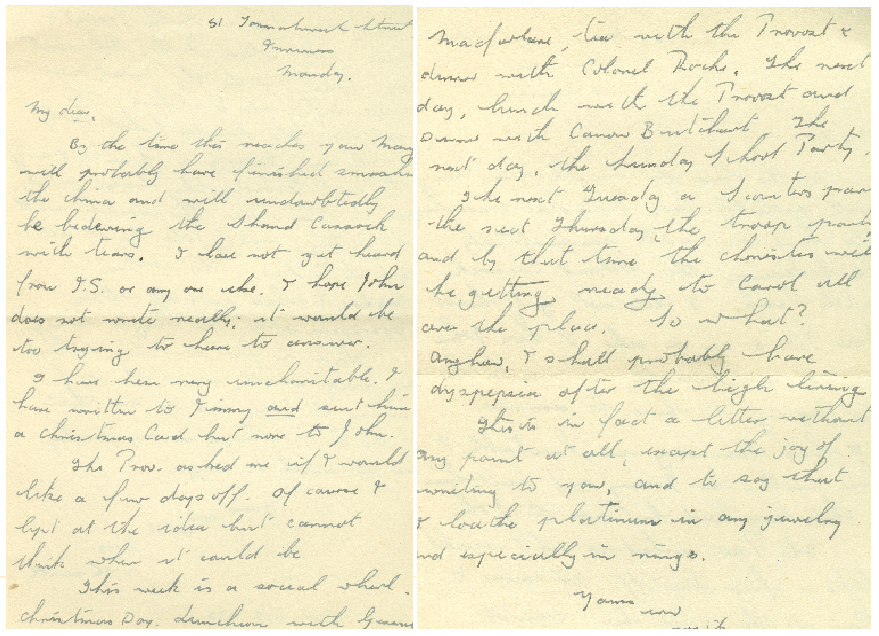
Christmas Eve 1940
Kenneth’s Christmas Eve letter follows on from a letter sent on the 9 December 1940, in which he charmingly falters into a hesitant proposal of marriage:
"What sort of husband do you think I should make? I don’t know, I’m rather weird really aren’t I? All this is vague and may sound daft but I am very, very serious minded. In short, have you ever thought of yourself as a parson’s wife? Or am I being impudent? If you think I am daft please tell me so and put me out of my misery."
Happily, by the time Kenneth writes his Christmas letter, it appears that Rosemary has accepted his offer that she become ‘a parson’s wife’, as by now Kenneth is planning what sort of wedding rings they might have!
As well as suffering restrictions on travel between Edinburgh and Inverness, Rosemary and Kenneth also experienced the scrutiny of the government’s postal examiners. About 10,000 postal censors were employed during World War Two. Their job was to open and examine civilian and military mail in order to look for any information that might be useful to the enemy. Often whole words or phrases might be obliterated because it was feared that they might be used by spies to give coded messages about the nation’s war effort. Many of the envelopes received by Rosemary had been opened and were then sealed shut again with printed tape saying that the envelope had been opened by an examiner, with that particular censor’s unique identifier.
The letters also provide a picture of the social life of the Cathedral during the Christmas period and the ebullient spirit of Highlanders keen to celebrate in the midst of, often literal, darkness and uncertainty. As cleric and medic, both Kenneth and Rosemary were in positions of significance and necessity, and it is clear from the correspondence that neither were free to be with each other on Christmas Day.
"The Prov[ost] has asked me if I would like a few days off. Of course I leapt at the idea but cannot think when it could be. This week is a social whirl. Christmas Day, Luncheon with General MacFarlane, tea with the Provost and dinner with Colonel Roche. The next day, Lunch with the Provost and Dinner with Canon B. The next day, the Sunday School Party.
The next Tuesday a Scouters’ Party. The next Thursday the Troop Party and by that time the choristers will be getting ready to carol all around the place. So what? Anyhow, I shall probably have dyspepsia after the high living. This is, in fact a letter without any point at all, except the joy of writing to you and to say that I loathe platinum in any jewellery and especially in rings.
Yours with love, Kenneth."
Wartime Christmas
Wartime Christmas celebrations were quite different to those we might experience today. One of the key strategies of the German military was to attack shipping bound for Britain, restricting British imports and potentially starving the nation. To deal with extreme shortages, the Ministry of Food instituted a system of rationing. Each household had to register at chosen shops and was provided with a ration book containing coupons. Turkey would have been completely unaffordable in wartime Inverness. Other cuts of meat would also have been very expensive. The weekly meat ration for a family of four would not have covered the cost of a small chicken. Many Christmas tables would have been graced with home-reared chickens or caught (or even pet) rabbits!
Christmas cakes and puddings were unlikely to have contained dried fruit, nuts and marzipan, and no brandy, for alcohol was extremely expensive. Brie and Camembert would also have been off the menu because, in May 1940, Germany had invaded France and large parts of the country were under occupation. Rev. Brown, during his busy festive week of hosting and being hosted, would have experienced tables offering such culinary feats as ‘Left-over Delight with Oxo Gravy’ and wobbling blancmange.
Kenneth and Rosemary went on to share many Christmases together. Their daughter, Gill, donated her father’s letters to IMAG in 2004. We are very grateful to her, and to all who gift us with their families’ treasured heritage, allowing them to be shared with all who live in and visit the Highlands, as a unique record of the lives of those who have lived through all the events, great and small, that make up our human story.
Ref: INVMG.2004.025.001-0041