




The Iain Sutherland Collection

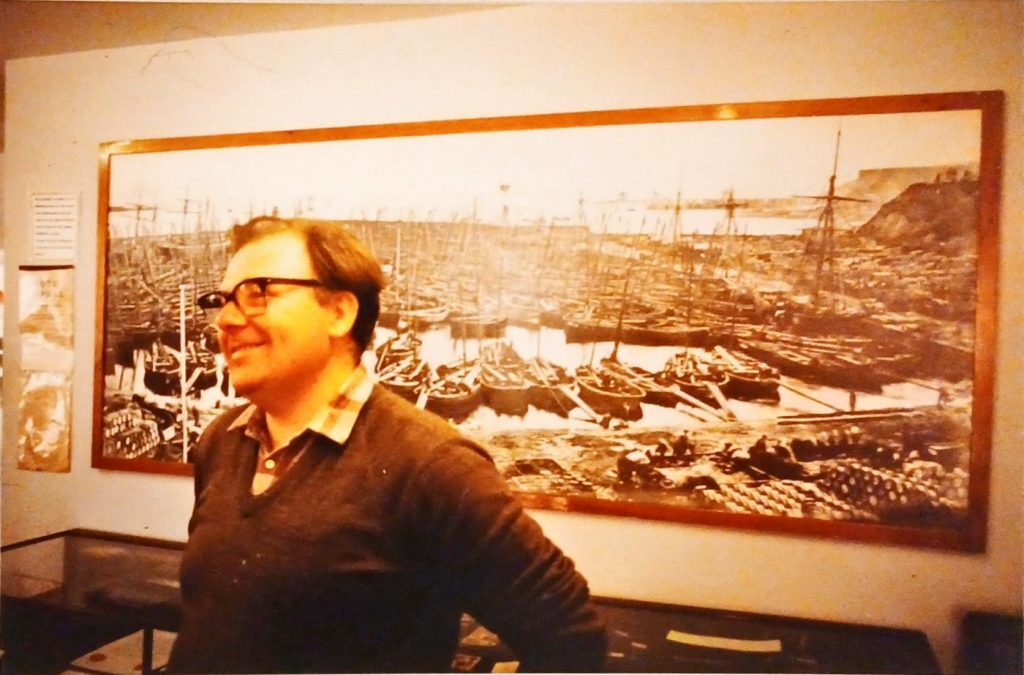
A person standing indoors in front of a large sepia-toned historical photograph depicting a busy harbor scene filled with numerous fishing boats and tall masts. The photograph is framed and mounted on a wall, with some informational text panels visible to the left. Display cases are positioned below the photograph, suggesting the setting is a museum or exhibition space.
Stories from the archives - Nucleus: The Nuclear and Caithness Archives
8th Apr 2022
Last update 9th Jan 2026
By Jamie McCaffrey

Caithness Archivist

Read more by Jamie McCaffrey

A Brief Introduction

Archives are unique historical records that allow us insight into the past, present and future. They allow for knowledge growth, community forming, wider perspectives, social pride, jurisdiction and accountability.

In this edition of Stories From The Archive we’d like to focus on a different kind of narrative. Through exploring a specific collection, the Iain Sutherland Collection, we’ll highlight some amazing archives and the importance of their deposit at Nucleus: The Nuclear and Caithness Archives. These archives reveal the importance of researchers visiting the archive, of depositors who leave their precious records in our care, and most of all, Iain’s unquenchable passion for the history of Caithness.

As well as extracting stories from the records held within the collection, we’d like to tell the story behind their journey to the archive and the importance of their continued preservation for posterity. We’ll look at Iain’s research, cartography and persistent advocacy for the county. In doing so the contribution Iain made to Caithness’s history, community and archives will ultimately shine through.

We understand that many of our readers will remember Iain fondly and would like to encourage anyone who would like to share their memories to email us. 

Alternatively you can post on our Facebook page.


Author: Iain Sutherland

Iain Sutherland was a prolific local historian who was born in Wick and who lived in Wick all of his life.  Iain was awarded an MBE for his services to local heritage in 2006. He was an employee at the Dounreay Nuclear Site for many years before retiring and becoming the Chairman of the Wick Society where he was fundamental in securing premises for the Wick Heritage Museum and preserving local heritage. Iain sadly passed away in 2020, aged 83.

Iain Sutherland is the author of many works including:

Wick Harbour and the Herring Fishing
From Herring to Seine Net Fishing
Dounreay: An Experimental Reactor Establishment
The Wick and Lybster Light Railway
Caithness 1770–1832
Sinclair and Girnigoe Castles
Vote no License
A Caithness Dictionary
The War of the Orange
The Fishing Industry of Caithness
Whaligoe and Its Steps: The Unique Harbour

and the plays

The Silver Sprig
By the Cran
King James VIIII
Barley Tree
Read Treasure Island

Many of his works can be found both in our searchroom reference section at Nucleus and in draft copies and research notes within his collection papers.


Provenance: Private Deposit

The Iain Sutherland collection was deposited by Iain Sutherland himself and without depositors such as Iain, the archive would suffer dearly. As a local authority archive the Caithness Archive holds both records of local government and those of private businesses, societies and individuals. This invaluable mix of the official and the personal allows for a wider view of the historical record of the county. Without generous donations, the historic record would remain less complete, with fewer perspectives and fewer opportunities for inclusive representation. Private deposits are important as they complement the official record, bridging the gap between the bureaucratic and the personal. They instil a sense of ownership within both the depositor and the community over the stories and histories of their local area.

If you or someone you know believes they have records of enduring value to the county of Caithness then we’d love to hear from you. We welcome all conversations and we’re always very excited about new deposits to the archive. You can contact us by email and by phone (01955 602 444).


Format: Research papers, correspondence, cartography, photographs, 35mm slides, plays

The archives within Iain’s collection are diverse and compelling. There are research papers; correspondence with individuals, societies, institutions and the government; hand drawn maps and guides; photographs of places around Caithness; 35mm slides of lectures; plays written by Iain and much, much more. We have picked a small collection to share with you here. The rest can be explored by anyone who visits Nucleus.  For the full catalogue of Iain’s collection, and to explore the rest of the Highland Archive Service’s collections, please click here

Whilst still exploring the compelling stories within the collection, the archives explored below give us a sense of the importance of Iain’s research and the great many gaps within the historic record that he filled. Iain’s use of archival material makes clear the importance he placed upon a sound and informed exploration of Caithness’s history. His subsequent deposit of his research materials, papers, drawings and photography within the archive reveal the value he placed upon their safekeeping and the ability of archives to bring people together.


Research
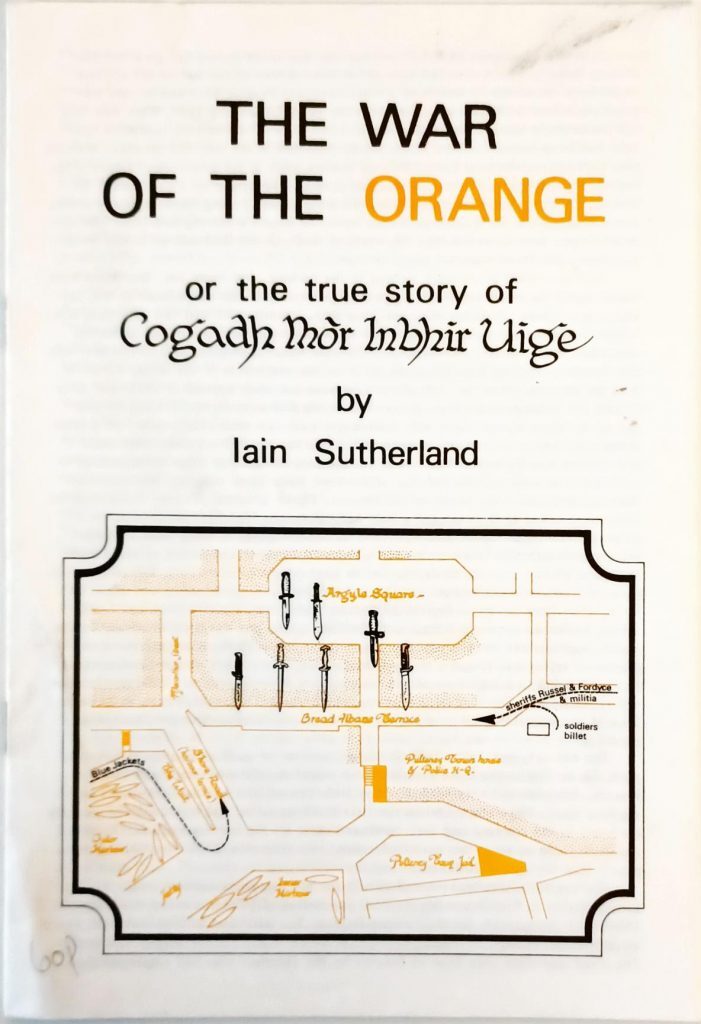
Book cover titled “The War of the Orange or the true story of Cogadh Mòr Inbhir Ùige” by Iain Sutherland. The design features bold black and orange text at the top, with a decorative map illustration below. The map shows labeled streets and locations such as Argyle Square, Grand Hotel Terrace, and Primary School House, along with marked positions for soldiers and militia. The map is framed with a black border, and the overall layout uses a combination of black and orange accents.
Cover of The War of the Orange by Iain Sutherland (SUTH/2/6/7)

Iain wrote a myriad of books, lectures and talks. The research time he gave and his passion for studying and representing Caithness is evident throughout his collection. This is made all the more potent due to the vast majority of his research being undertaken in a pre-internet world. Over the last twenty odd years Google searches, online catalogues, email and video links to the other side of the world have become the norm for many researchers. It can be hard to imagine the patience needed, the innumerable hours spent searching and the great many letters that were written in order to accomplish research goals before these  tools became available.

Iain knew that much of the county’s history had been left underrepresented and he committed himself to reaching out for answers. Below are a few examples of letters sent out by Iain. One is to the Society of Antiquaries of Scotland requesting permission to research collections concerning Viking and medieval landscape and agriculture, or to be recommended sources that he can consult. Iain mentions the incomplete reference tools available at the local library showing that he is actively seeking to fill knowledge gaps and make them available locally – the work of a truly local historian. You can click on all pictures to enlarge them and zoom in.
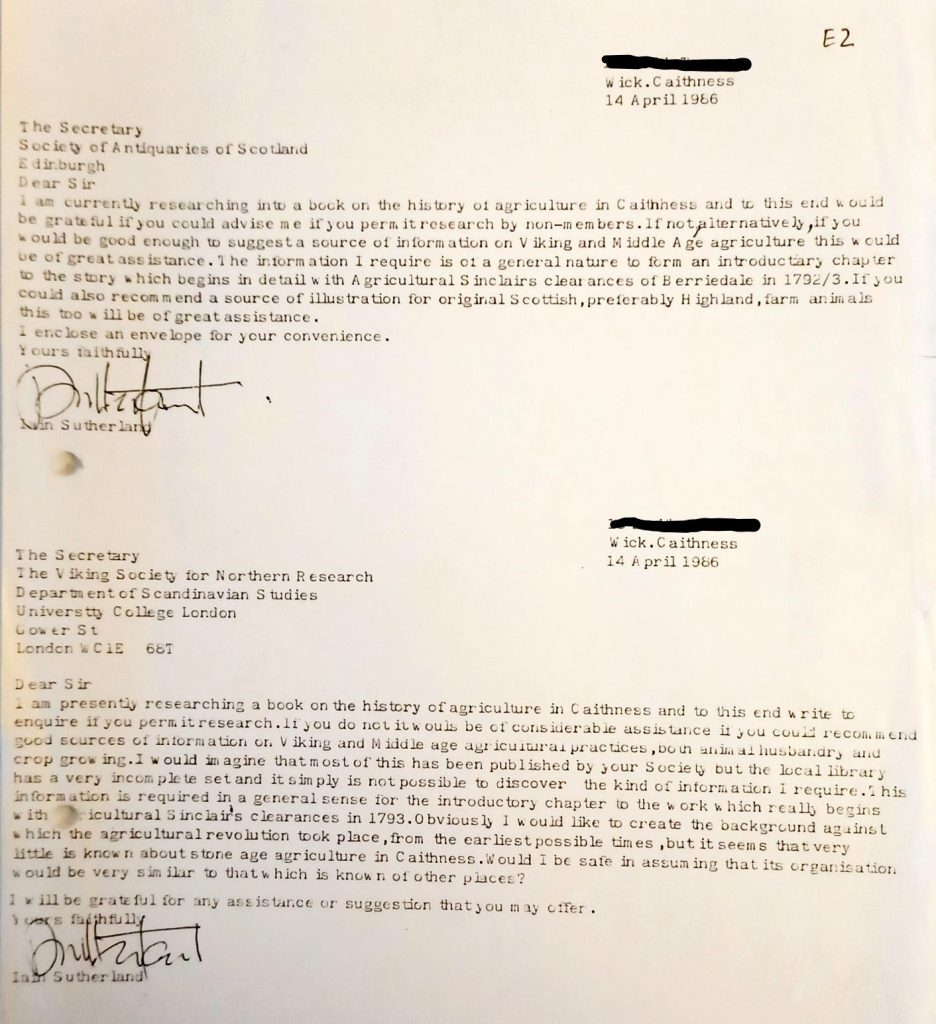
A typed letter dated 14 April 1986 from Wick, Caithness, addressed to two different recipients: the Secretary of the Society of Antiquaries of Scotland in Edinburgh and the Secretary of The Viking Society for Northern Research at University College London. The letters discuss research for a book on the history of agriculture in Caithness, requesting advice on permissions and sources of information about Viking and Middle Age agricultural practices. Both letters mention the need for general historical context, including agricultural clearances of Berriedale in 1792/3, and seek illustrations of Scottish farm animals. Each letter is signed by Iain Sutherland. The page includes typed text with handwritten signatures and some underlined words for emphasis.
Letter to the Society of Antiquaries of Scotland (SUTH/2/5/3)

The second letter is to the Air Photography Unit of the Scottish Development Department seeking to purchase two aerial photographs of Caithness in order to assist in making a map. We’ll be showing examples of Iain’s many maps and drawings below. It is presumed that he was in touch with this department fairly regularly as within the same file are two aerial photographs of Thurso. The letter and the two pictures of Thurso are reproduced below.
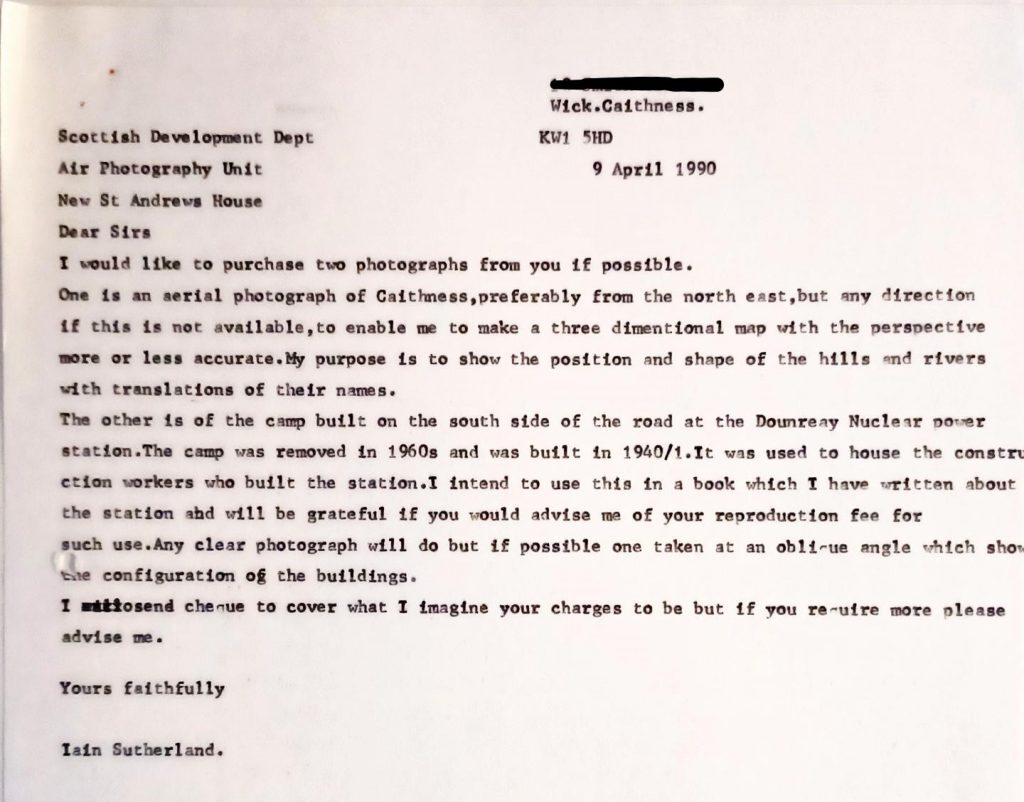
A typed letter dated 9 April 1990 from Wick, Caithness, addressed to the Scottish Development Dept, Air Photography Unit, New St Andrews House. The letter requests the purchase of two photographs: one aerial photograph of Caithness (preferably from the northeast) to create a three-dimensional map showing hills and rivers with name translations, and another of the camp built on the south side of the road at the Dounreay Nuclear Power Station, which was constructed in 1940/41 and removed in the 1960s. The writer explains the intention to use these images in a book about the station and asks for advice on reproduction fees, noting that any clear photograph will suffice, ideally one taken at an oblique angle to show building configurations. The letter closes with a polite request for charges and is signed Iain Sutherland.

Letter to the Air Photography Unit (SUTH/2/3/1)
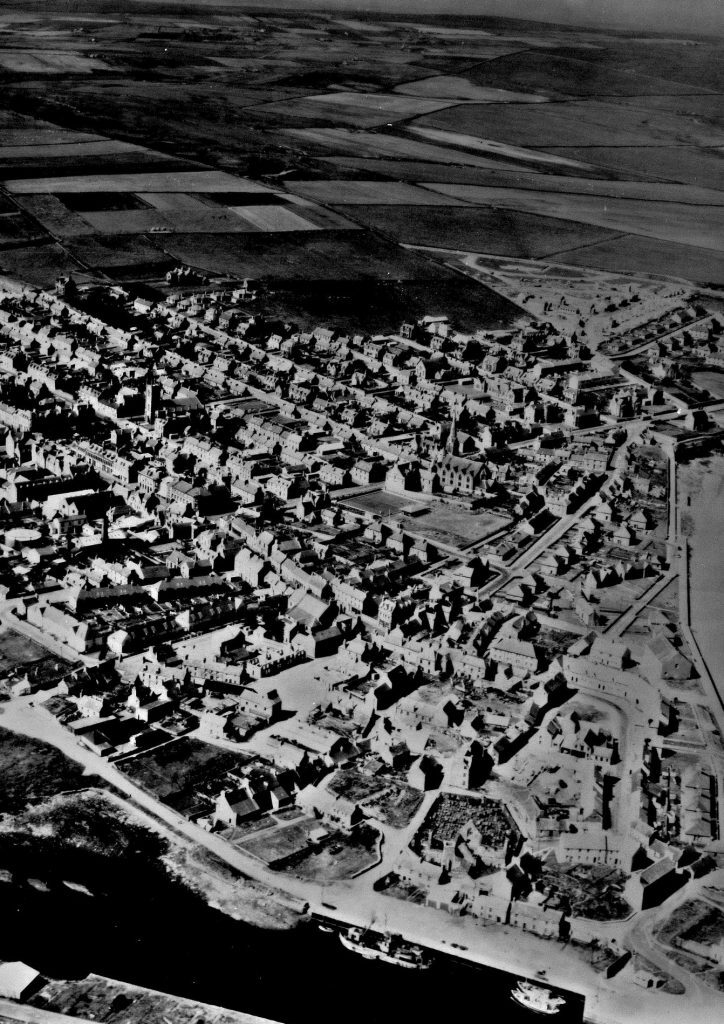
A black-and-white aerial photograph of a coastal town showing a dense cluster of buildings, streets, and rooftops. In the foreground, there is a harbor area with water and several boats docked along the quay. The town layout includes narrow streets and closely packed houses, with larger structures interspersed throughout. Beyond the town, open fields and farmland stretch into the distance, creating a stark contrast between the urban and rural landscape. The image captures a detailed view of the town’s architecture and surrounding terrain.

Aerial photograph of Thurso i (SUTH/2/2/1)
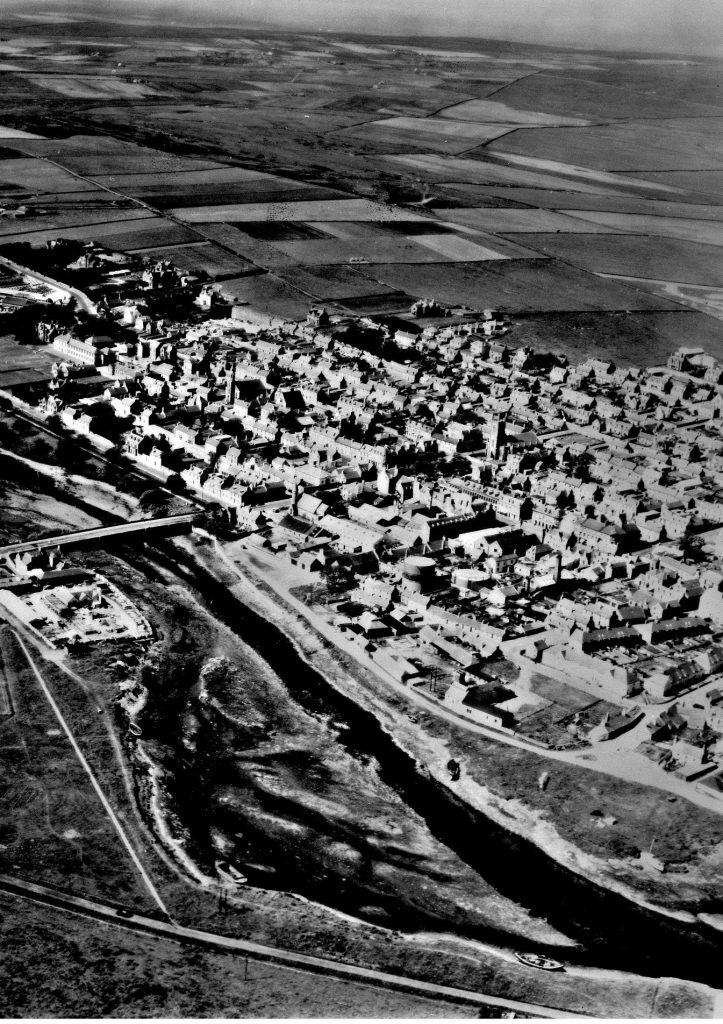
A black-and-white aerial photograph of a town with a river running through the foreground. A bridge spans the river, connecting two parts of the town. The town consists of densely packed buildings and streets, with larger structures interspersed among smaller houses. Beyond the town, expansive open fields and farmland stretch into the distance, creating a contrast between the urban area and rural landscape. The image captures the layout of the town, the river’s winding path, and the surrounding countryside.

Aerial photograph of Thurso ii (SUTH/2/2/1)

The stories of his many research journeys are in themselves evidential records, giving insight into his research methodology and the unbelievable scope of his passion and interest. Myriad aspects of the Caithness story and history are represented throughout his correspondence and reveal the gaps in knowledge and insight he constantly complemented.

The extent of the correspondence, filling numerous files, demonstrates not only the eclectic interests and subjects of his research, but also the patience and determination needed to commit to the undertaking that he did. The value of his work is continually seen, even today, when simple Google searches often bring back no results for many of the subjects he wrote on; or more tellingly lead you directly to one of his books as the only known source of compiled information.

One great example is The Caithness Dictionary which compiled words and expressions which were in common use in the county of Caithness until the latter third of the twentieth century. After this time, the books blurb laments, ‘the introduction of television, on top of a century of persecution by the teaching profession, finally killed the language off’. Below are some handwritten notes of Iain’s showing a small fraction of his lengthy lists of Caithness dialect words. This example concerns local names for wildlife.
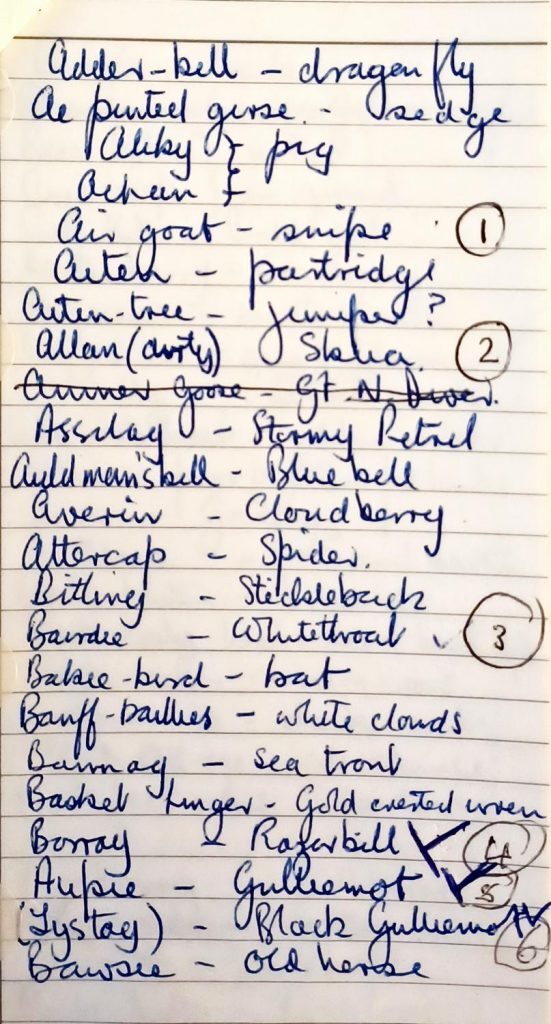
A handwritten list on lined paper featuring Caithness dialect words alongside their English meanings. Examples include:

“Adder-bell – dragon fly”
“Ae pintel gurse – tree dye”
“Air goat – snipe”
“Auten-tree – juniper?”
“Auld men’s bell – bluebell”
“Averin – cloudberry”
“Attorcap – spider”
“Bittney – stickleback”
“Bandie – whitetroat”
“Baake-bird – boat”
“Buff-bailies – white clouds”
“Bummag – sea front”
“Brakel tunger – gold crested wren”
“Borrey – rabbit”
“Mufree – guillemot”
“Tystey – black guillemot”
“Bawree – old horse”

Some words have circles or check marks next to them, and numbers (1, 2, 3, 4, 5, 6) are written in circles beside certain entries. The handwriting is in blue ink and written in a neat cursive style.
List of Caithness dialect and English words (SUTH/2/5/2)

Below is a short audio recording from one of Iain’s numerous oral history interviews where he discusses the above mentioned disappearance of the local Scots language with an interviewee.

Iain Sutherland Interview - Dialect and Stories - SUTH/5/27

Further correspondence reveals research into the acidification of soil by tree species throughout Scotland. This includes correspondence with a professor at the University of Aberdeen showing the extent of Iain’s passion for the natural environment, and a specific concern for the wildlife of Caithness.

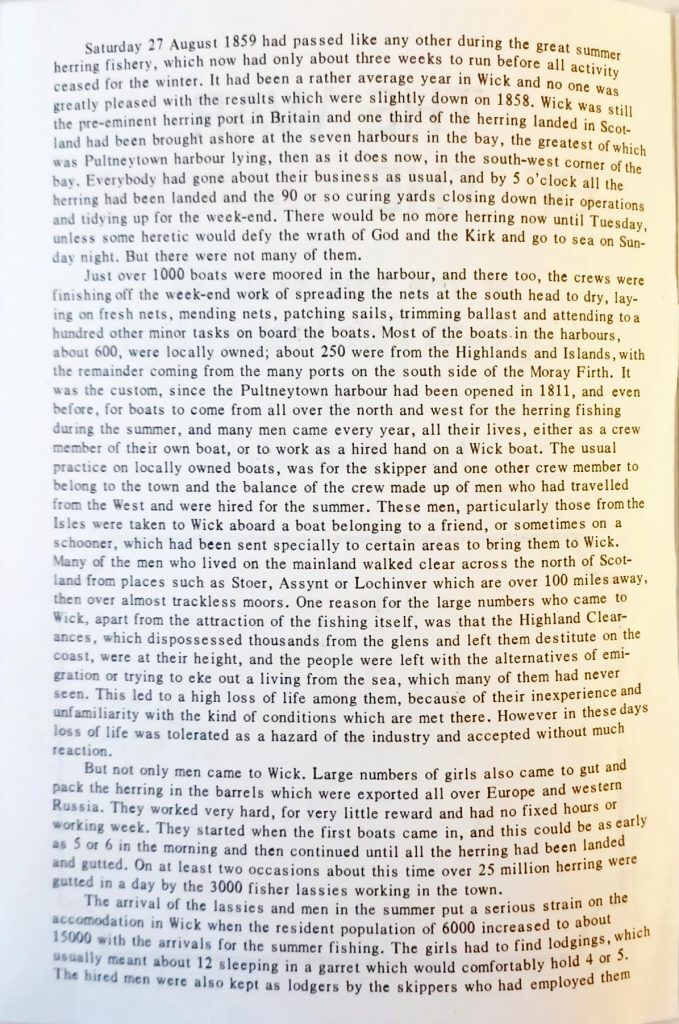
The final products of his research, his books, talks and lectures are a fine testament to the time and effort given in pursuit of Caithness’s untold stories. Below is an example showing a page from an initial draft copy written by Iain and then the final booklet page from The War of the Orange. They really give a sense of the writing process and the craft needed to hone it so well.
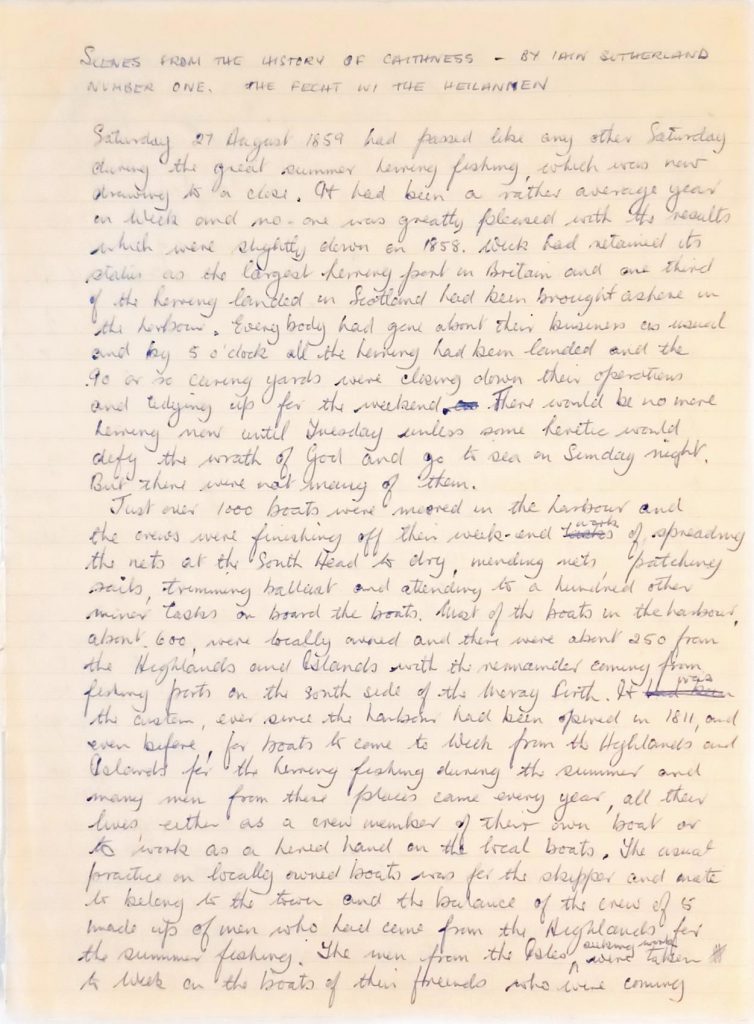
A handwritten page titled “Scenes from the History of Caithness – By Iain Sutherland, Number One: The Fight in the Hellamnen.” The text is written in blue ink on lined paper and describes events from Saturday, 27 August 1859, focusing on herring fishing activities and local life in Caithness. The narrative mentions the herring fleet, nets being dried, and the bustling harbor scene, including references to the Dounreay area and historical context such as the Highland Clearances. The handwriting is neat but slightly slanted, with occasional underlined words and corrections.
Handwritten draft copy from The War of the Orange by Iain Sutherland (SUTH/2/6/7)
A printed page of text titled “Saturday 27 August 1859 had passed like any other during the great summer herring fishery…” The passage describes the bustling activity in Wick during the herring season, mentioning over 1,000 boats moored in the harbor and crews working on tasks such as spreading nets, trimming ballast, and preparing for fishing. It details the origins of the fishermen, including many from the Highlands and Islands, and explains the economic and social context, such as the impact of the Highland Clearances and the influx of seasonal workers. The text also notes the arrival of girls to pack herring for export and the logistical challenges posed by the large numbers of people in the town. The page is densely typed in black ink on white paper, with no illustrations or decorations.
Final printed copy from The War of the Orange by Iain Sutherland (SUTH/2/6/7)

Also within Iain’s extensive recordings is an extract of him telling the story of the War of the Orange in the early 90s. You can listen below to Iain telling the fascinating story in two parts below.

Iain Sutherland the story of the War of the Orange - Part 1 - SUTH/5/109

Iain Sutherland the story of the War of the Orange - Part 2 - SUTH/5/109


Local history and community

As well as seeking out Caithness history through institutions and societies, Iain was also a great believer in documenting local history through the capture of memories and reminiscences. Here, again, we see private and individual stories complimenting the official body of historical records.

Within the collection are over 100 CD-ROMS of interviews conducted by Iain exploring the stories and memories of people from Caithness. There are hundreds of hours of fascinating conversation to be explored.This extract with a local Wick man discusses World War I, Wick harbour and boats.

Below are extracts from only a few of these audio recordings and they give a sense of the wonderful local heritage and stories they captured. In this first extract we hear Iain interviewing a local woman about her time working as a herring gutter around the UK.

Iain Sutherland Interview – Herring Gutters – SUTH/5/74

This extract with a local Wick man discusses World War I, Wick harbour and boats.

Iain Sutherland Interview – WWI, Wick Harbour, Boats – SUTH/5/12

Finally, here is a wonderful clip of a woman singing a song about the Caithness Family History Society.

Caithness Family History Society song

Today, you can explore this fine tradition of oral histories being continued through the Wick Society’s Wick Voices Oral History Section

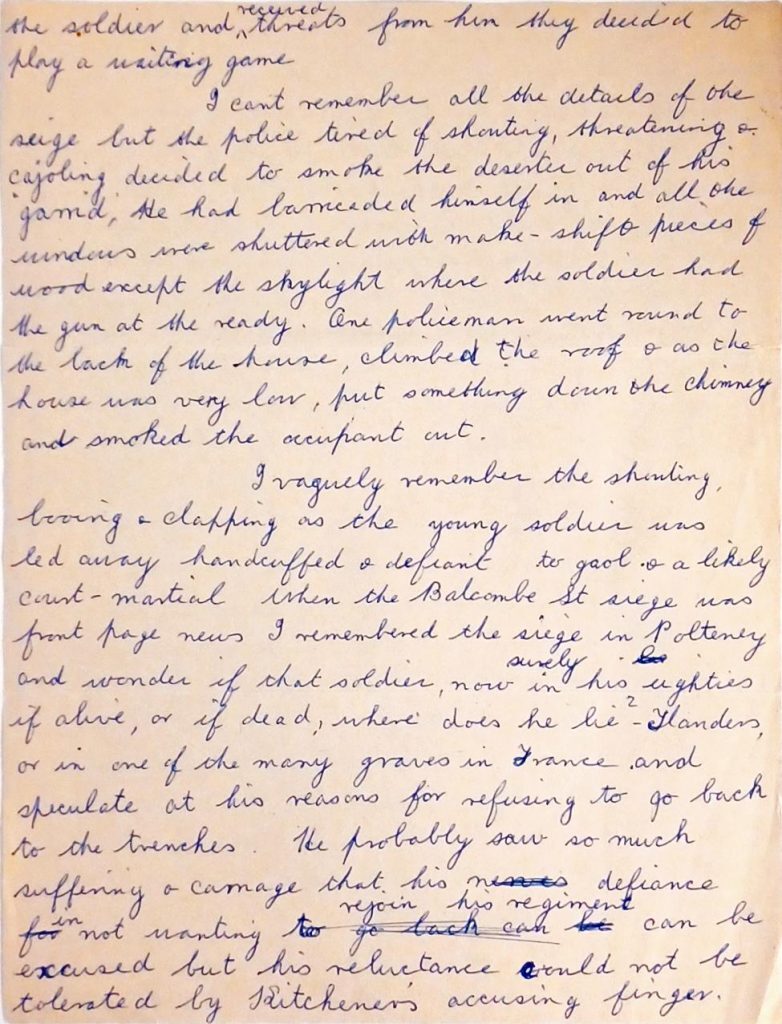
Alongside Iain’s interviews there are also wonderful pieces of correspondence with local people writing of their experiences and of how the county has changed over time. One stand out letter is from a local women named Ina who sent Iain at least three stories. One story remembers a siege in Pulteneytown during the First World War. Below is a reproduction of the letter and a transcript.
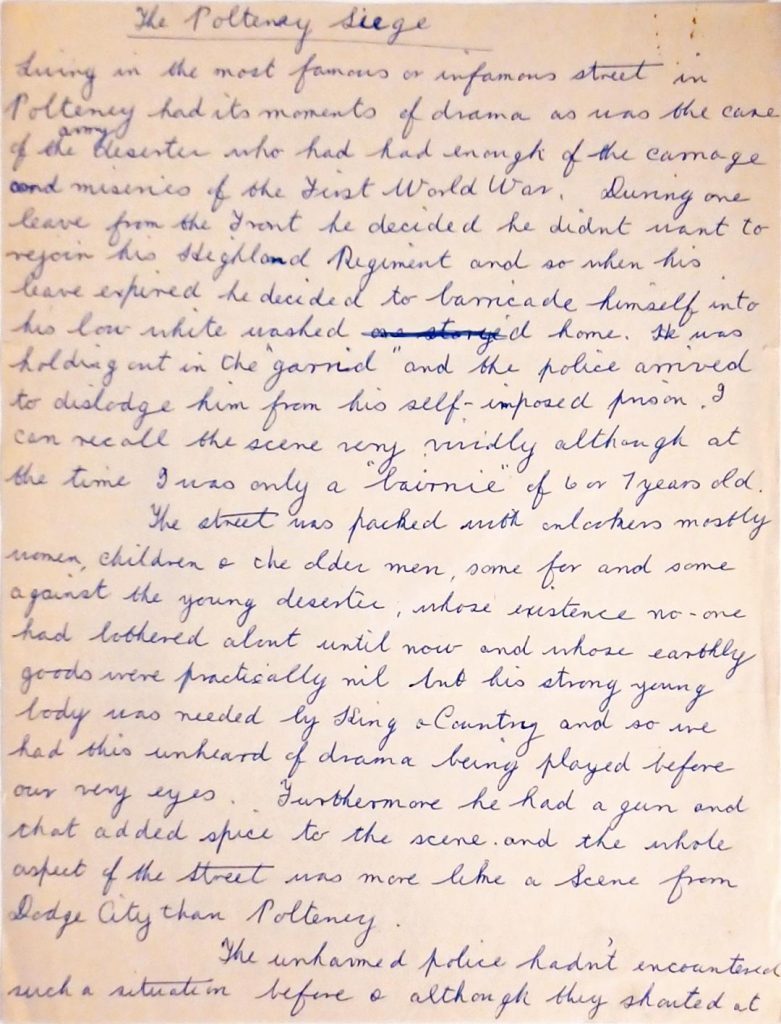
A handwritten page titled “The Pulteney Siege” written in blue ink on lined paper. The text recounts a dramatic incident involving a deserter from a Highland regiment during the First World War who barricaded himself in his home in Pulteney rather than return to service. It describes the police arriving to remove him, the street crowded with onlookers—women, children, and older men—and the tension of the scene, likened to something from Dodge City. The narrative mentions the man being armed and the police being unprepared for such a situation. The handwriting is neat and cursive, with occasional underlined words and edits. Page 1
Handwritten letter to Iain Sutherland from Ina. Page 1. SUTH/2/6/1
A handwritten page in blue ink on lined paper continuing the narrative of “The Pulteney Siege.” The text describes the conclusion of the incident, where police, tired of shouting and threats, decided to smoke the deserter out of his barricaded home. It mentions the windows being shuttered except for a skylight, a soldier with a gun at the ready, and a policeman climbing the roof to drop something down the chimney. The writer recalls the scene vividly, including the cheering and clapping as the young soldier was led away in handcuffs, defiant and facing a likely court-martial. The passage reflects on the soldier’s possible fate, speculating whether he survived or lies in one of many graves in France, and considers his reasons for refusing to return to the trenches. The handwriting is neat and cursive, with occasional underlined words and edits for emphasis.
Handwritten letter to Iain Sutherland from Ina. Page 2. SUTH/2/6/1.

Transcript:

The Polteney Siege

Living in the most famous or infamous street in Polteney had its moments of drama as was the case of the army deserter who had enough of the carnage and miseries of the First World War. During one leave from the Front he decided he didn’t want to rejoin his Highland Regiment and so when his leave expired he decided to barricade himself into his low white washed one storied home. He was holding out in the “garrid” and the police arrived to dislodge him from his self-imposed prison. I can recall the scene very vividly although at the time I was on a “bairnie” of 6 or 7 years old.

The street was packed with onlookers mostly women , children and the older men, some for and some against the young deserter, whose existence no-one had bothered about until now and whose earthly goods were practically nil but his strong young body was needed by King and Country and so we had this unheard of drama being played before our very eyes. Furthermore he had a gun and that added spice to the scene and the whole aspect of the street was more like a scene from Dodge City than Polteney.

The unarmed policed hadn’t encountered such a situation before and although they shouted at the soldier and received threats from him they decided to play a waiting game.

I can’t remember all the details of the siege but the police tired of shouting, threatening and cajoling decided to smoke the deserter out of his “garrid”. He had barricaded himself in and all the windows were shuttered with make-shift pieces of wood except the skylight where the soldier had the gun at the ready. One policeman went round to the back of the house, climbed the roof and as the house was very low, put something down the chimney and smoked the occupant out.

I vaguely remember the shouting, booing and clapping as the young soldier was led away handcuffed and defiant to goal and a likely court-martial. When the Balcombe St. siege was front page news I remembered the siege in Polteney and wonder if that soldier, now surely in his eighties if alive, or if dead, where does he lie – Flanders or in one of the many graves in France and speculate at his reasons for refusing to go back to the trenches. He probably saw so much suffering and carnage that his defiance in not wanting to rejoin his regiment can be excused but his reluctance could not be tolerated by Kitchener’s accusing finger.

Ina explains in her letter to Iain that she hopes her stories ‘will be of some help in compiling your booklet on bye-gone days’. Iain’s reputation as an advocate for local history and community memories seems clear. It cannot be underestimated how important people such as Iain are in allowing the reminiscences and heritage of any place to flourish and not be forgotten. Indeed, it is the passion and integrity that those such as Iain show for their local area and its history that inspires others and allows the foundations for community spirit and pride to be set.


The Wick Society and Heritage Centre
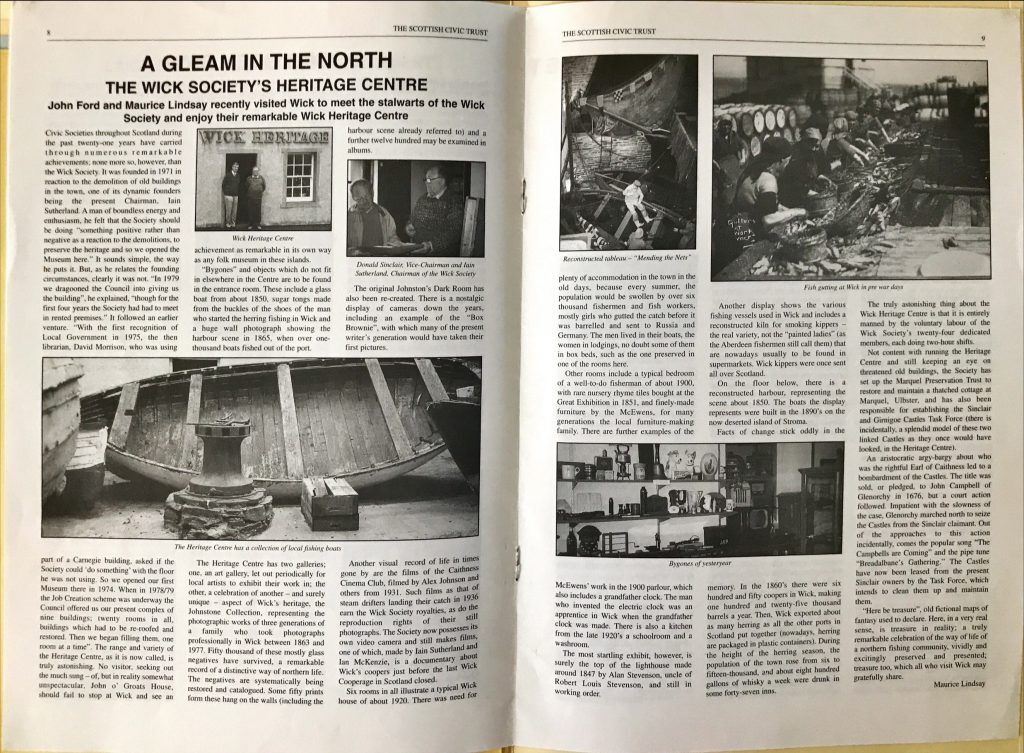
A two-page magazine spread from The Scottish Civic Trust Newsletter (No. 14, Autumn 1997) featuring an article titled “A Gleam in the North: The Wick Society’s Heritage Centre.” The article discusses the Wick Heritage Centre and its collections. The left page contains the main text with two black-and-white photographs: one showing the entrance to the Wick Heritage Centre and another depicting a large wooden boat keel with a capstan. The right page includes three black-and-white photographs:

A person working on a boat restoration inside a workshop.
A busy harbor scene with barrels and fishing nets.
An interior view of a recreated domestic kitchen with shelves of crockery and utensils.

The layout is text-heavy with captions under each image, and the article highlights the efforts of the Wick Society in preserving maritime and local heritage.
Article on Wick Heritage Museum in the Scottish Civic Trust Newsletter No. 14 Autumn 1997 (SUTH/8/1/5)

Iain’s passion was strongly displayed through his role as Chairman of the Wick Society and the work and legacy that was established through the organisation, which continues to grow today. Iain led a group of like minded individuals to form the society in 1971. He was also a driving force in acquiring premises at Bank Row where Wick Heritage Museum has been located since 1980.

Amongst his papers is a discussion document for the members of the society, c.1990, looking at Tourism in Caithness and the part that the society can play in any future that it may have. Iain’s passion for his home county is laid bare here. He explains the inadequacy of the current tourism infrastructure in Caithness and talks of the potential that the county could take advantage of.

The continuing popularity and reputation of the Wick Society and Heritage Museum, as well as many broader successes within the Caithness heritage community, speak volumes of Iain’s influence. He evidently made an enduring mark, advancing civic and community responsibility as well as the self-promotion and care of the counties past.

Local historian is perhaps an inadequate descriptor for someone who is not only researching and writing local history but also actively engaging in and promoting the infrastructure of the county for locals and visitors alike. Iain’s work and restless spirit really shine through here and he says it best when stating:

if we start modestly and work our way from one modest objective successfully to another a little more ambitious we may show the way by example

Below are reproduced the introduction and conclusion from this inspiring paper.
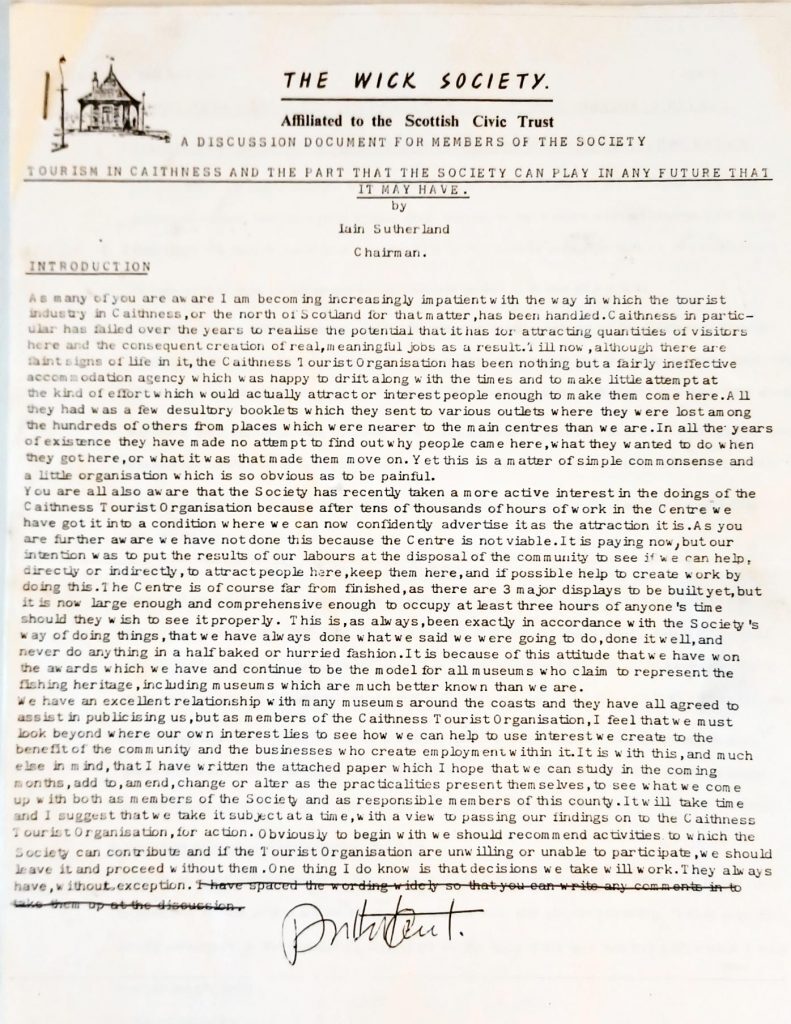
A typed discussion document titled “The Wick Society – Affiliated to the Scottish Civic Trust: Tourism in Caithness and the Part That the Society Can Play in Any Future That It May Have” by Iain Sutherland, Chairman. The page includes an introduction section expressing concerns about how tourism in Caithness has been poorly managed and the missed opportunities for attracting visitors and creating meaningful jobs. It criticizes ineffective efforts by the Caithness Tourist Organisation and emphasizes the need for practical, common-sense approaches to improve tourism. The text suggests the Wick Society could play a role in enhancing visitor experiences through displays and activities. At the top left, there is a small illustration of a building with the words “The Wick Society.” The document ends with a handwritten signature at the bottom. The layout is single-column, black text on white paper.
Tourism in Caithness and the part that the society can play in any future that it may have, Introduction (SUTH/2/6/8)

I feel that we must look beyond where our own interest lies to see how we can help to use interest we create to the benefit of the community and the businesses who create employment within it
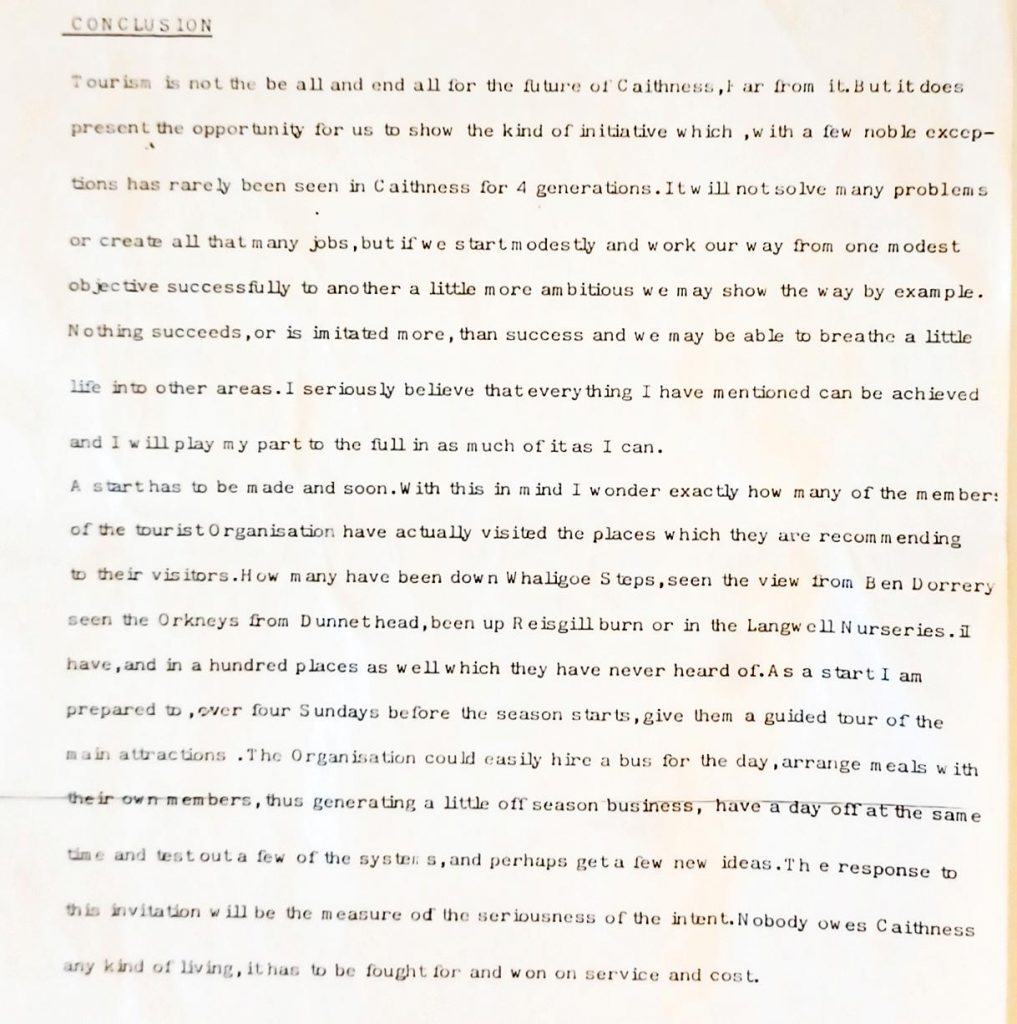
A typed page titled “CONCLUSION” from a discussion document about tourism in Caithness. The text emphasizes that tourism is not the ultimate solution for Caithness but offers opportunities for local initiative and development. It advocates starting modestly and working toward ambitious goals to set an example and create success. The author suggests practical steps, such as organizing guided tours of local attractions over four Sundays before the tourist season, hiring buses, and arranging meals to generate off-season business. The conclusion stresses that improving tourism requires effort, creativity, and commitment, stating that “Nobody owes Caithness any kind of living, it has to be fought for and won on service and cost.” The page is typed in black ink on white paper, with some words underlined for emphasis.
Tourism in Caithness and the part that the society can play in any future that it may have, Conclusion (SUTH/2/6/8)

I seriously believe that everything I have mentioned can be achieved and I will play my part to the full in as much of it as I can… Nobody owes Caithness any kind of living, it has to be fought for and won on service and cost

We also hold this wonderful interview with Iain speaking passionately about the society, Halloween traditions in Caithness and his research and writing.

Iain Sutherland Interview – The Wick Society – SUTH/5/7


Cartography

As well as filling many of the gaps in the historical record of Caithness through his writing, Iain was also passionate about cartography, the making of maps. His collection showcases many wonderful hand drawn examples that afford fantastic new perspectives of the county landscape. Below are seven maps drawn by Iain of areas throughout Caithness and Sutherland. There are captions provided with each.
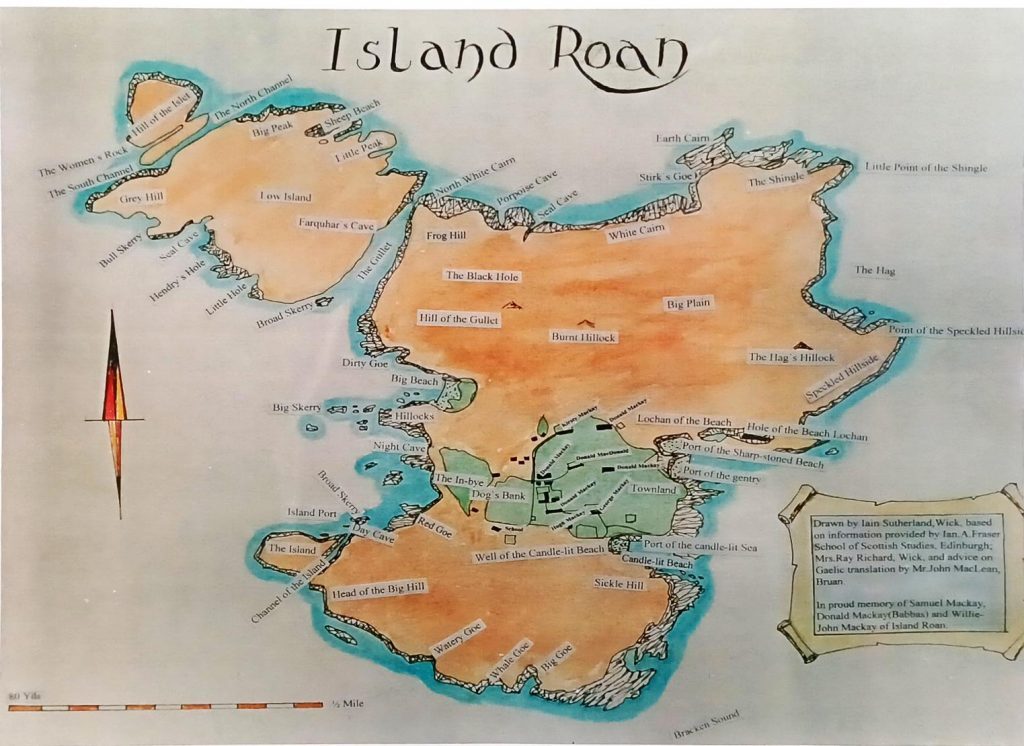
A hand-drawn, colored map titled “Island Roan” depicting the island of Eilean nan Ròn off the north coast of Scotland. The map shows the island outlined in blue with surrounding sea, and the land shaded in orange and green tones to indicate terrain. Various locations are labeled, including The Black Hole, Hill of the Wailer, Big Plain, Lochan of the Beach, Head of the Wail Hill, and The Hag’s Hillock. A decorative compass rose is positioned on the left side, and a scale bar at the bottom indicates distances in miles. In the lower right corner, a note states that the map was drawn by Iain Sutherland with assistance from others, and includes historical references. The lettering is stylized, and the map has an artistic, illustrative style rather than a technical one.

Hand drawn map of Eilean nan Ron i (SUTH/3/2)
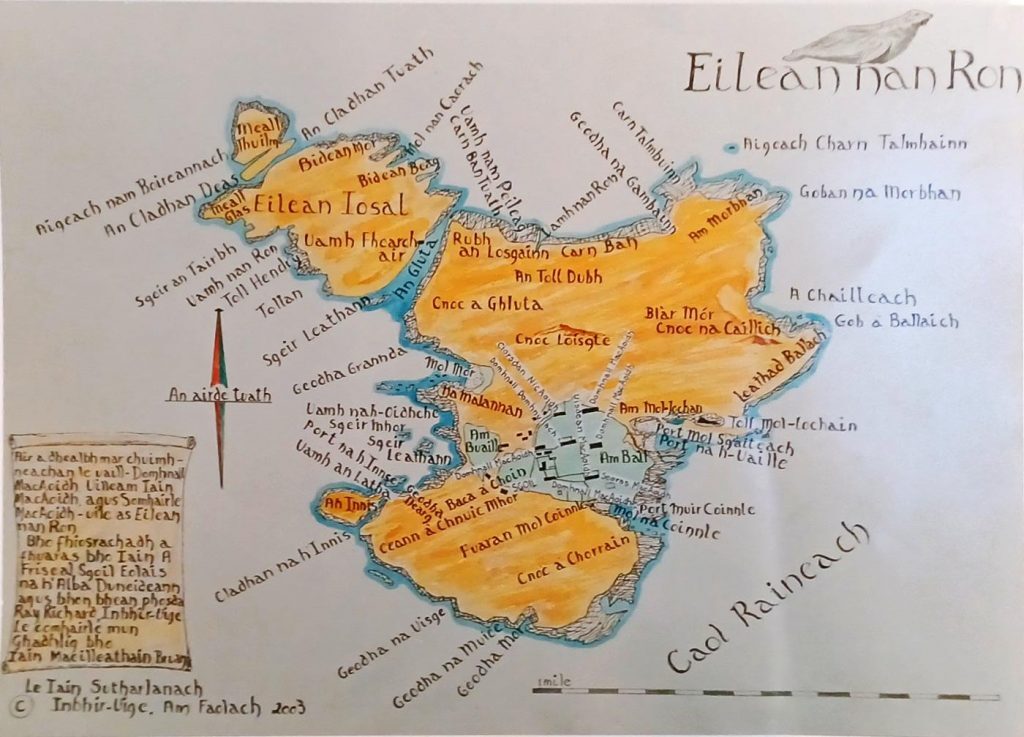
A hand-drawn, colored map titled “Eilean nan Ròn” (Island of Seals) with detailed Gaelic place names. The map shows the island divided into two main areas labeled Eilean Iosal and the larger section of Eilean nan Ròn, shaded in orange with blue coastal outlines. Various geographic features are marked, including hills, lochs, and headlands, such as Blàr Mòr, Cnoc na Caillich, and Am Meidhleach. A decorative compass rose appears on the left, and a scale bar at the bottom indicates distances in miles. In the lower-left corner, there is a text box with additional Gaelic notes, and at the top right, an illustration of a seal accompanies the title. The map has an artistic style with handwritten labels and soft color shading.

Hand drawn map of Eilean nan Ron ii (SUTH/3/2)
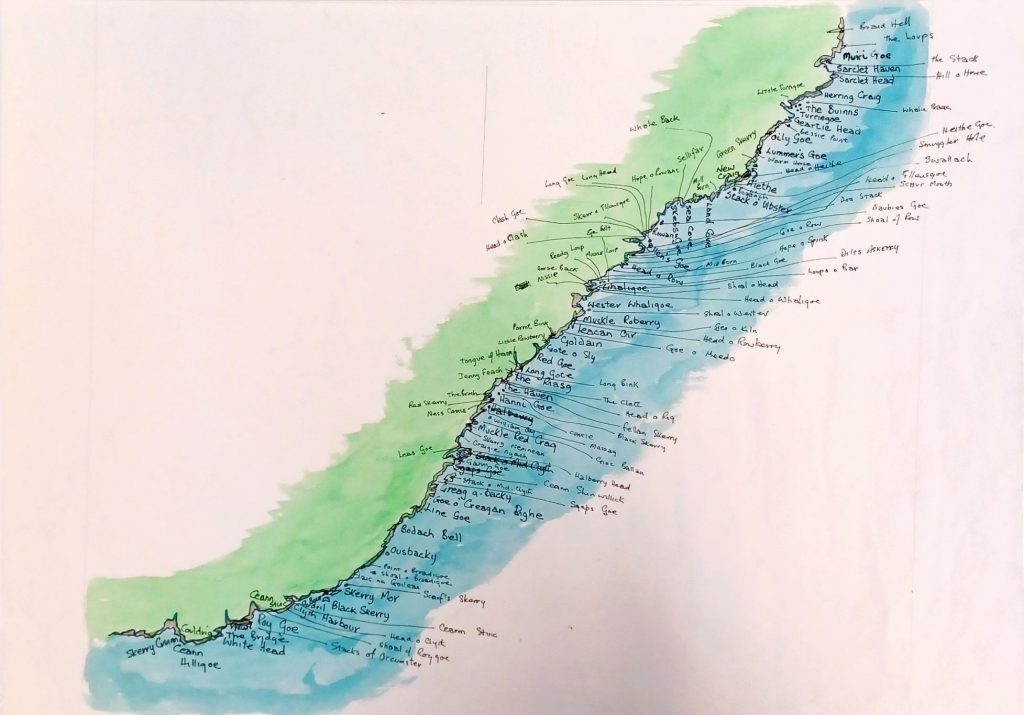
A hand-drawn, colored map depicting the east coast of Caithness, Scotland, from Sarclet in the south to just below Clyth in the north. The coastline is illustrated with blue shading for the sea and green shading for the land, with numerous detailed labels marking geographic features such as headlands, bays, stacks, and skerries. Names include Sarclet Head, Black Stacks, Muckle Skerry, Whaligoe Steps, and Clythness. Fine lines extend from the coast into the sea, pointing to offshore features. The map has an artistic style with handwritten annotations and a naturalistic color palette, emphasizing the rugged coastal landscape.

Detailed coloured map of the east coast of Caithness from Sarclet to just below Clyth
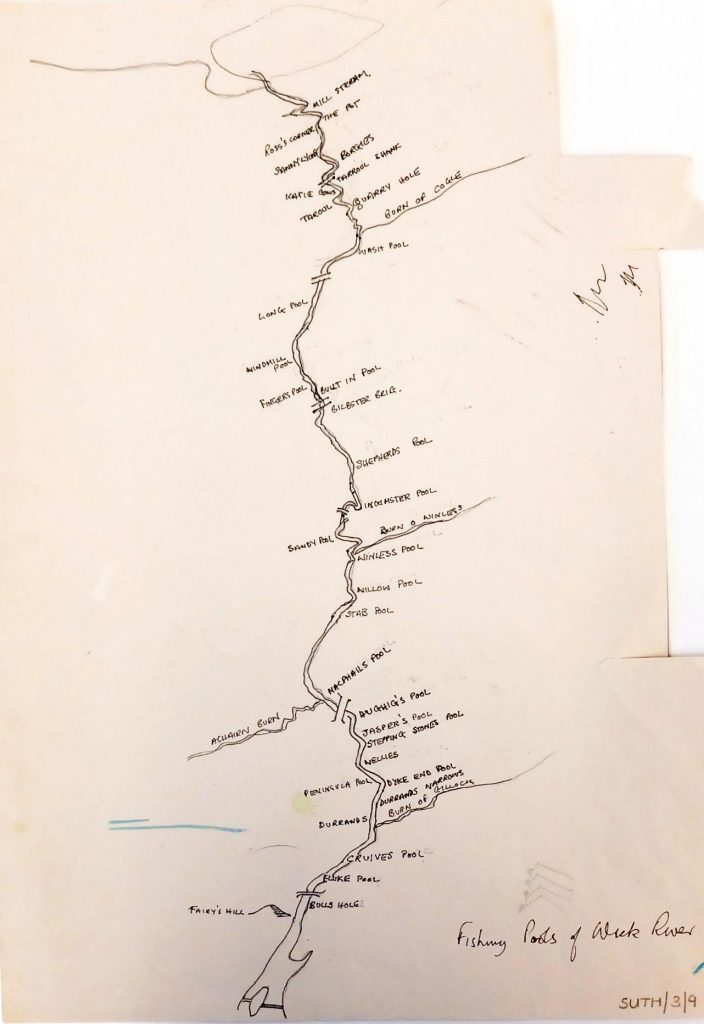
A hand-drawn black-and-white map titled “Fishing Pools of Wick River” showing the river’s course from its upper reaches down to Fairy’s Hill. The river is illustrated as a winding line with numerous labeled fishing spots along its length, including names such as Ruth’s Pool, Mate’s Pool, Large Pool, Shepherd’s Pool, Sunny Pool, Salmon Pool, Duncan’s Pool, and Fairy’s Hole. Some pools have descriptive names like The Black Hole of Combe and The Minister’s Pool. The map includes small directional annotations and a few hand-drawn marks in blue near the bottom, possibly indicating water. The layout is simple and functional, focusing on the sequence of fishing pools along the river.

Map of the fishing spots on Wick River from the top of the river down to Fairy’s Hill (SUTH/3/9)
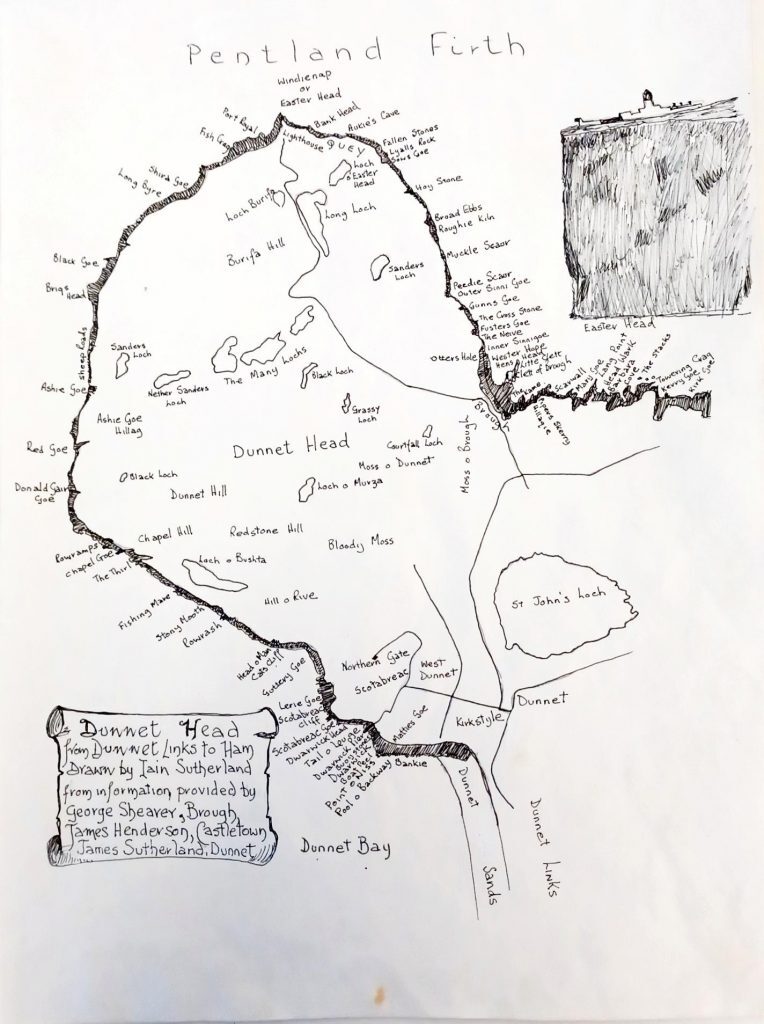
A hand-drawn black-and-white map titled “Dunnet Head from Dunnet Links to Ham” showing the northernmost point of mainland Scotland and surrounding areas. The map includes detailed labels for geographic features such as Pentland Firth, Dunnet Head, Dunnet Bay, St John’s Loch, and numerous smaller landmarks like hills, lochs, and coastal points. Roads and paths are sketched in, along with settlements such as Dunnet and Kirkstyle. In the lower-left corner, there is a decorative title box crediting the map to Iain Sutherland and listing contributors. The upper-right corner contains a shaded inset illustration labeled Easter Head, depicting a textured cliff or headland. The map uses handwritten text throughout and has an artistic, illustrative style rather than a technical cartographic design.

Map entitled ‘Dunnet Head from Dunnet Links to Ham’ drawn by Iain Sutherland
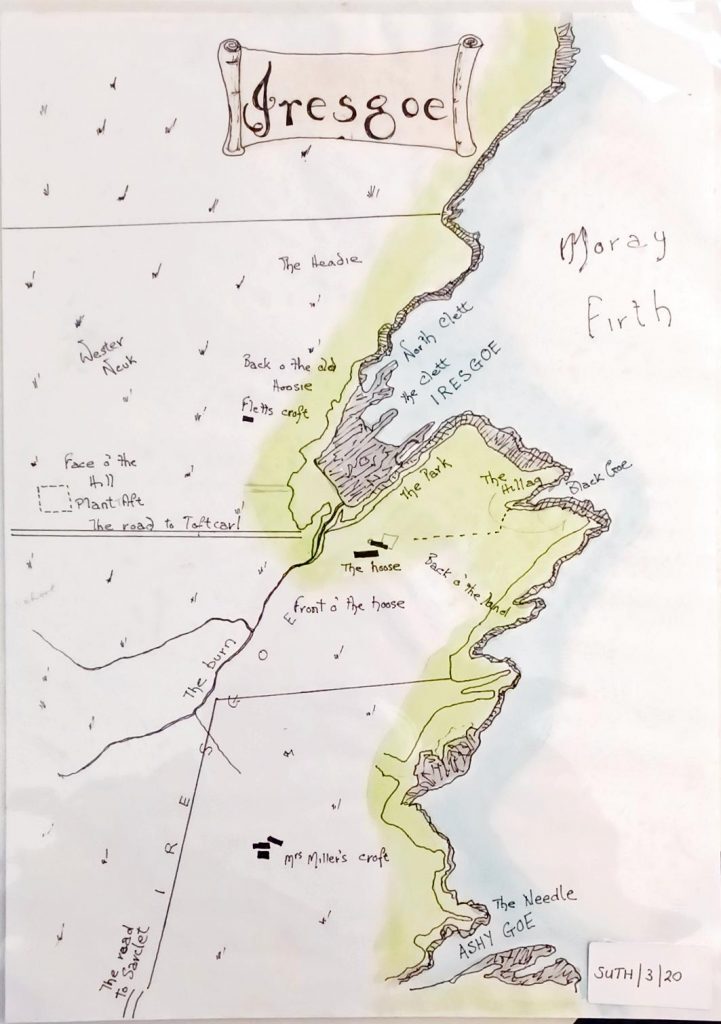
A hand-drawn, colored map titled “Iresgoe” depicting a coastal area near Yarrows and Thrumster in the parish of Wick, Scotland. The map shows the coastline along the Moray Firth shaded in blue for water and green for land, with detailed handwritten labels marking features such as The Needle, Ashy Goe, The Park, The Hillock, and Mr. Miller’s croft. Roads and paths are sketched in, including The road to Telford. A decorative title banner reading “Iresgoe” appears at the top, and the map includes small arrows and annotations indicating directions and landmarks. The style is artistic and illustrative, with soft color shading and clear handwritten text.

Hand drawn coloured map of Iresgoe which is near Yarrows and Thrumster in the parish of Wick (SUTH/3/20)
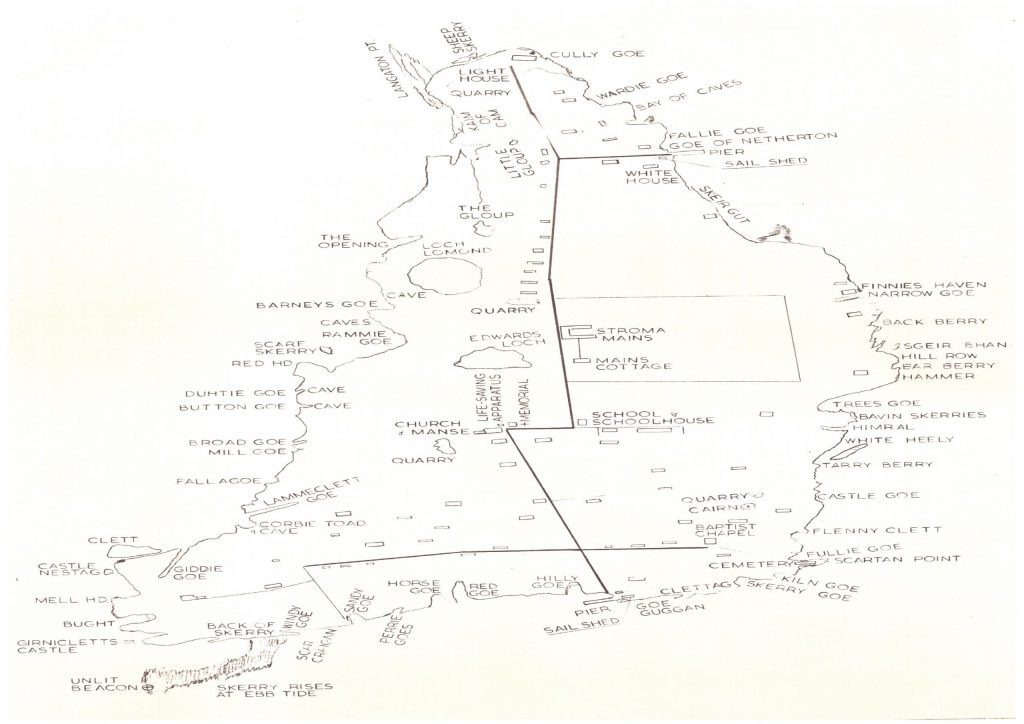
A hand-drawn black-and-white map of Stroma, an island off the north coast of Scotland. The map outlines the island’s shape and marks numerous geographic features, including headlands, caves, quarries, and coastal points such as Cully Goe, Vallie Goe, Barneys Goe, and Plenny Clett. Inland features include Stroma Mains, Schoolhouse, Church Manse, and Mains Cottage, along with multiple quarries and roads sketched across the island. Additional labels identify caves like Button Goe Cave and Mill Goe Cave, as well as landmarks such as Castle Clett and Unlit Beacon near the southern tip. The map uses simple line work with handwritten annotations, focusing on natural and man-made features.

Hand drawn map of Stroma (SUTH/3)

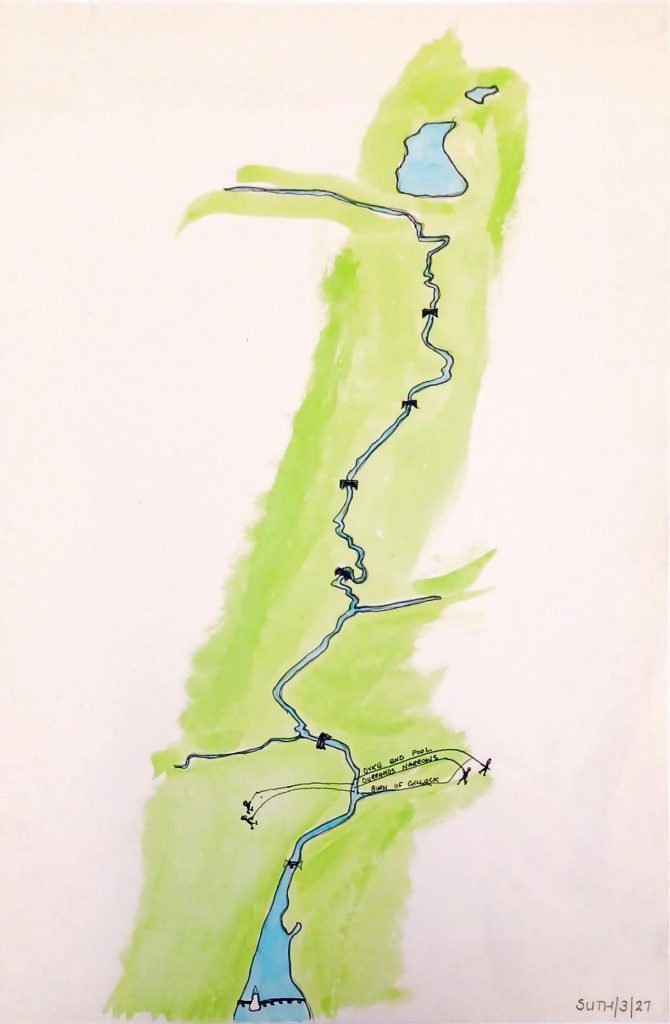
A hand-drawn, colored map illustrating the waterway of Gillock Burn with fishing spots marked along its course. The map shows a narrow, winding blue stream flowing vertically through a green-shaded landscape. Two small blue lochs are depicted—one near the top and a larger one at the bottom. Several fishing pools are labeled in handwritten text, including Pool of Gillock and Pool of Smeara, with arrows pointing to their locations. Simple black lines represent paths or boundaries, and small bridge-like symbols appear at crossings along the burn. The style is artistic and minimalistic, focusing on the waterway and its fishing features.

Drawing of the waterway of Gillock Burn with fishing spots marked (SUTH/3/27)


Advocacy and inspiration - Spreading the word

There is plenty of evidence throughout the collection of Iain’s travels across Scotland to give lectures and deliver classes, all the while advocating for the county and spreading word of the wonderful histories and stories he had researched. Correspondence reveals Iain travelled across the country delivering courses and lectures about the history of Caithness and it’s notable figures, whilst also performing readings of traditional songs and working with students.

The many letters include reference to the Institution of Electrical Engineers, Scotland North and their Perth and Aberdeen events in 1994. Iain delivered a lecture entitled Alexander Bain, The Forgotten Pioneer.

Iain was also involved in delivering local studies courses on Fishing in Caithness and Fishing in Orkney throughout 1994 and 1995. These were delivered by tape to students at the University of Aberdeen.

Iain was a guest speaker at the Crofters Commission Regional Assessors Seminar  in Inverness on  the 24th Feb 1994.
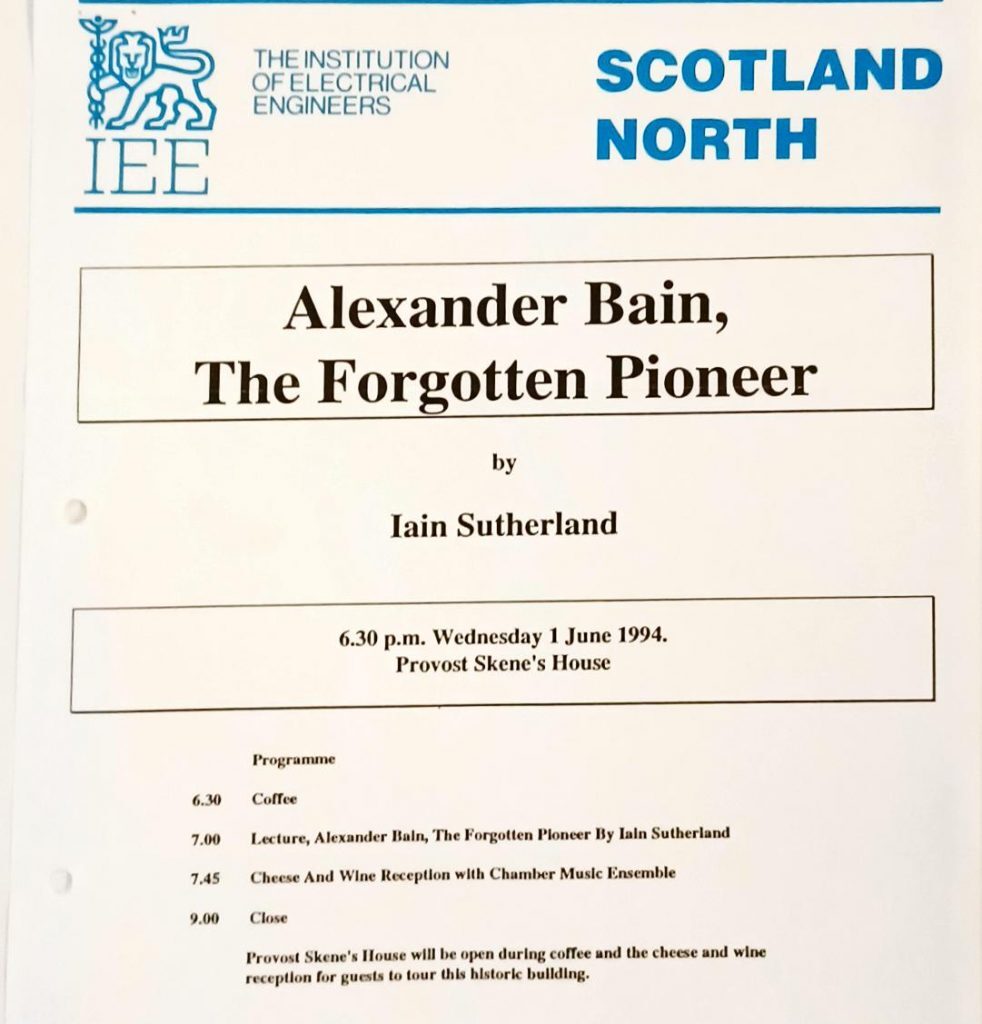
A printed event programme for The Institution of Electrical Engineers (IEE), Scotland North. The title reads:
“Alexander Bain, The Forgotten Pioneer” by Iain Sutherland.
The event details are:

Date and Time: 6.30 p.m., Wednesday 1 June 1994
Venue: Provost Skene’s House

Programme schedule:

6.30 – Coffee
7.00 – Lecture: Alexander Bain, The Forgotten Pioneer by Iain Sutherland
7.45 – Cheese and Wine Reception with Chamber Music Ensemble
9.00 – Close

A note at the bottom states that Provost Skene’s House will be open during coffee and the reception for guests to tour the historic building. The layout includes the IEE logo at the top left and bold blue text reading SCOTLAND NORTH at the top right.

Institution of Electrical Engineers event programme(SUTH/7/15)
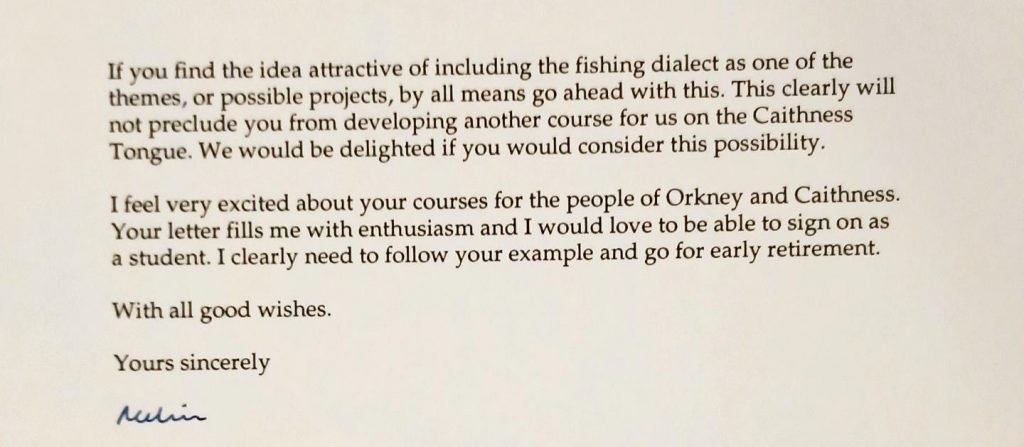
A typed letter excerpt discussing the inclusion of fishing dialect as a theme or project in a course. The text encourages proceeding with the idea and notes it will not prevent developing another course on the Caithness Tongue. The writer expresses enthusiasm for courses aimed at people in Orkney and Caithness, stating the letter fills them with enthusiasm and joking about wanting to sign on as a student and retire early. The letter closes with the phrase “With all good wishes. Yours sincerely” followed by a handwritten signature in blue ink. The layout is simple, with black printed text on white paper.

Letter to Iain Sutherland from academic at University of Aberdeen(SUTH/7/15)
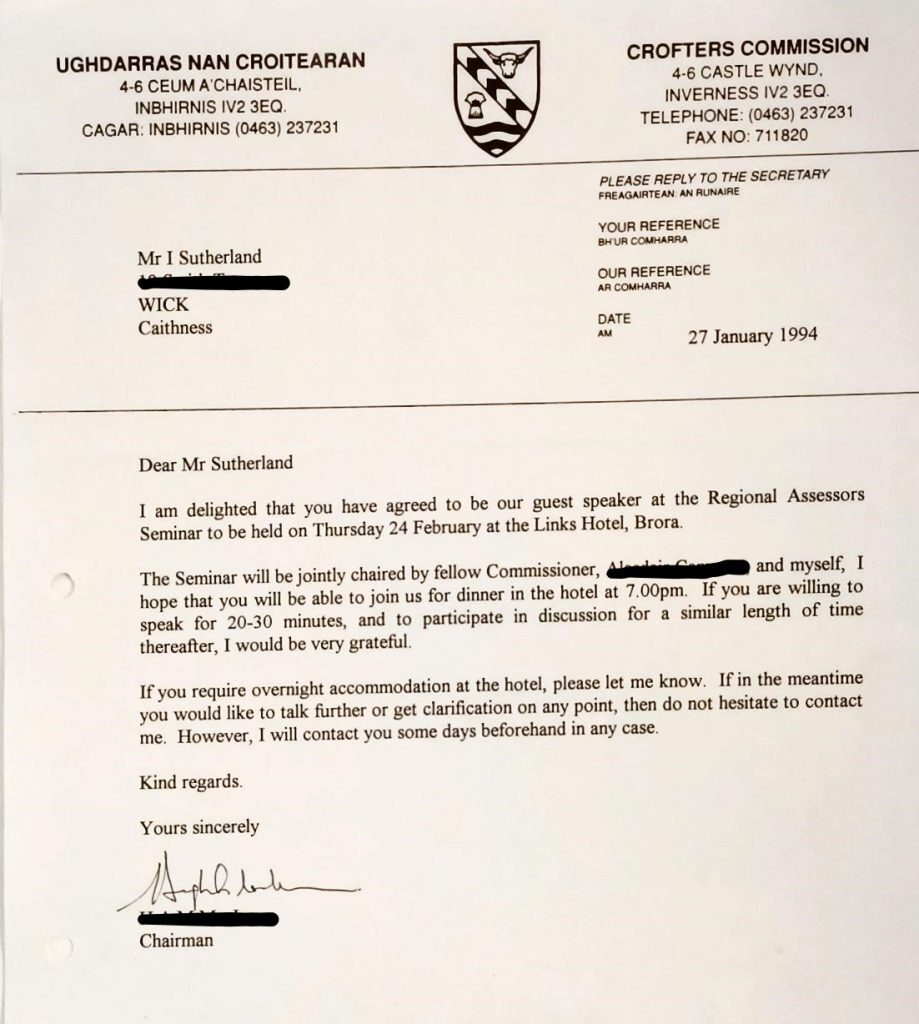
A formal letter on Crofters Commission letterhead, dated 27 January 1994, addressed to Mr. I. Sutherland, Wick, Caithness. The letter confirms that the recipient has agreed to be a guest speaker at the Regional Assessors Seminar scheduled for Thursday 24 February at the Links Hotel, Brora. It mentions that the seminar will be jointly chaired by two commissioners and invites the recipient to join for dinner at 7:00 p.m. The letter requests a 20–30 minute talk followed by discussion and offers assistance with overnight accommodation if needed. The closing includes “Kind regards” and “Yours sincerely,” followed by a handwritten signature and the printed title Chairman. The letterhead features bilingual text in English and Gaelic, the Crofters Commission crest, and contact details including address, telephone, and fax numbers.

Letter to Iain Sutherland from the Crofters Commission (SUTH/7/15)

The Orkney Science Festival welcomed Iain to speak over many decades. In 1993 and 1994 he spoke on Caithness history, specifically herring fishing, as well as Alexander Bain and lighthouse machinery. The letter below explains that Iain was ‘one of a handful of men still living who have actually assembled the machinery of a mechanical lighthouse’. Also included below are digitised slides from Iain’s collection showing photographs and lecture slides concerning lighthouses and their operation.
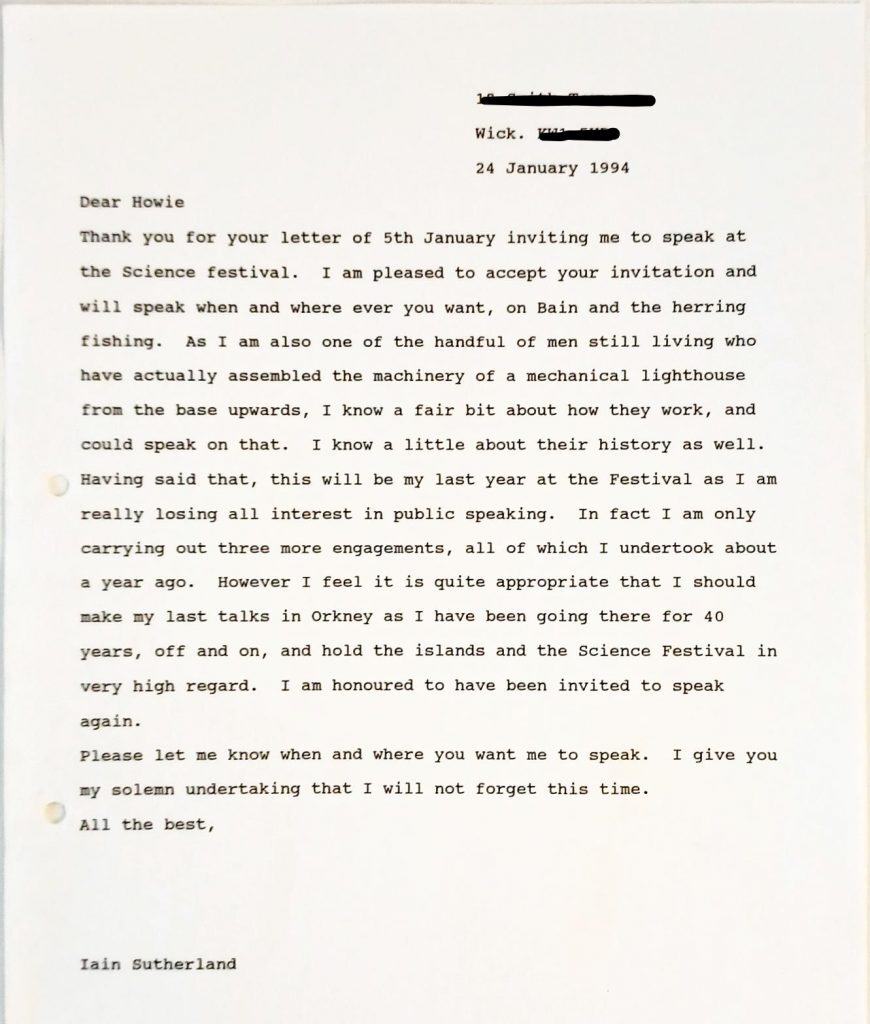
A typed letter dated 24 January 1994 on white paper. The letter is addressed to “Dear Howie” and expresses acceptance of an invitation to speak at the Science Festival. The writer mentions willingness to speak on topics such as Bain and herring fishing, and notes being one of the few remaining individuals who assembled mechanical lighthouse machinery. The letter states this will be the writer’s last year at the festival due to losing interest in public speaking, and mentions having attended the Orkney Science Festival for 40 years. The letter closes with thanks and is signed “Iain Sutherland.”

Letter written by Iain Sutherland accepting an invitation to speak at the Orkney Science Festival (SUTH/7/15)
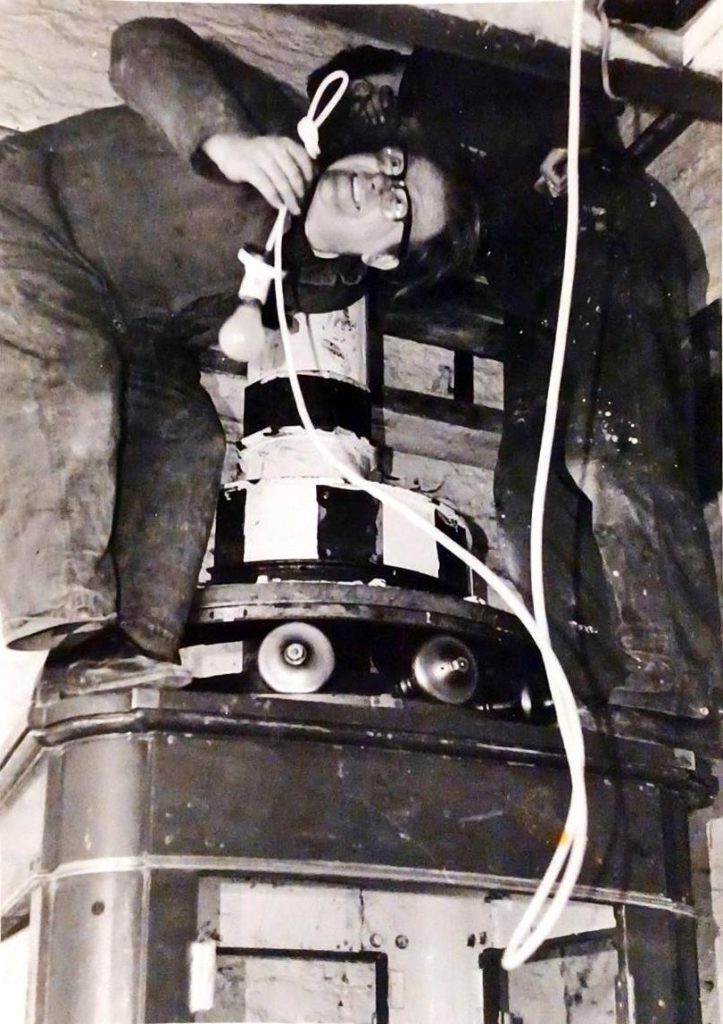
A black-and-white photograph showing a person crouched inside a confined space, working on what appears to be a large mechanical or electrical device. The person is wearing glasses and practical work clothes, holding a light bulb attached to a cord. The device beneath them has a cylindrical section with alternating black and white stripes and several round components resembling bells or speakers. Wires and cables are visible, hanging loosely around the person and the equipment. The setting looks industrial or workshop-like, with rough walls and a sense of maintenance or construction work in progress.

Photograph of Iain found amongst loose papers in his collection (SUTH/2/2/1)
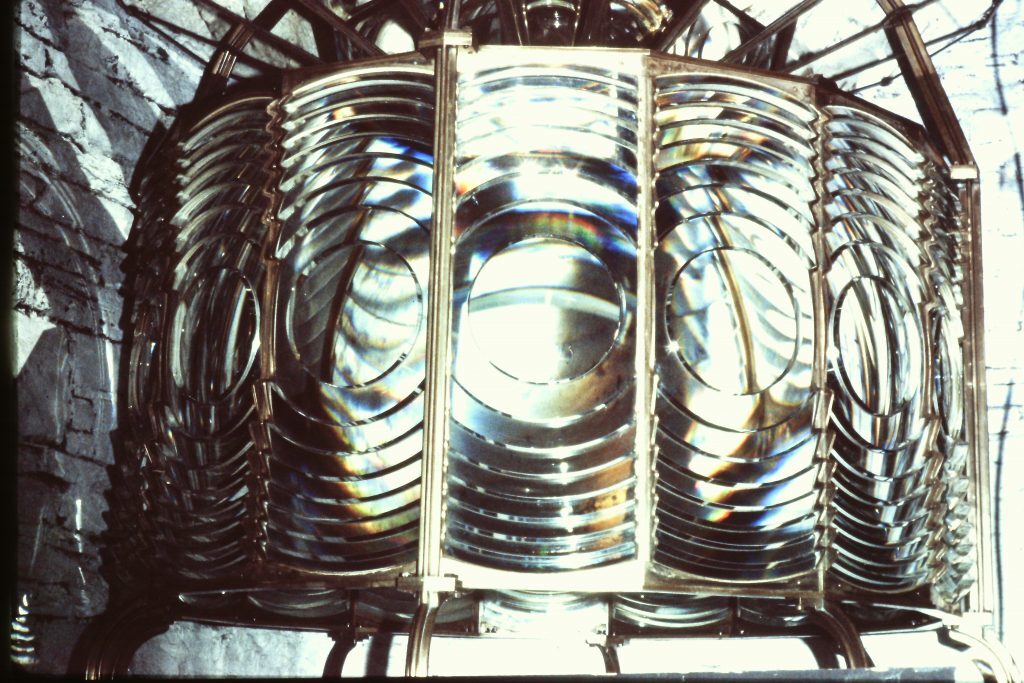
A large, intricate lens assembly. The lens consists of multiple concentric glass prisms arranged in a circular pattern, supported by a metal frame. Light reflects and refracts through the glass, creating rainbow-like colors. The background shows a stone wall with a rough texture.

Digitised 35mm slide found within an unlabelled slide box in Iain’s collection (SUTH/6/26)
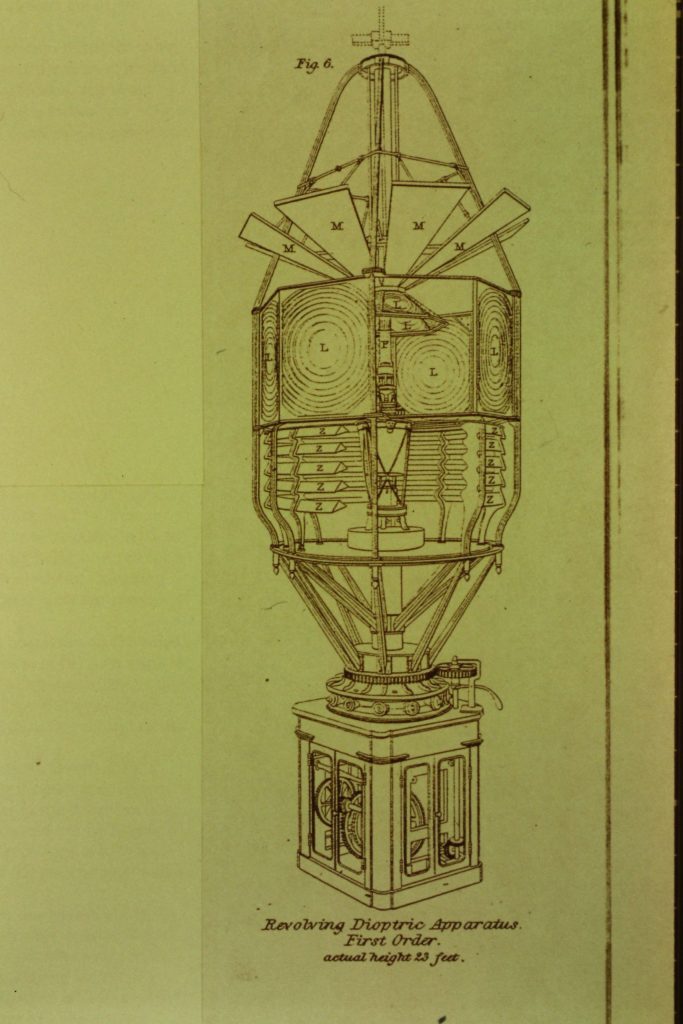
Technical drawing of a revolving dioptric apparatus, first order, with an actual height of 23 feet. The detailed illustration shows the internal structure, including lenses, mirrors, and mechanical components, used in a lighthouse optic system.

Digitised 35mm slide found within an unlabelled slide box in Iain’s collection (SUTH/6/26)
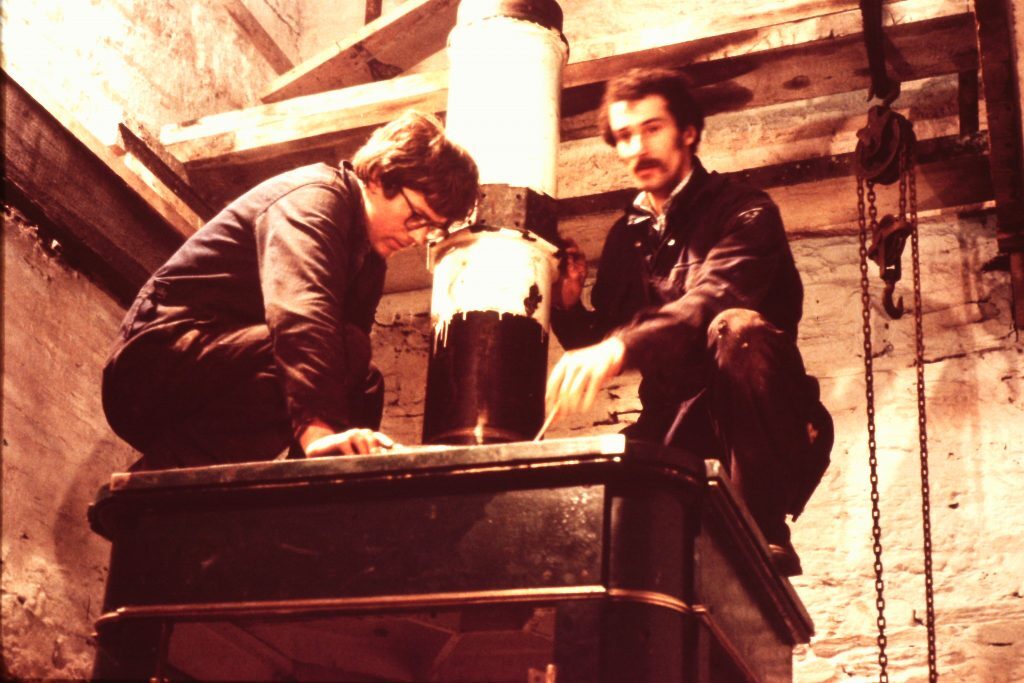
Two individuals working on a large mechanical component inside a stone-walled structure. They are positioned on top of a dark metal base, handling a cylindrical part with white and black sections. Wooden beams and a hanging chain are visible in the background.

Digitised 35mm slide found within an unlabelled slide box in Iain’s collection (SUTH/6/26)
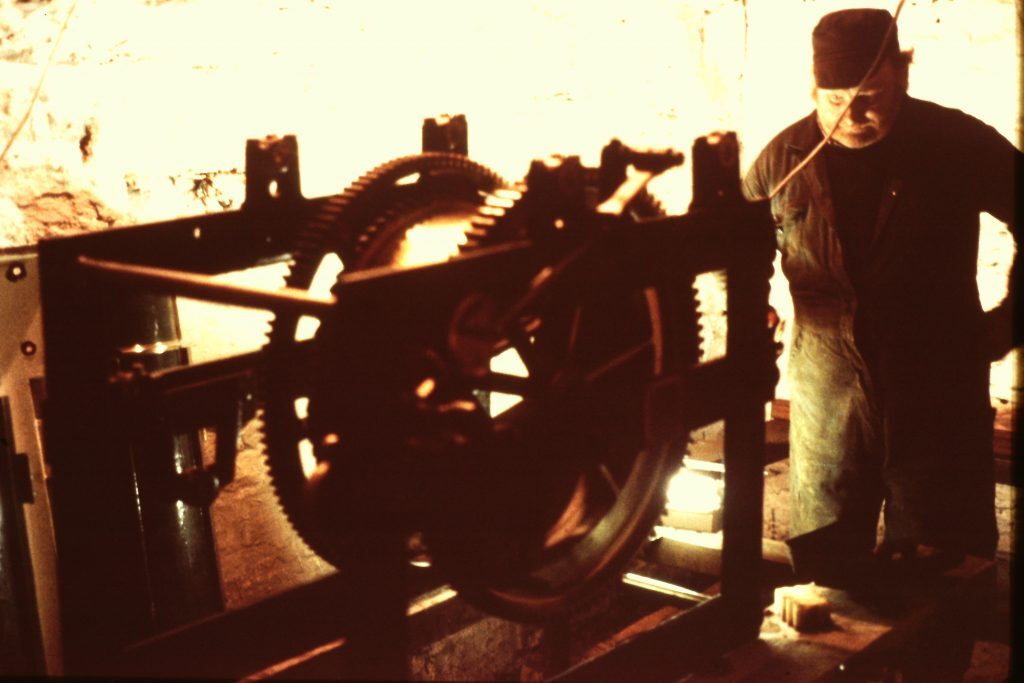
Person standing near a large mechanical assembly with visible gears and rods inside a stone-walled room. The machinery appears to be part of a clockwork or rotational mechanism, possibly related to lighthouse equipment. Bright light from behind casts the scene in silhouette.

Digitised 35mm slide found within an unlabelled slide box in Iain’s collection (SUTH/6/26)
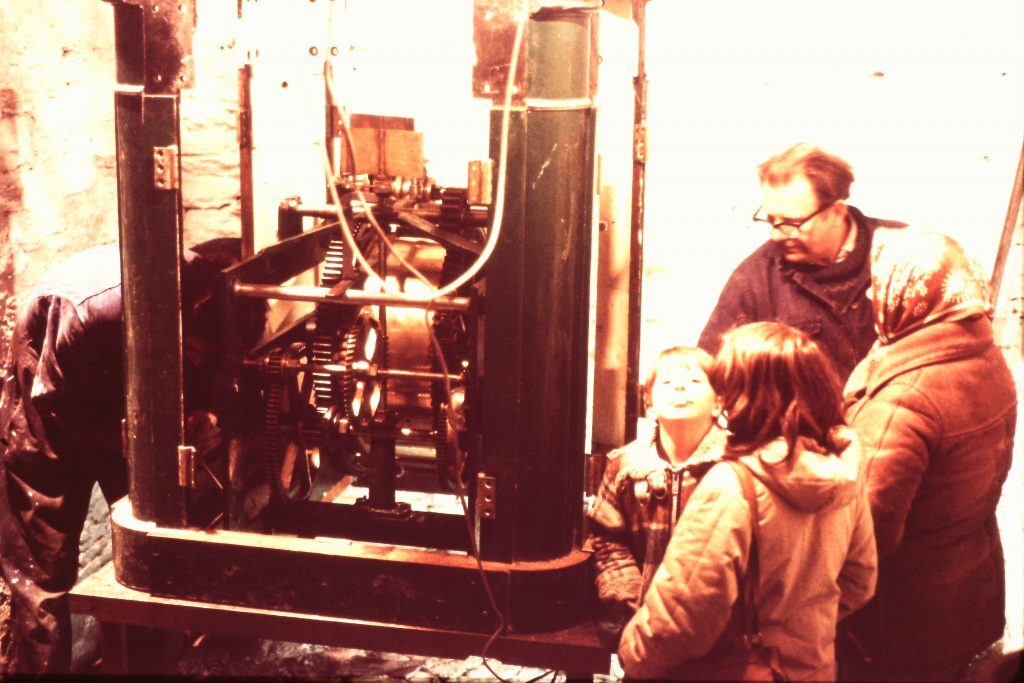
Group of people gathered around a large mechanical apparatus with visible gears and rods inside a green metal frame. The setting appears to be indoors with stone walls, and the machinery looks like part of a lighthouse mechanism or clockwork system.

Digitised 35mm slide found within an unlabelled slide box in Iain’s collection (SUTH/6/26)
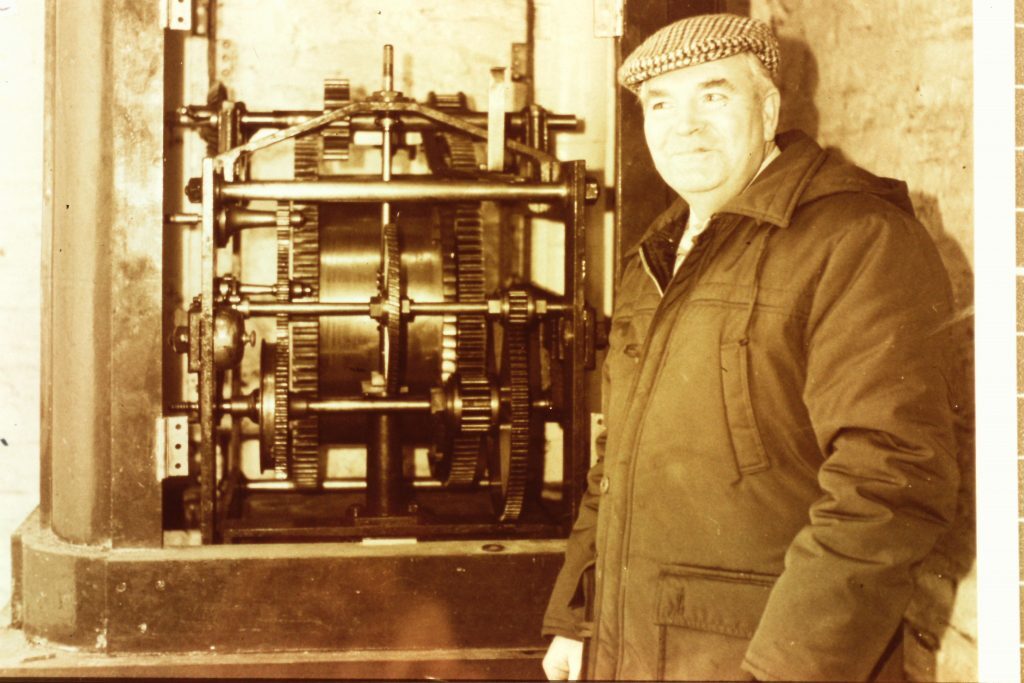
Large mechanical apparatus with multiple interlocking gears and cylindrical components housed within a sturdy metal frame, mounted on a base against a stone wall. A person wearing a heavy coat and patterned flat cap stands beside the machinery.

Digitised 35mm slide found within an unlabelled slide box in Iain’s collection (SUTH/6/26)
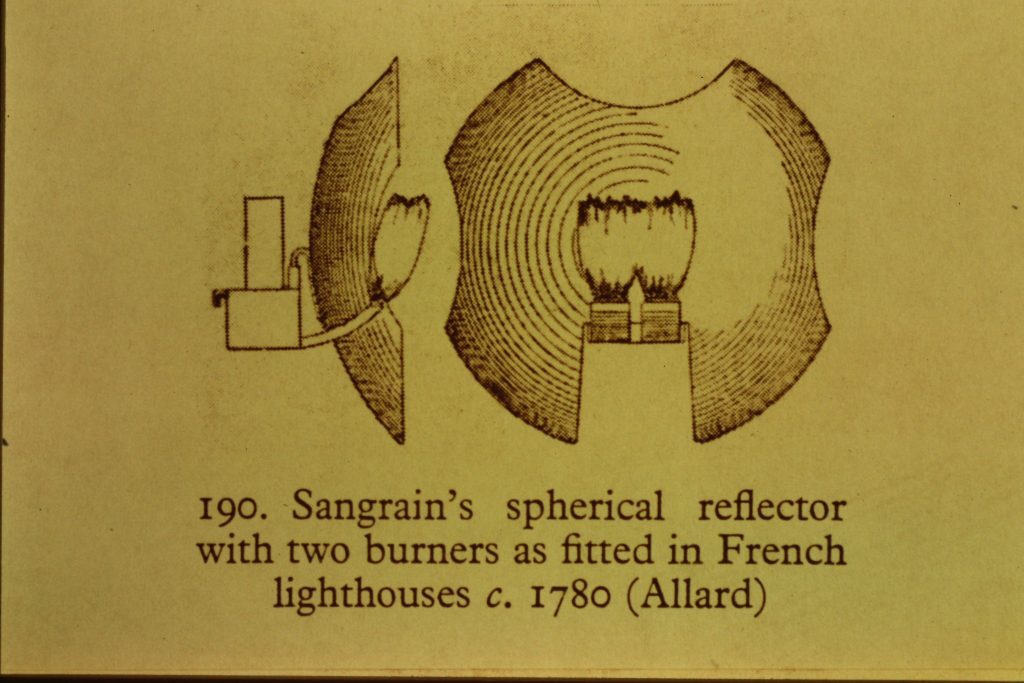
Illustration of Sangrain’s spherical reflector with two burners, as used in French lighthouses around 1780. The diagram shows two views of the reflector and burners, with concentric lines indicating the reflective surface.

Digitised 35mm slide found within an unlabelled slide box in Iain’s collection (SUTH/6/26)
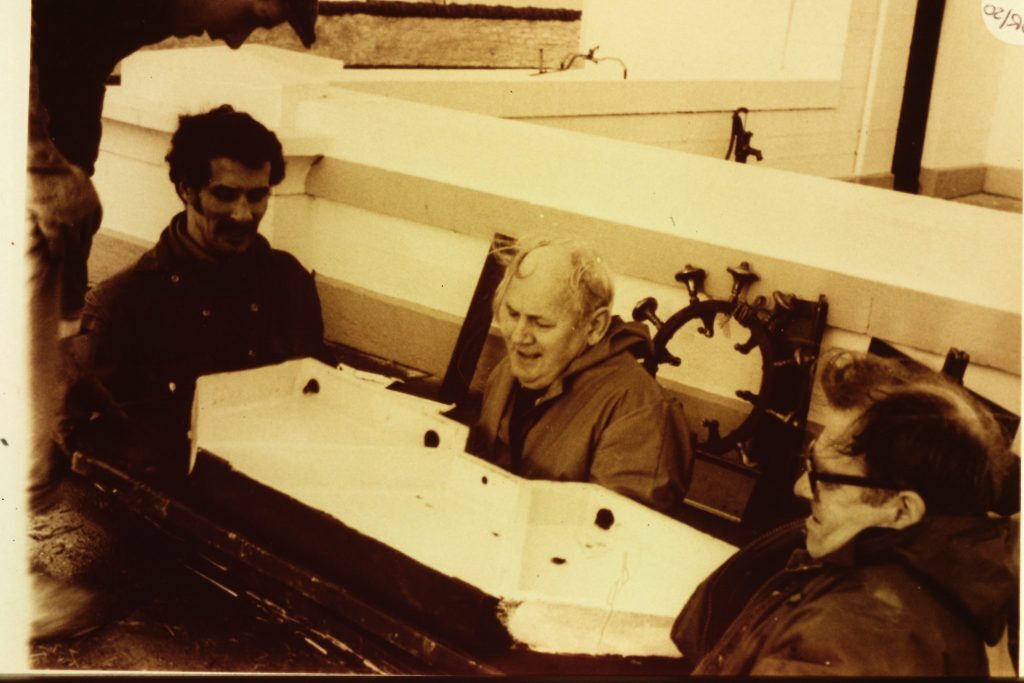
Three people gathered around a large metal component with gears, positioned outdoors near a white-painted structure. The component appears to be partially disassembled, with bolts and fittings visible.

Digitised 35mm slide found within an unlabelled slide box in Iain’s collection (SUTH/6/26)
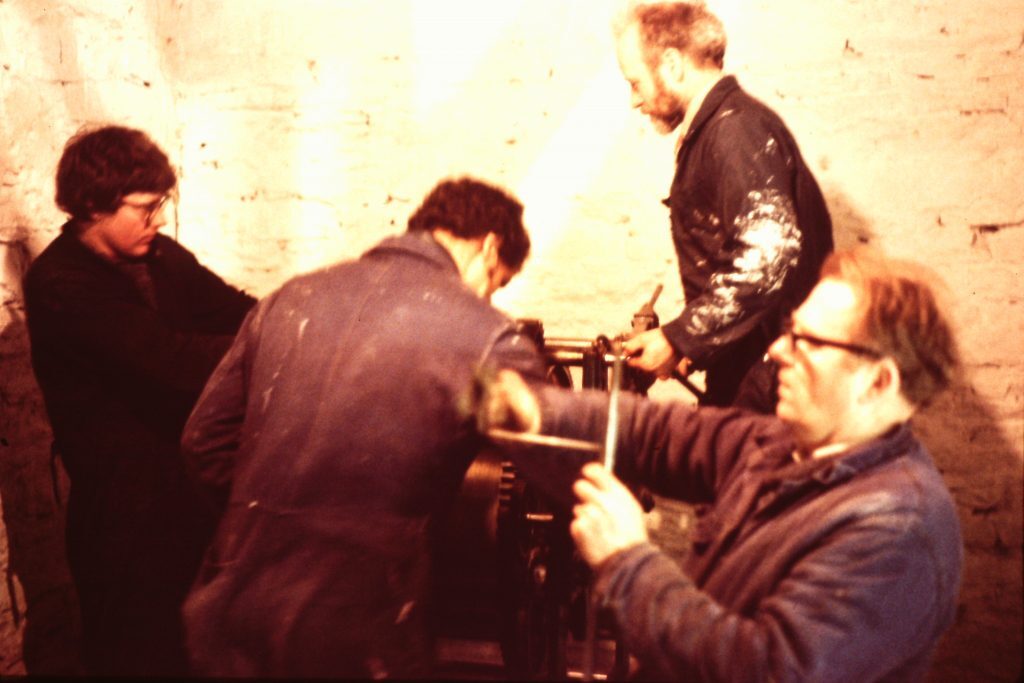
Four individuals working inside a stone-walled room on mechanical equipment. They are wearing work clothes and appear to be engaged in maintenance or assembly tasks. The equipment includes metal rods and a large cylindrical component.

Digitised 35mm slide found within an unlabelled slide box in Iain’s collection (SUTH/6/26)

Finally, and quite differently, Iain was asked to perform a reading of Barley Bree for the Traverse Theatre in Edinburgh.
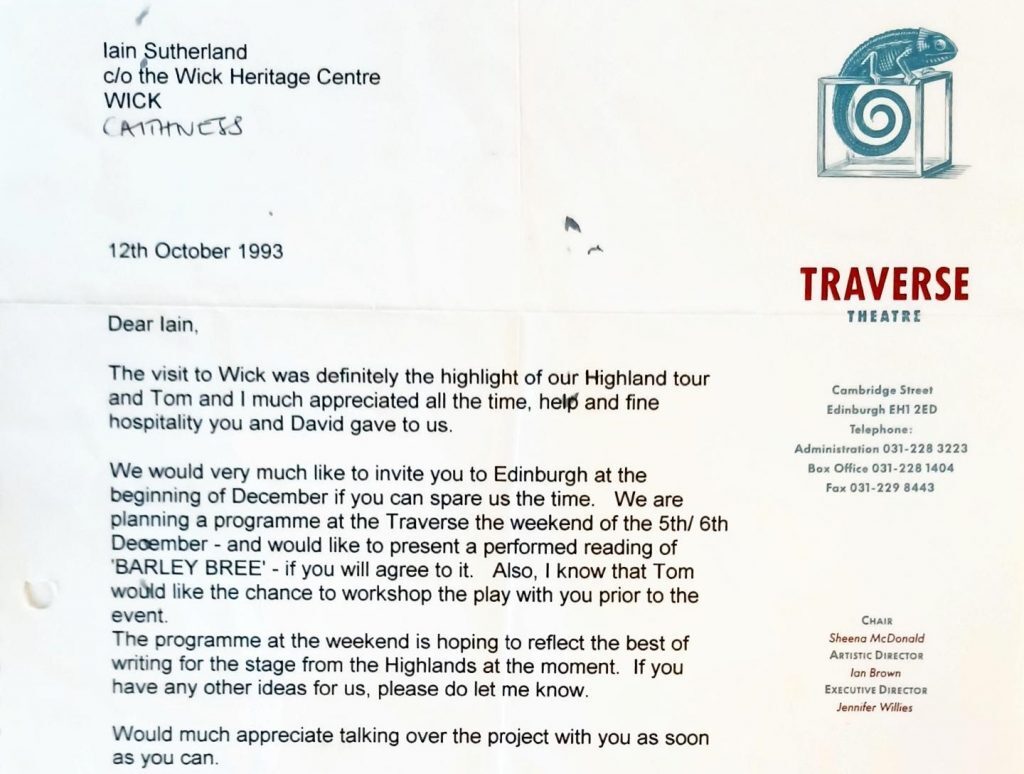
Typed letter dated 12th October 1993 on Traverse Theatre letterhead, addressed to Iain Sutherland at Wick Heritage Centre. The letter expresses appreciation for hospitality during a Highland tour and invites Iain to Edinburgh in early December for a programme at the Traverse Theatre, including a performed reading of 'Barley Bree' and a workshop. The letter mentions the event aims to showcase Highland stage writing and requests further discussion. Contact details and theatre logo are visible on the right.
Letter from the Traverse Theatre in Edinburgh to Iain Sutherland (SUTH/7/15)

Local preservation

Iain’s hands on approach to the preservation of Caithness heritage is perhaps no better displayed than through his work at the Whaligoe Steps and its unique harbour. Iain wrote:

I had always been attracted to the Steps and the Haven as I used to visit my granduncle and aunt with my brothers from early childhood to see them and hear the stories of the past

Iain Sutherland, Whaligoe and Its Steps: A Unique Harbour (2007), p. 14.

In the early 70s, it became clear that the preservation of the steps leading down to the harbour had been abandoned and so Iain and some friends began work to save what he described as a ‘treasure chest’ for both wildlife and heritage.

Unbeknownst to them at first, a local women, Etta Juhle, had also been doing the same thing and they thenceforth worked together to repair damages the steps suffered from landslides. A plaque in Etta’s honour was erected at the top of the steps by Iain and his friends in 2002.

The Shell Better Britain Campaign has awarded those involved in the steps maintenance on multiple occasions. The full story of the harbour and its preservation can be read in Whaligoe and Its Steps: A Unique Harbour. Below is reproduced one of Iain’s original sketches of Whaligoe Harbour.
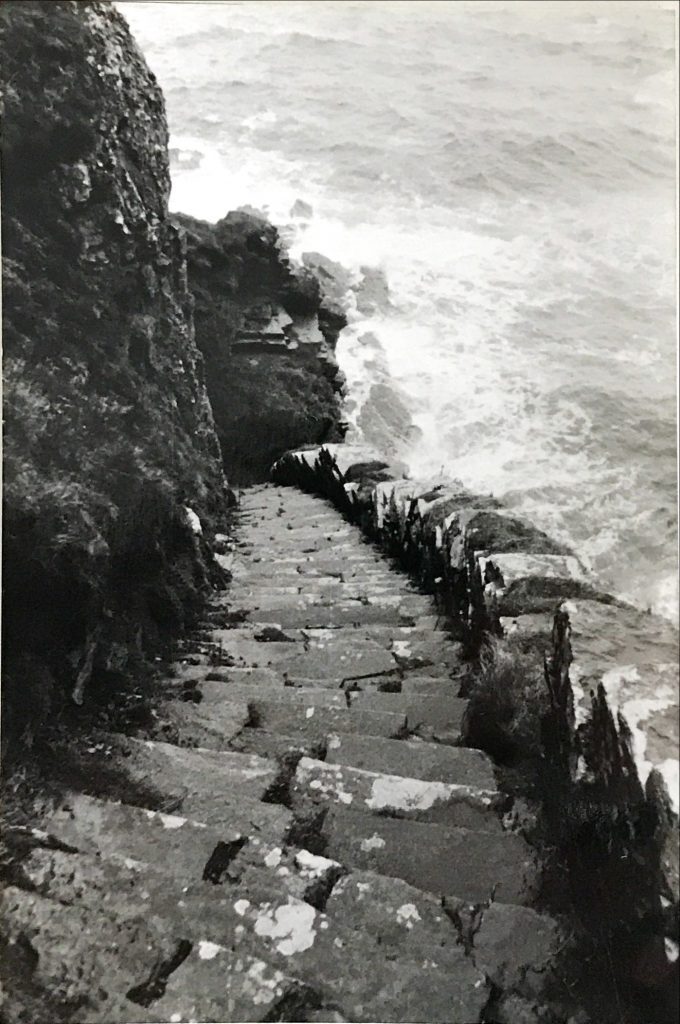
Black and white photograph showing a steep stone staircase, known as the Whaligoe Steps, descending along a rocky cliff toward the sea. The steps are uneven and weathered, with a rough stone wall on one side and waves crashing against the rocks below.

Photograph of Whaligoe Steps (SUTH/6/6)
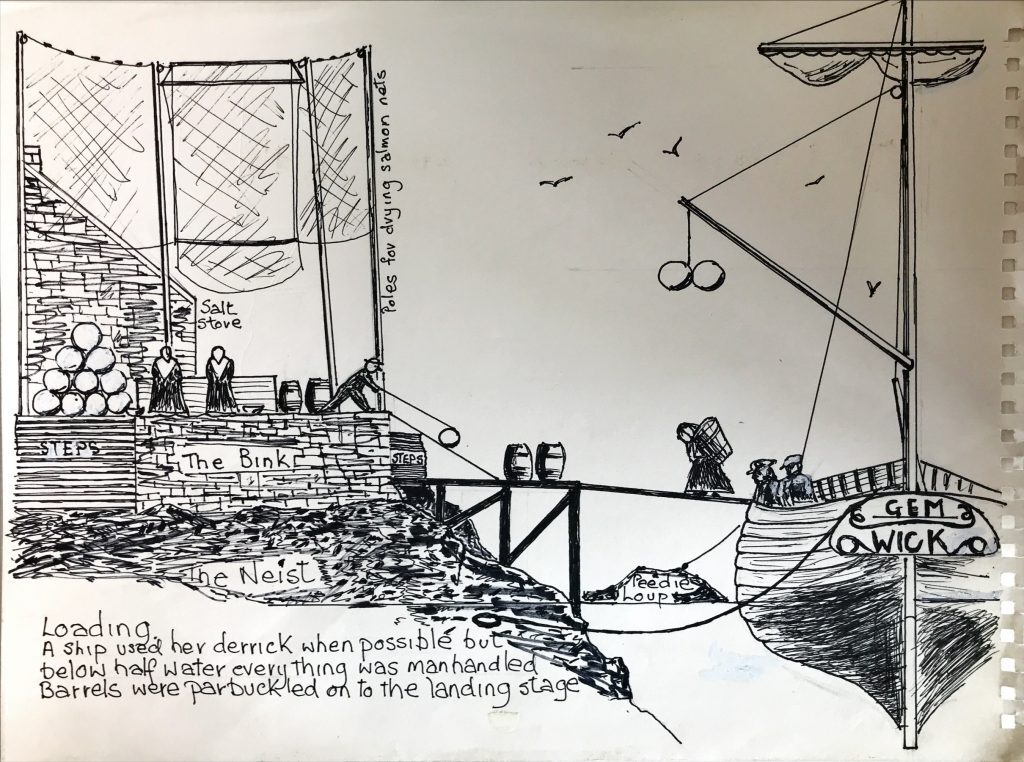
Hand-drawn sketch of Whaligoe Harbour showing a dockside scene with labeled features including 'Salt Store,' 'The Bink,' 'The Neist,' and 'Steps.' A ship named 'Gem of Wick' is moored at the landing stage, with barrels and cargo being loaded. Text at the bottom reads: 'Loading. A ship used her derrick when possible but below half water everything was manhandled. Barrels were parbuckled on to the landing stage.' Birds are flying above the harbor.

Original sketch of Whaligoe Harbour (SUTH/2/2/1)
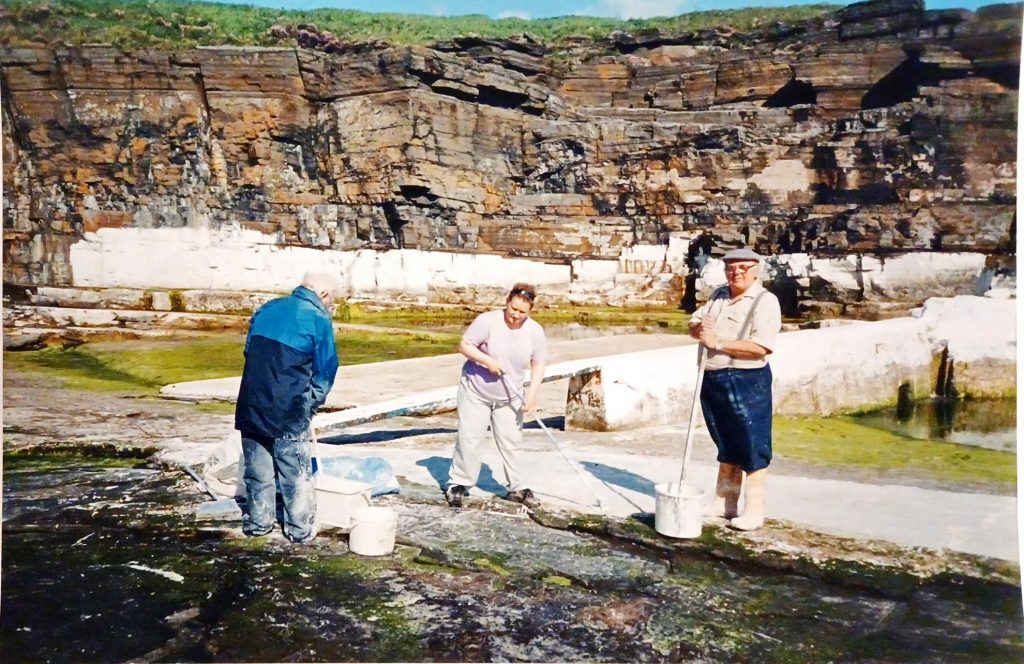
Three people working outdoors at a tidal pool area with rocky cliffs in the background. They are cleaning or painting the concrete edges of the pool using brushes and buckets. The pool is partially filled with water, and the surrounding rocks are covered in patches of green algae.

Iain and others painting the beloved Trinkie in Wick


Inspiration

Iain was a great inspiration to many locally and nationwide. There is overwhelming evidence of this throughout his collection. We’d like to share a few select examples of the impact his work and advocacy had and the undying hospitality and insight he was always ready to share. Reproduced below is a recording of different individuals speaking of Iain’s influence and character.

Various people talking of Iain’s influence and inspiration – SUTH/5/7

Iain also received many thank you cards including this one.
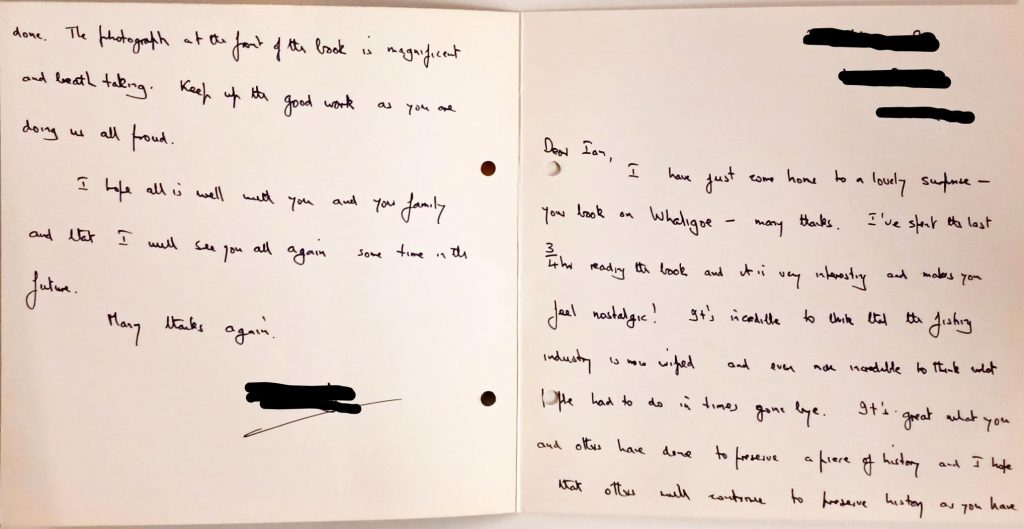
Open thank-you card with handwritten messages on both pages. The left page expresses appreciation for a photograph in a book, compliments the recipient’s work, and sends good wishes for the future. The right page thanks the recipient for a sculpture and mentions Whaligoe, reflecting on the fishing industry and praising efforts to preserve history. Both messages are written in cursive handwriting, and the card has two punched holes along the center fold.
Thank you card addressed to Iain Sutherland (SUTH/2/1/9)

It’s great what you an others have done to preserve a piece of history [Whaligoe Steps] and I hope that others will continue to preserve history as you have

Iain was an inspiration to other researchers and historians and the letter below makes clear the impact his writing and hospitality could have.
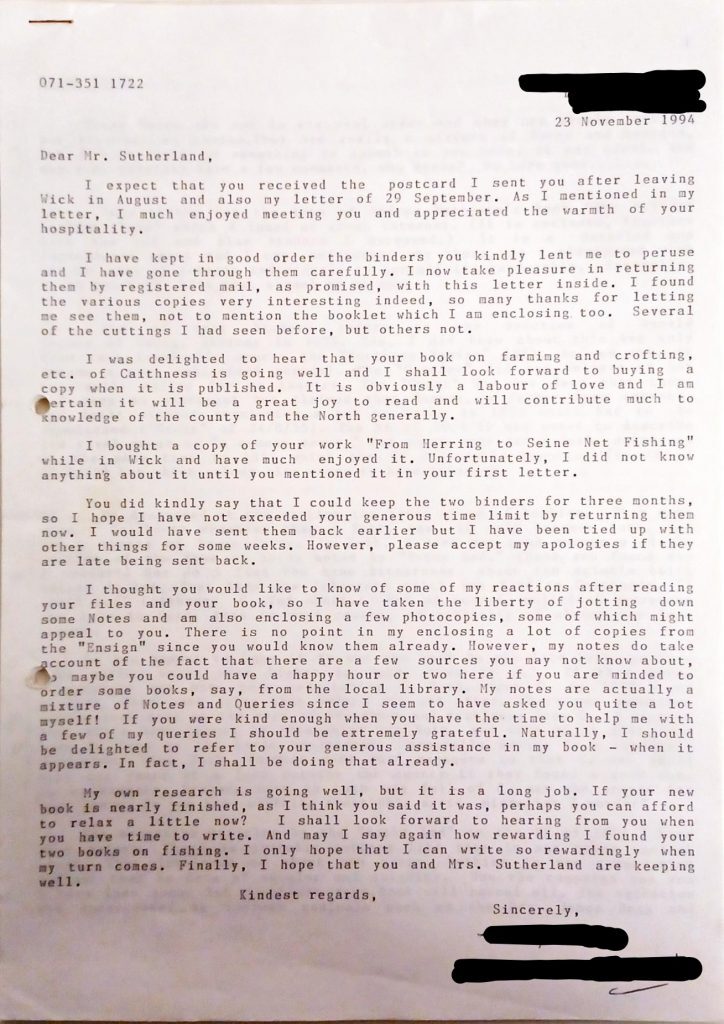
Typed letter dated 23 November 1994 addressed to Mr. Sutherland. The letter expresses gratitude for hospitality during a visit to Wick, mentions returning borrowed binders, and compliments a book on farming and crofting in Caithness. It refers to purchasing a copy of 'From Herring to Seine Net Fishing' and shares thoughts on preserving local history. The sender praises the recipient’s work and acknowledges the effort involved in writing and compiling historical material. The letter ends with kind regards and hopes that Mr. and Mrs. Sutherland are keeping well.
Letter of gratitude addressed to Iain Sutherland (SUTH/2/1/9)

I much enjoyed meeting you and appreciated the warmth of your hospitality… I was delighted to hear that your book on farming and crofting etc. in Caithness is going well and I shall look forward to buying a copy when it is published. It is obviously a labour of love and I am certain it will be a great joy to read

Finally, Nucleus posted on Facebook about Iain and his collection last year. The comments received in response were wonderful and show the deep appreciation people feel for Iain.

A legend remember when he worked at Dounreay.

Brilliant man could spend hours listening to him. Fondly remembered.

I was in the same class in Wick High School and he was a very bright boy. After school he used to help his grandfather store drifters at the harbour as he managed the ship handlers there.

The county would be much poorer if it wasn’t for the likes of Iain and many others who recorded our history. Always enjoyed chatting to him and discussing local history.

An absolute legend of a man… The much loved and much missed Iain (Tuddie) Sutherland. Gentleman.

I remember Iain fondly, and the many conversations we had together, either in my study at Kirkhill House, at the Wick Heritage Museum or, often as not at the old Fish Mart or the Pilot House at the Braehead. Iain truly was a legend in his ain lifetime, and he is sorely missed.


Photographs and 35mm slides

To end we have collated an assortment of digitised photographs and 35mm slides from Iain’s collection. There are hundreds, if not thousands, of individual slides held at Nucleus. Presented here is just a glimmer of their richness and importance.
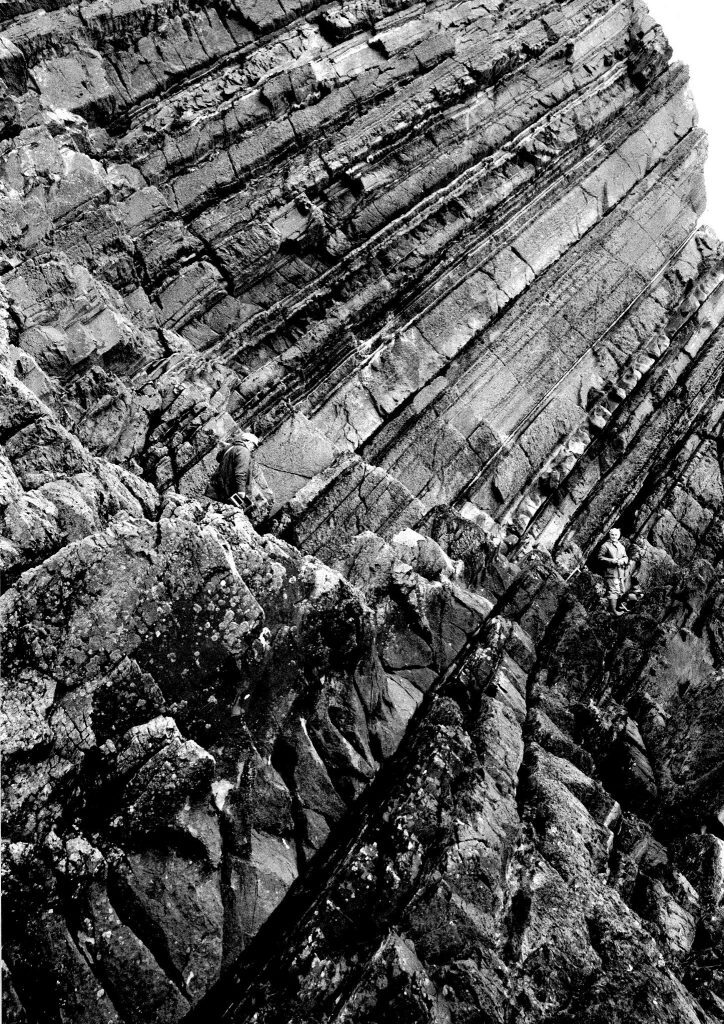
Black and white photograph of a steep, jagged rock face with prominent horizontal and diagonal striations. The textured surface shows layers of sedimentary rock, and a person wearing outdoor gear is climbing the formation using ropes, positioned toward the lower right section of the image.

Photograph found within the research papers of Iain’s collection (SUTH/2/2/1)
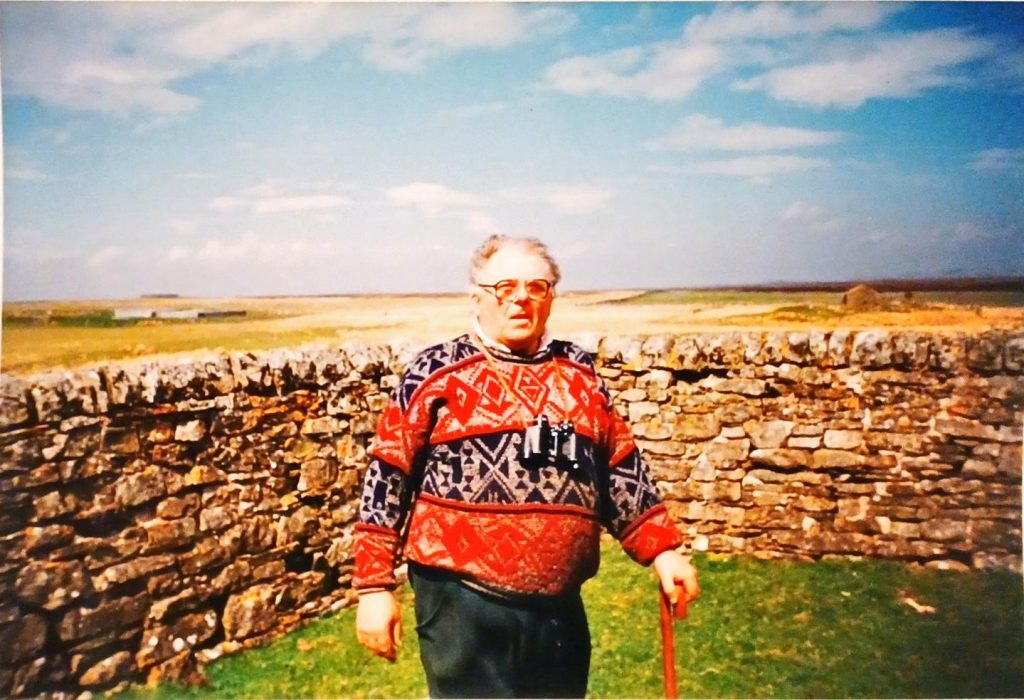
Person standing outdoors in front of a low stone wall, wearing a patterned red and blue sweater and holding a walking stick. Behind the wall is an open landscape with grassy fields stretching toward the horizon under a bright blue sky with scattered clouds.

Photograph found within the research papers of Iain’s collection (SUTH/2/2/1)
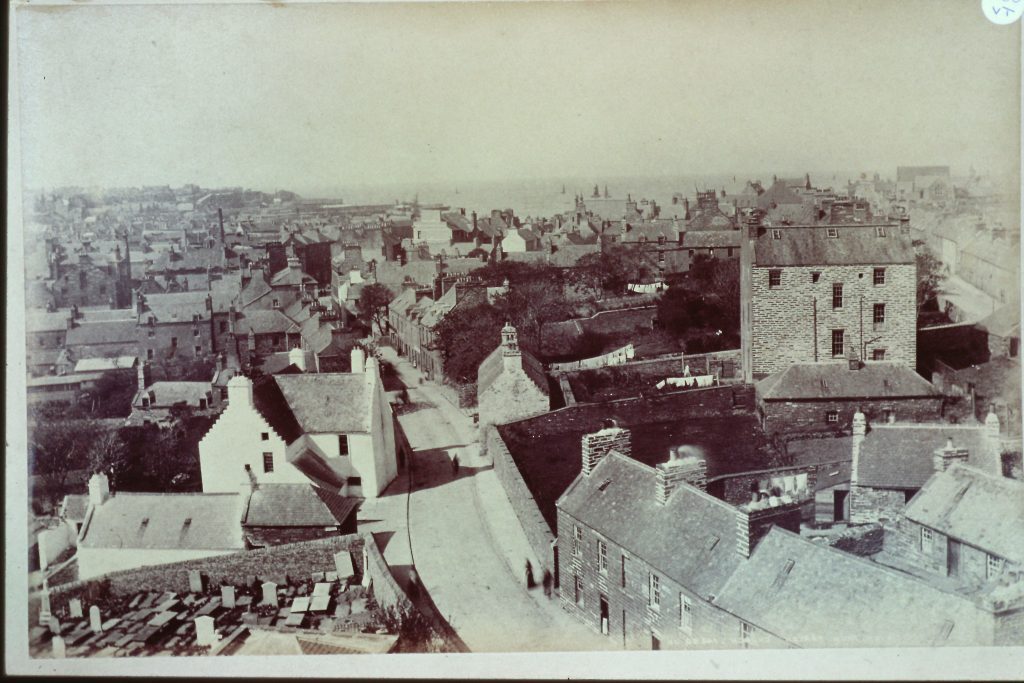
Historic sepia-toned photograph showing an elevated view of a coastal town with densely packed stone and slate-roofed buildings. A winding street runs through the center, flanked by houses and larger structures, including a prominent multi-story stone building on the right. In the foreground, a graveyard with rows of headstones is visible, and the background extends toward the sea with faint outlines of ships and harbor structures.

Digitised 35mm slide from Iain’s collection (SUTH/6)
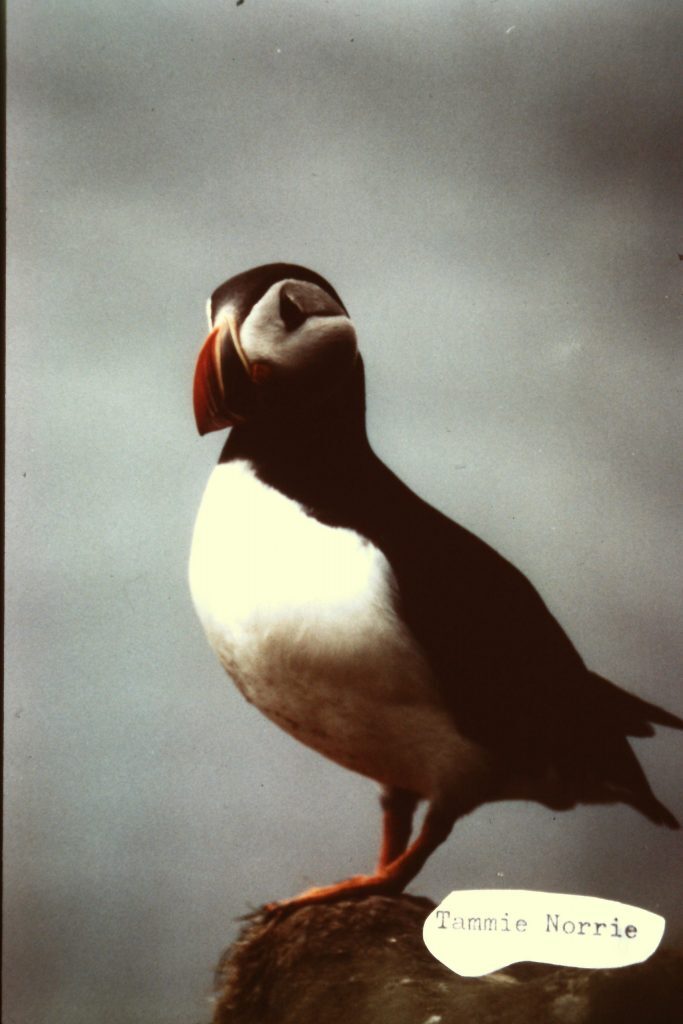
Close-up photograph of a puffin standing on a rock against a muted gray background. The puffin has a distinctive black and white body, bright orange beak with colored markings, and orange feet. A label reading 'Tammie Norrie' is placed near the bottom right corner of the image.

Digitised 35mm slide from Iain’s collection – Tammie Norrie (SUTH/6/16)
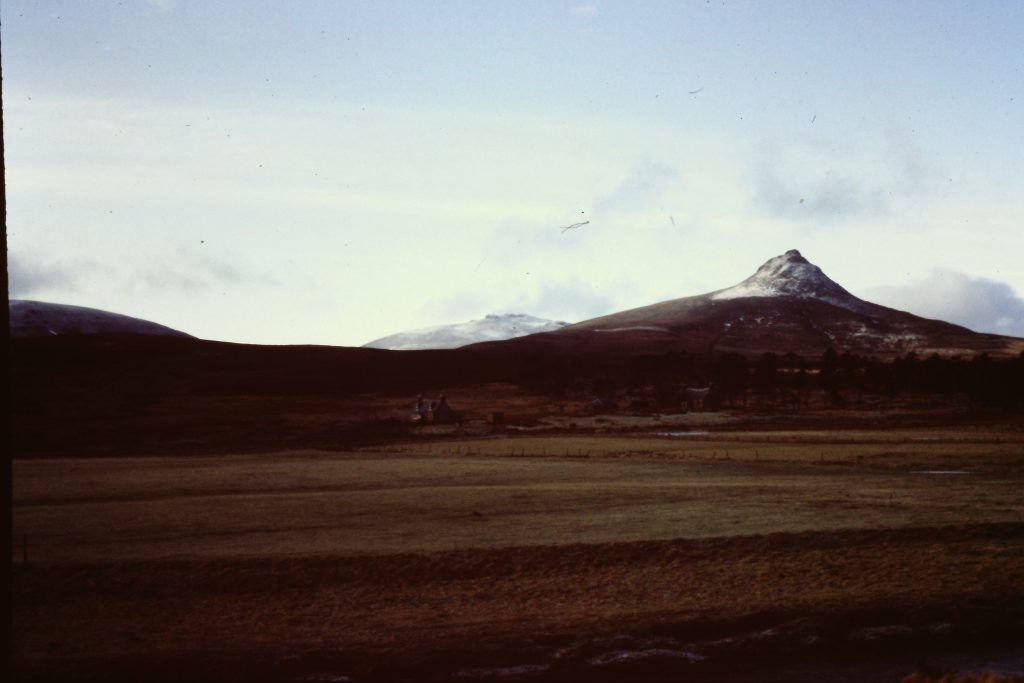
Landscape view of a rural area with open grassy fields in the foreground and a range of hills in the background. One prominent peak, partially dusted with snow, rises sharply against a pale blue sky with scattered clouds. A few small buildings and a cluster of trees are visible near the base of the hills.

Digitised 35mm slide from Iain’s collection (SUTH/6/17)
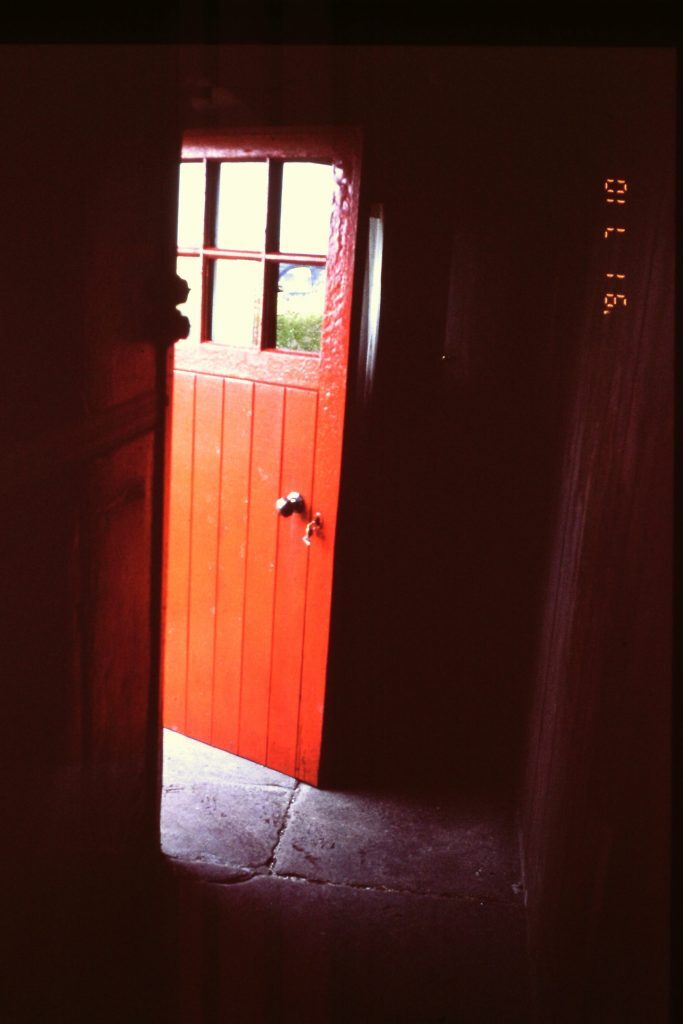
View from inside a dimly lit room looking toward an open red wooden door with a small window panel at the top. The door opens outward to reveal a glimpse of bright daylight and greenery outside. The floor inside is made of large stone slabs, and the surrounding walls are dark and wooden.

Digitised 35mm slide from Iain’s collection – West Side Croft (SUTH/6/17)
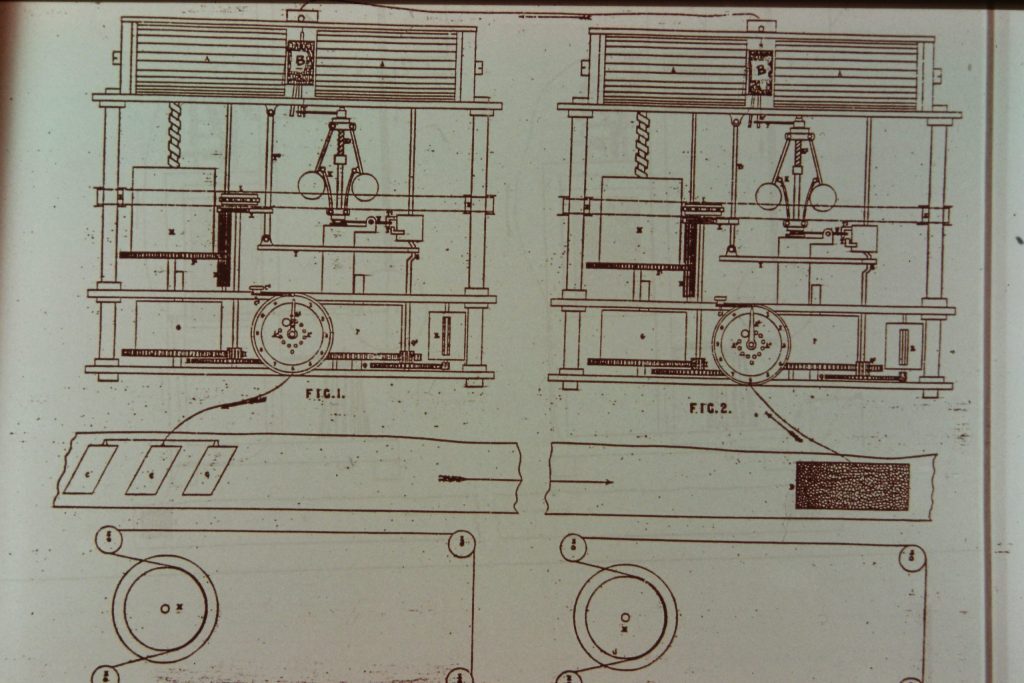
Technical drawing showing two detailed mechanical diagrams labeled Fig. 1 and Fig. 2, depicting machinery with gears, rollers, and structural frames. Below each figure are illustrations of material strips and roller arrangements, suggesting an industrial process or machine operation.

Digitised 35mm slide from Iain’s collection (SUTH/6/24)
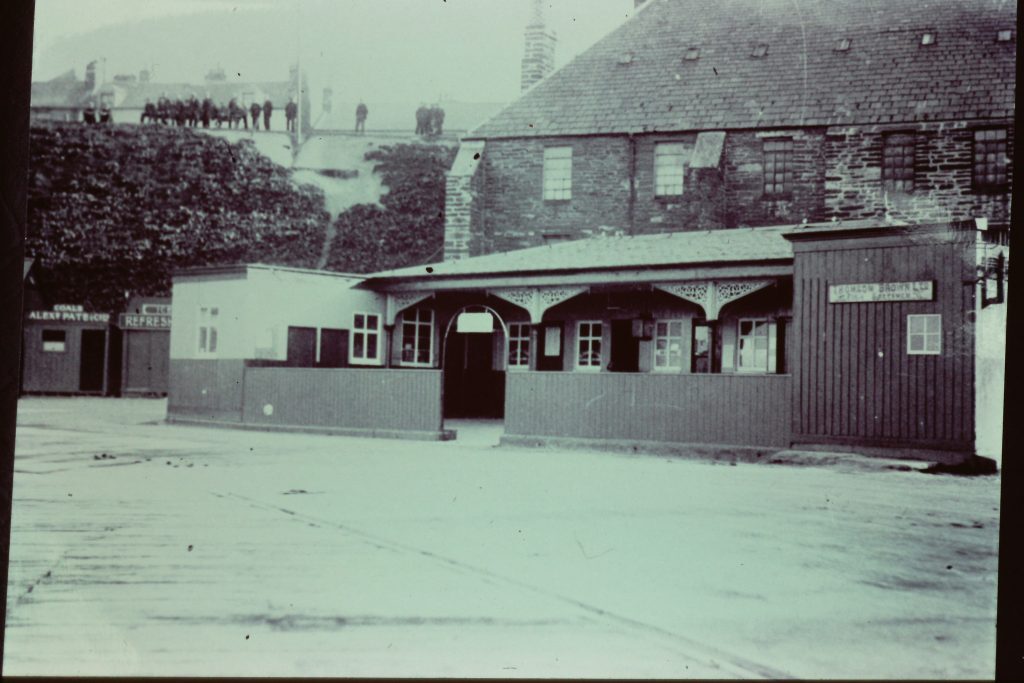
Historic photograph of a wooden building labeled 'Herring Mart' with decorative trim around the entrance and windows. The structure has multiple sections, including a central doorway and side extensions. Behind it is a large stone building with a pitched roof and chimneys. In the background, a group of people stands along a raised stone wall, and a sign reading 'Refreshments' is visible on a smaller building to the left.

Digitised 35mm slide from Iain’s collection – Herring Mart (SUTH/6/23)


Afterword

Iain’s work, dedication and community loyalty has made his name synonymous with the history of Caithness. The above selection of archives from his collection only begins to show the impact he had and the countless people he educated, brought together and inspired.

Iain in many ways has become one of the Caithness notables, like Alexander Bain, the man he spent so many years researching and promoting. Although perhaps known as a local historian Iain was clearly so much more and it is a privilege to hold his papers, and the story behind them, at Nucleus. In this way generations to come may also know of his work and spirit.

We understand that many of our readers will remember Iain fondly and would, again, like to encourage anyone who would like to share their memories to email us. Alternatively you can post on our Facebook page here.

These memories can then be kept to compliment Iain’s precious collection.
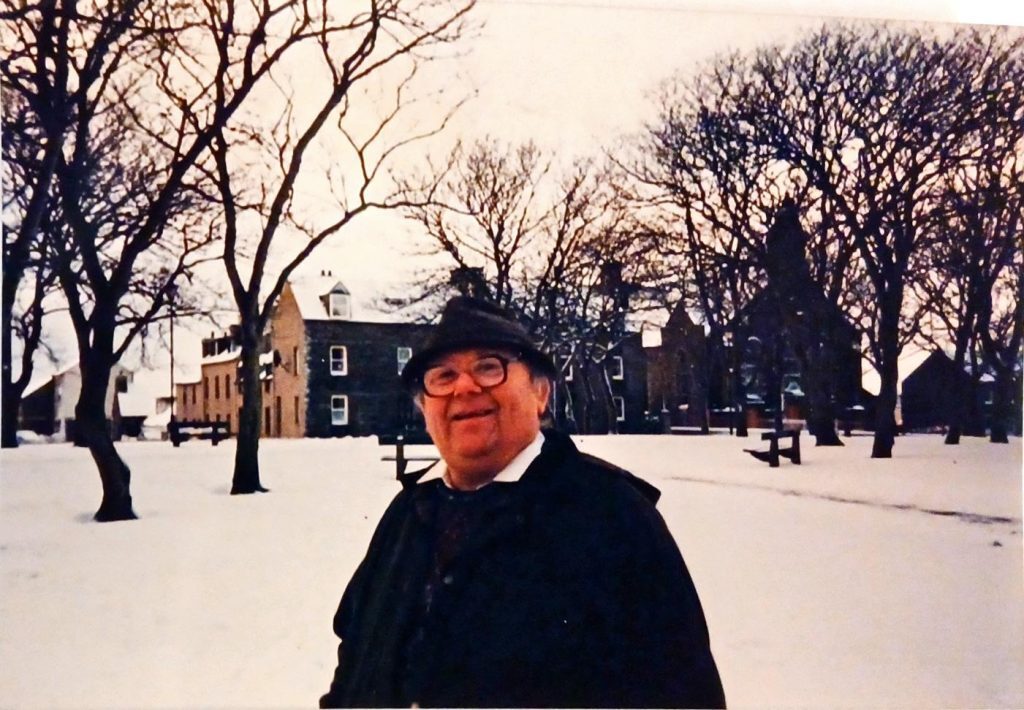
Snow-covered open area with several leafless trees and stone buildings in the background. The buildings have chimneys and multiple windows, and wooden benches are scattered across the snowy ground. A person wearing a dark coat stands in the foreground.
Photograph of Iain Sutherland in Wick (SUTH/2/2/1)

References

[1] Iain Sutherland, Whaligoe and Its Steps: A Unique Harbour (2007), p. 14.