



Photograph collections

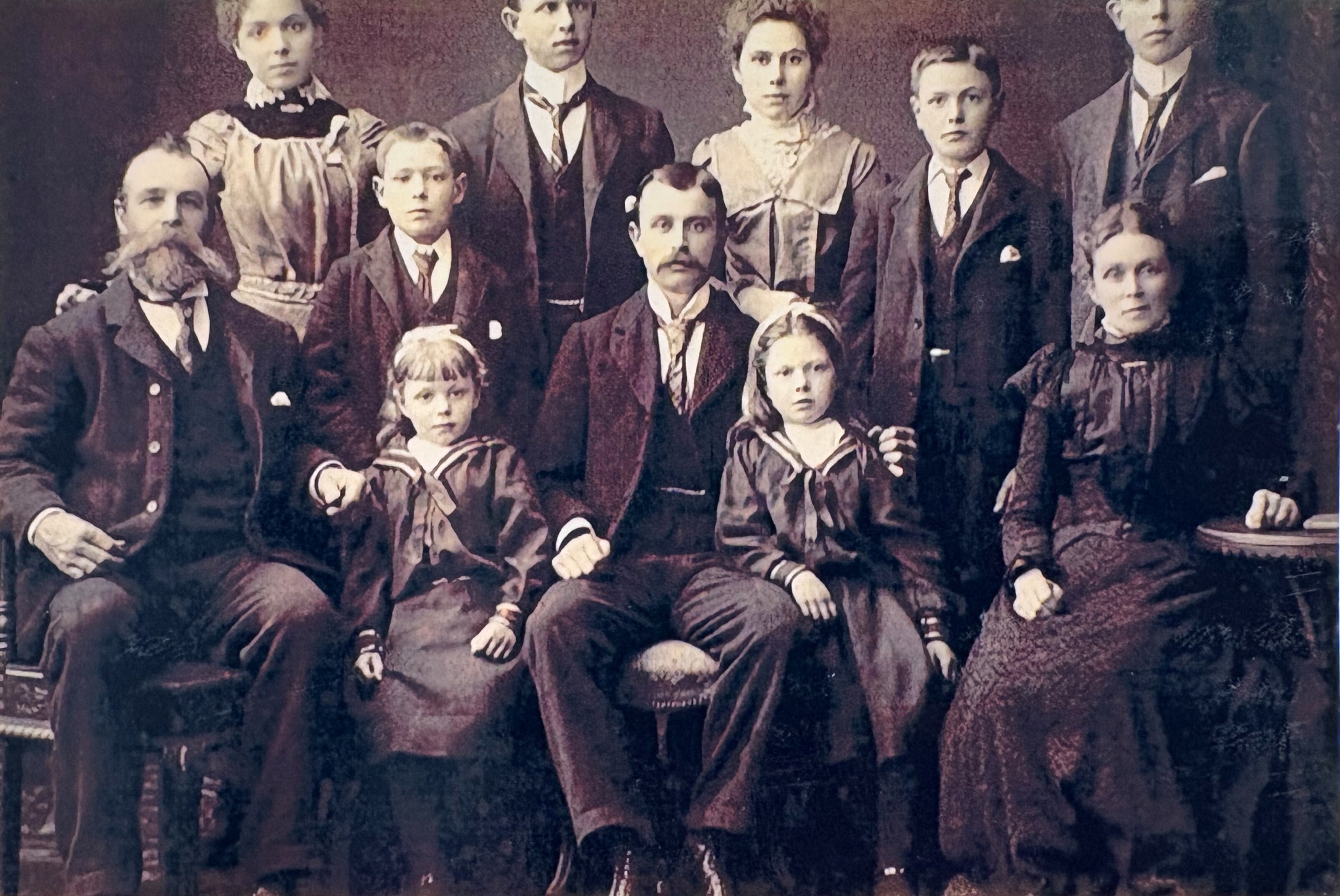
A sepia-toned vintage family portrait featuring a group of ten individuals arranged in two rows. The front row includes four seated figures, with two children in sailor-style outfits positioned in the center. The back row consists of six standing figures dressed in formal Victorian-era clothing, including high-collared dresses and dark suits with waistcoats. The overall setting suggests a studio photograph with a plain backdrop and ornate chairs.
Stories from the archives - Highland Archive Centre
12th Jan 2026
Last update 14th Jan 2026
By Jennifer Johnstone

Archivist at Highland Archive Centre

Read more by Jennifer Johnstone

Each year, the Highland Archive Service receives new material, either transferred from The Highland Council or deposited by members of the public (and which is deemed to have archival significance, be worthy of permanent preservation and relates to the Highlands).

There are several collections that have been gifted to us by people who are unsure what else to do with them. As with all the collections in our care, when they arrive at the Archive Centre, they are initially assessed to see if there are any conservation issues; is the material in a fragile or damaged state? Is there evidence of mould growth or pests? Once our Conservator has given the all clear, the material will then be catalogued, given a unique reference number, housed in suitable archival boxes and folders and stored in one of our temperature and humidity controlled strong rooms. The collections are then safe and ready to be used. We may use them as part of one of our many public engagement activities or they can be requested by members of the public wanting to view them in the Archive Searchroom. These collections can vary in size and content and can contain glimpses of lives that may otherwise have been forgotten, had they not been passed into the care of the Highland Archive Service.

McLean family photographs

One such collection is HCA/D1570 McLean Family Photographs which consists of only 6 photographs. John McLean (1845-1922) worked at the pottery at Dores and lived at Pottery Cottage with his family. The pottery was known as Aldourie Pottery and was established around 1900 by Mary Watts (nee Fraser Tytler) whose family owned Aldourie Castle.  Mary married G F Watts, a well-known 19th century artist and after her marriage, she began to concentrate on art forms including pottery. It appears that the Pottery operated only for a few years, but the building stood until 1950. Dores Parish Hall is now situated on the site.  Pottery Cottage was demolished in the 21st century, prior to 2007 and in its place stands a modern bed and breakfast establishment known as Pottery House. The photographs show the pottery building and members of the McLean family.
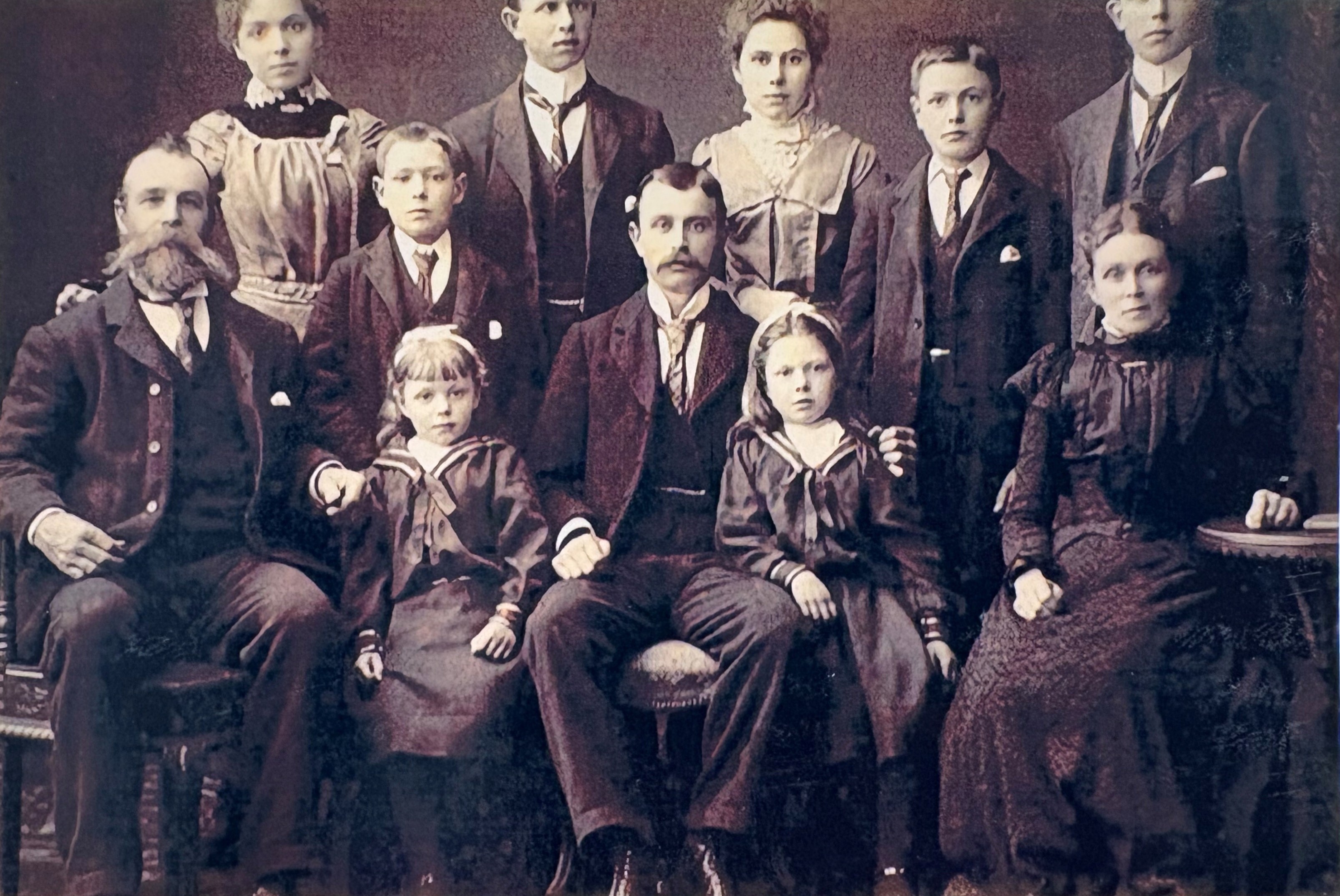
A sepia-toned vintage family portrait featuring a group of ten individuals arranged in two rows. The front row includes four seated figures, with two children in sailor-style outfits positioned in the center. The back row consists of six standing figures dressed in formal Victorian-era clothing, including high-collared dresses and dark suits with waistcoats. The overall setting suggests a studio photograph with a plain backdrop and ornate chairs.

The McLean family

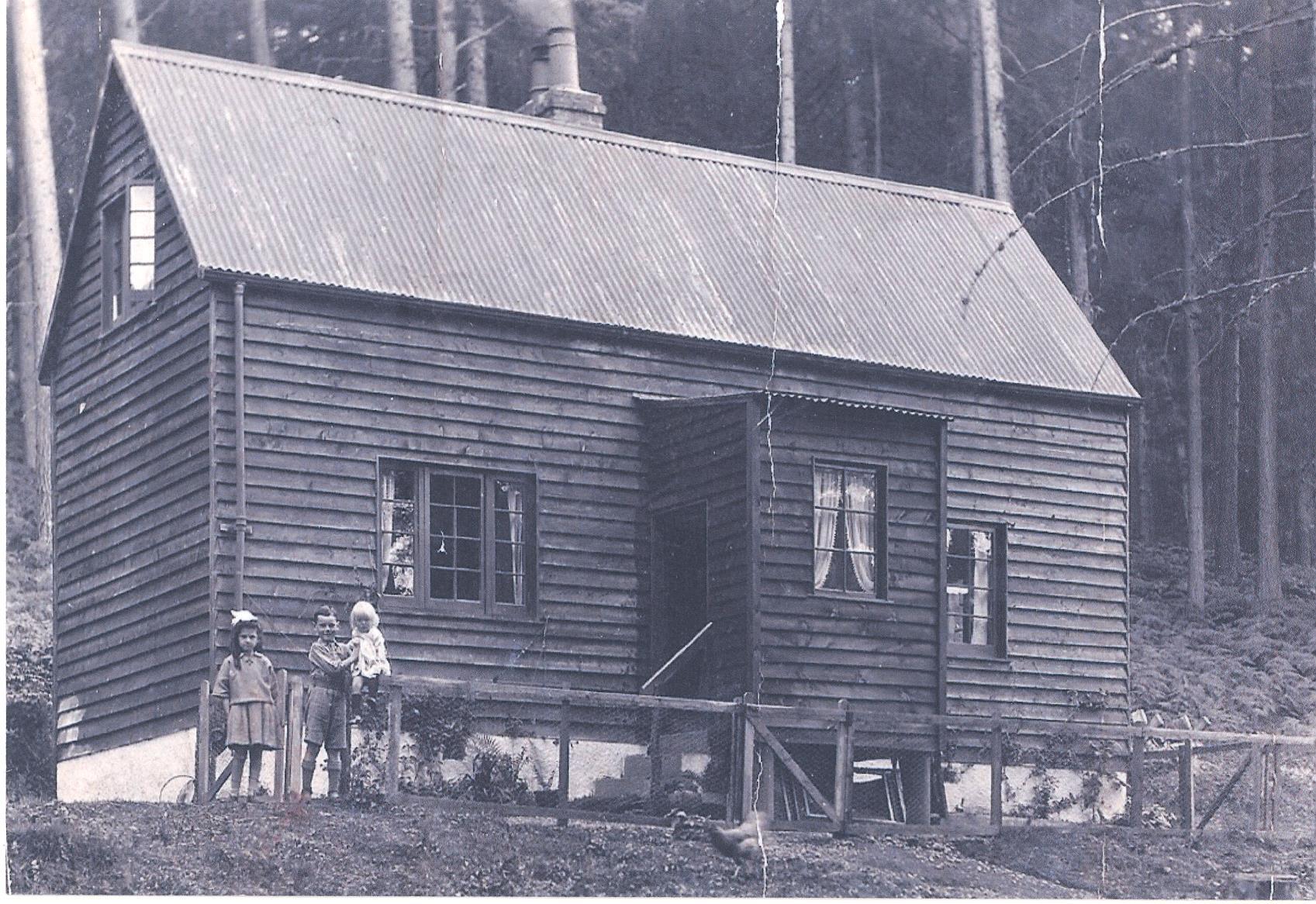
A black-and-white photograph of a small wooden house with a steep, corrugated metal roof and a chimney. The house has two visible windows with curtains and a central doorway, accessed by a short set of steps. A simple wooden fence runs along the front of the house. In front of the fence stand three children, dressed in early 20th-century clothing. The background shows tall trees, suggesting the house is located in a forested or rural area.

A photograph of a dwelling from the McLean Family album
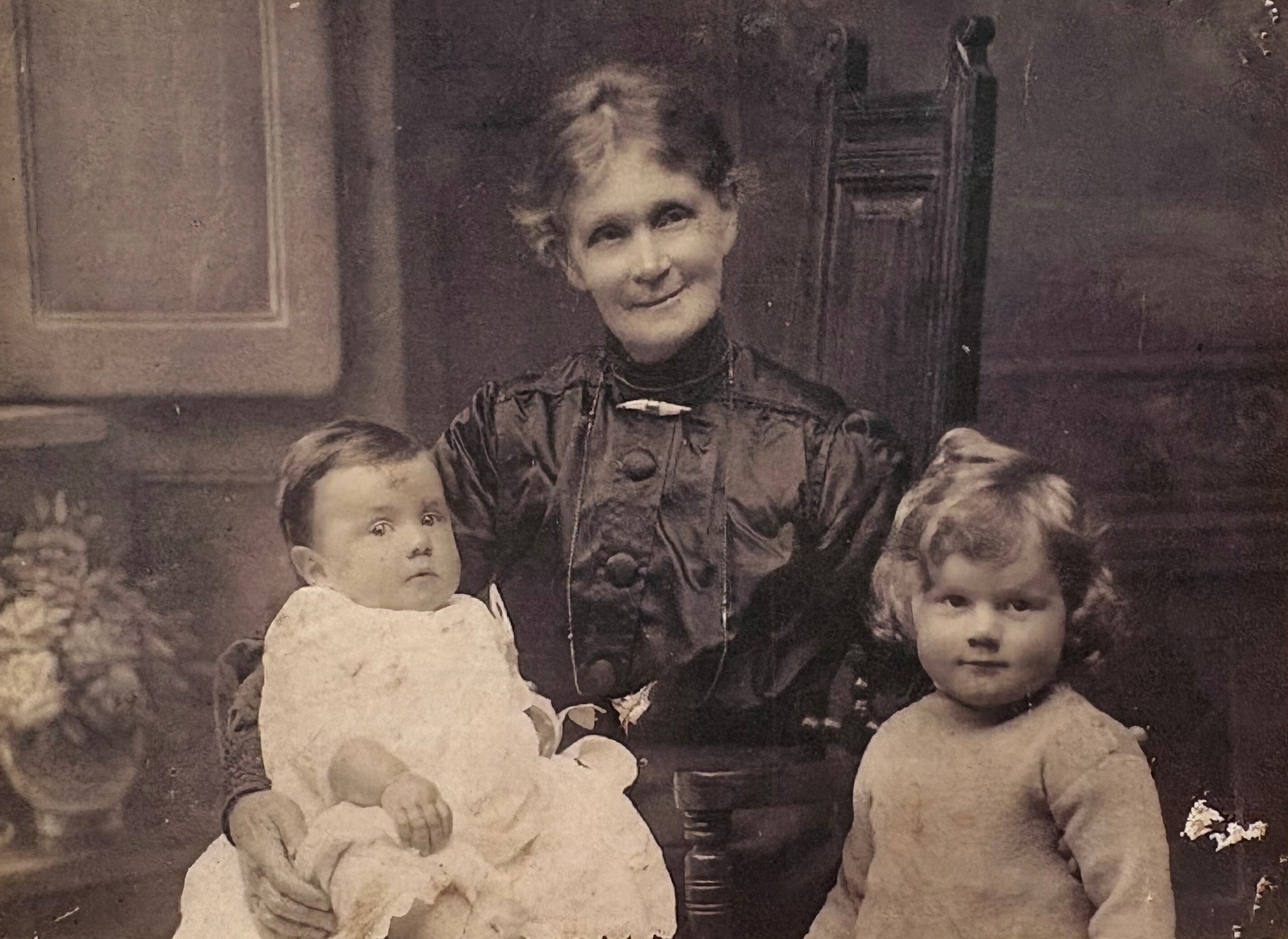
A sepia-toned vintage photograph showing three individuals posed indoors. The central figure is seated on a wooden chair with a tall, ornate backrest, wearing a dark, high-necked dress with decorative buttons and a bow at the collar. On the left, a small child dressed in a long, white gown is sitting on the lap of the central figure. On the right, another child stands, wearing a light-colored outfit with long sleeves. The background includes a floral arrangement and a paneled wall, suggesting a formal studio setting.

Mary Ann Mc Lean with two children, c.1915

With the McLean Family Photographs we know exactly where they came from and what and who they are photographs of, but this is not always the case with every item that is deposited with us.

J. Anderson Photograph Album

Another photographic collection, J. Anderson Photograph Album (HCA/D/1560), consists of one album dated around the late 19th to early 20th centuries. The album was in the possession of the depositor's parents, but it was unknown how they came to have it; it was believed to have been bought at auction, but where and by whom? This means, that little is known about the contents of the album or who the individuals photographed are. The only clue we have is a handwritten ‘J. Anderson’ on the inside cover. The description for the album reads ‘Photograph album of Highland scenes, events and people, late 19th early 20th Centuries’.
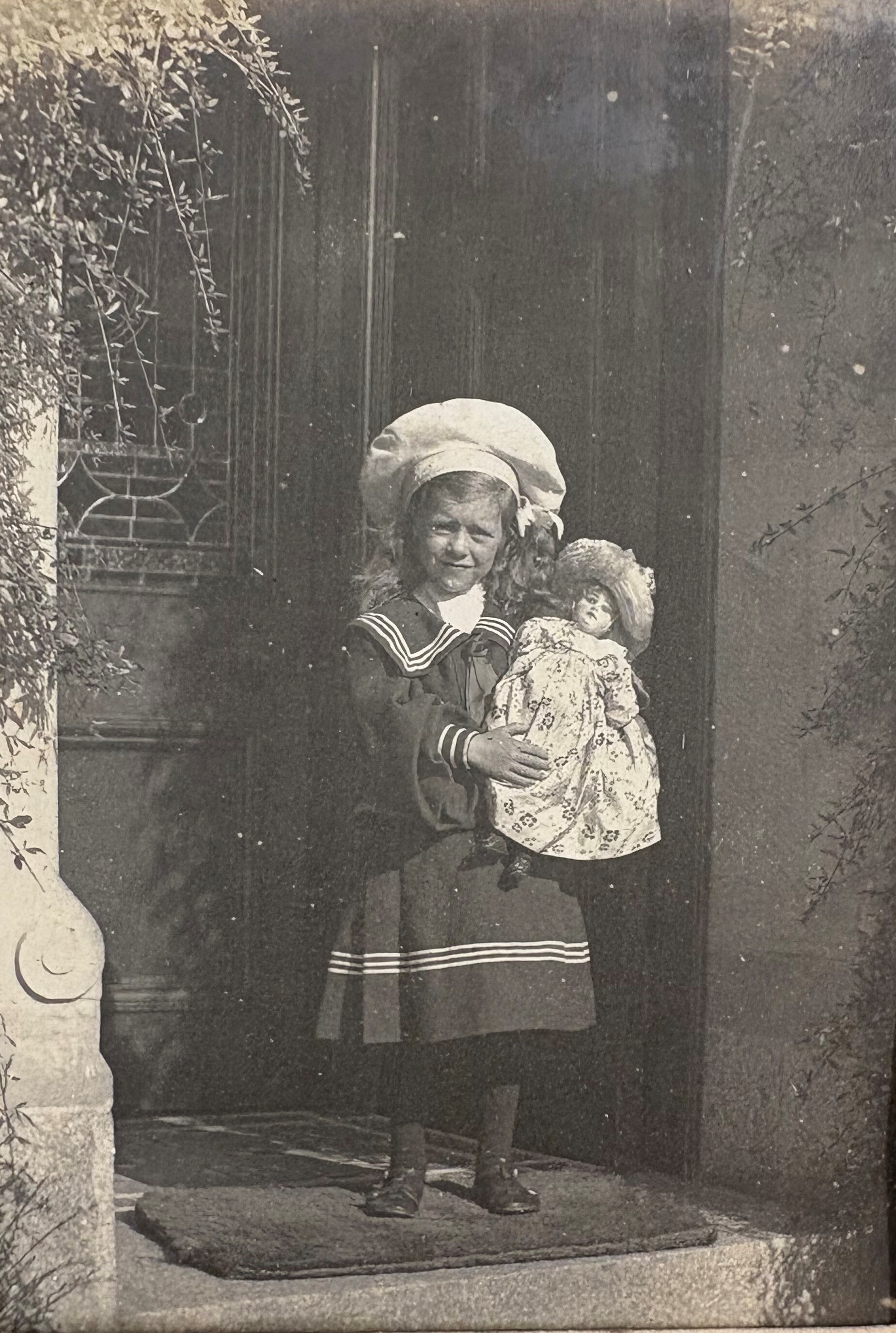
A vintage black-and-white photograph of a child standing in a doorway holding a large doll dressed in a patterned gown and bonnet. The child is wearing a sailor-style outfit with a wide-brimmed hat, dark stockings, and shoes. Decorative foliage frames the doorway on the left side, and part of a carved stone column is visible.

From the J. Anderson photograph album
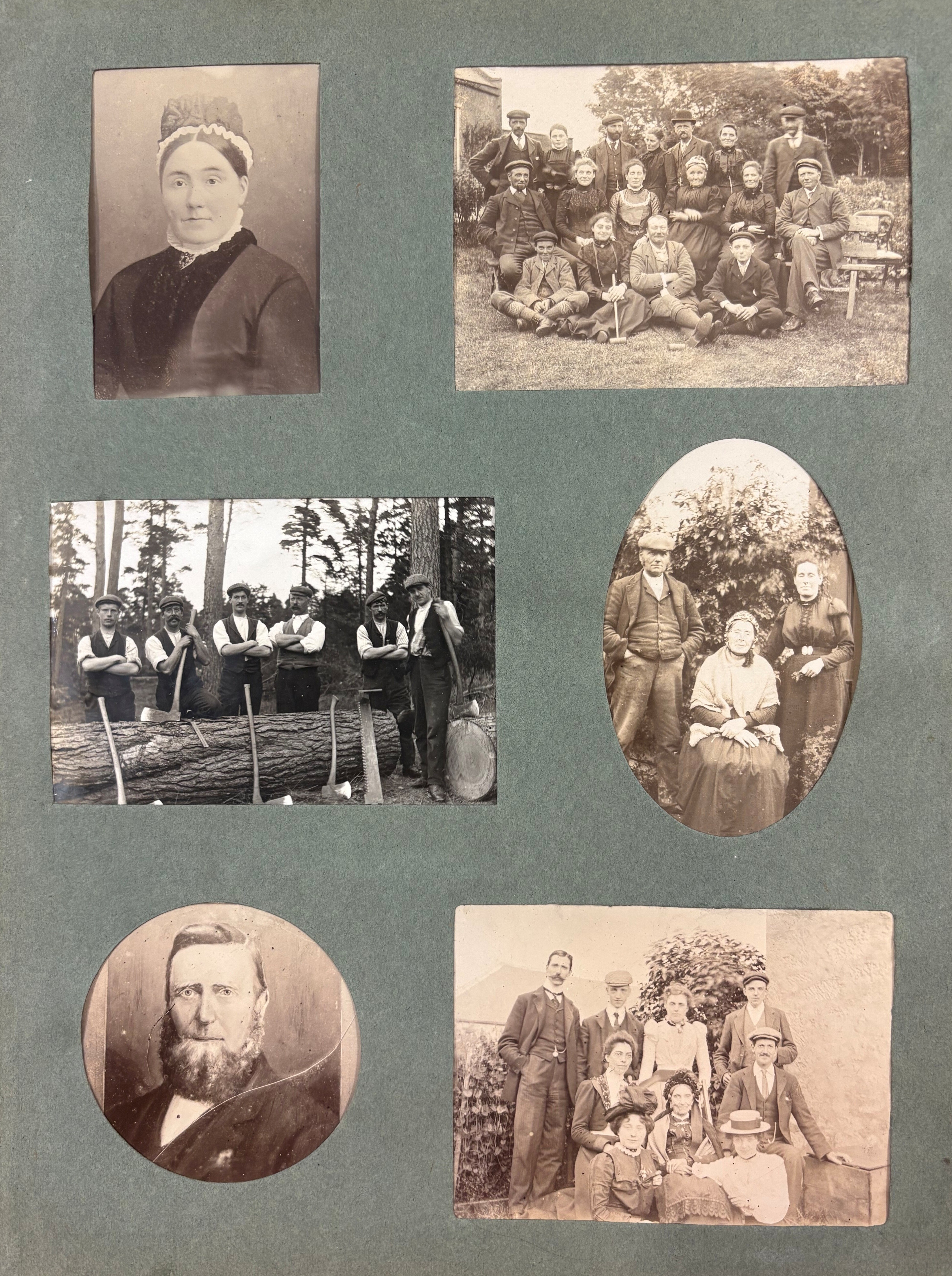
A scrapbook page featuring five black-and-white photographs arranged on a green background. The images include: a rectangular portrait of a person wearing a dark dress with a decorative collar; a group photo of about fifteen people seated and standing outdoors, some holding walking sticks; a photo of six individuals leaning on a large felled tree trunk with axes resting against it, suggesting logging work; an oval photo of three people outdoors, two standing and one seated, dressed in formal clothing; and a rectangular group portrait of ten people posed in front of a hedge, with some seated and others standing.

From the J. Anderson photograph album
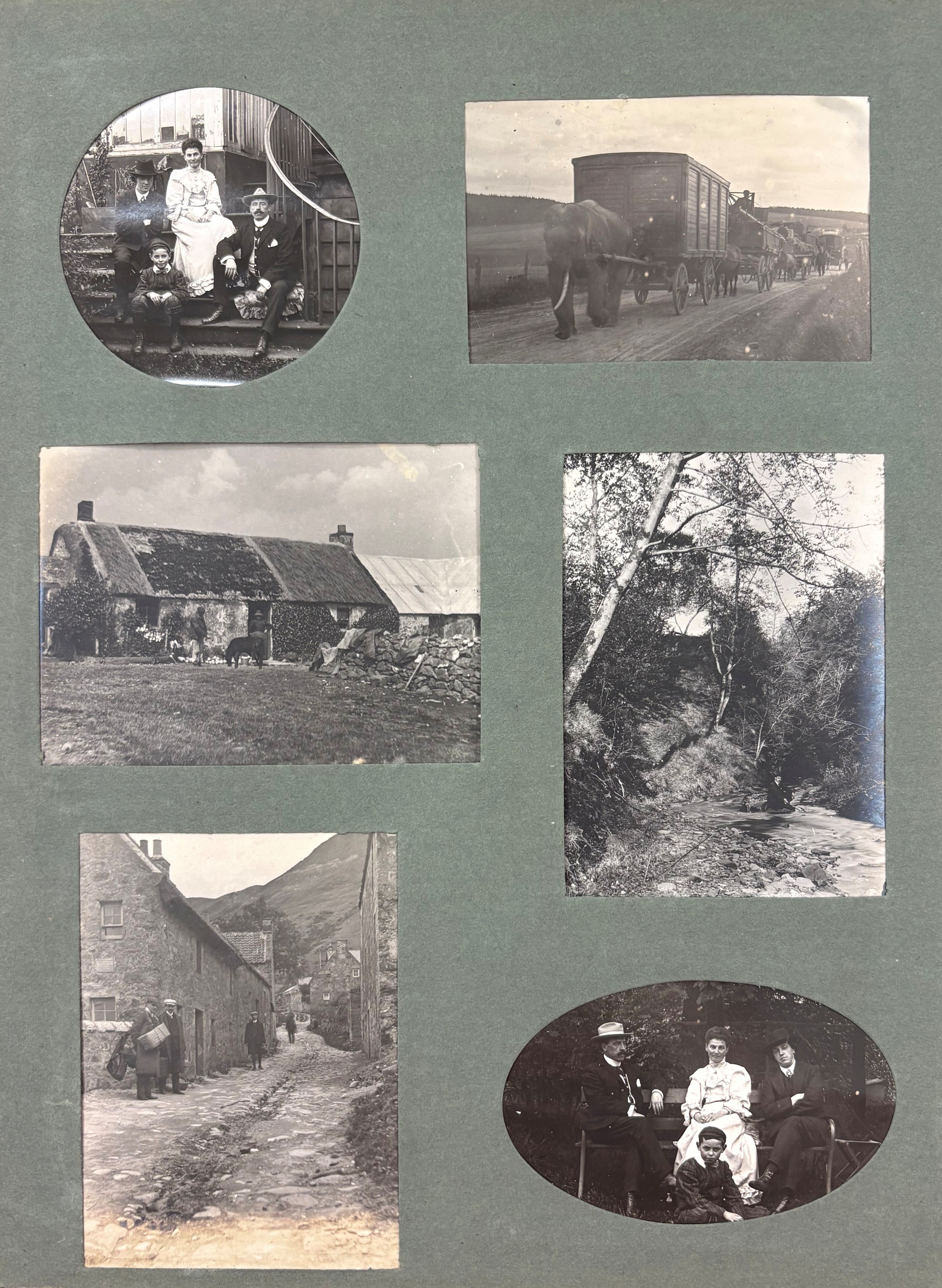
A scrapbook page featuring six black-and-white photographs arranged on a green background. The images include: a circular photo of three people seated on outdoor steps, dressed in formal clothing; a rectangular photo of a horse-drawn wagon train carrying large containers along a dirt road; a photo of a stone cottage with a thatched roof and a small flock of sheep in front; a photo of a narrow cobblestone street lined with stone buildings, with several people walking along it; a photo of a wooded stream with trees arching over the water; and an oval photo of three people seated outdoors, wearing formal attire and hats.

From the J. Anderson photograph album
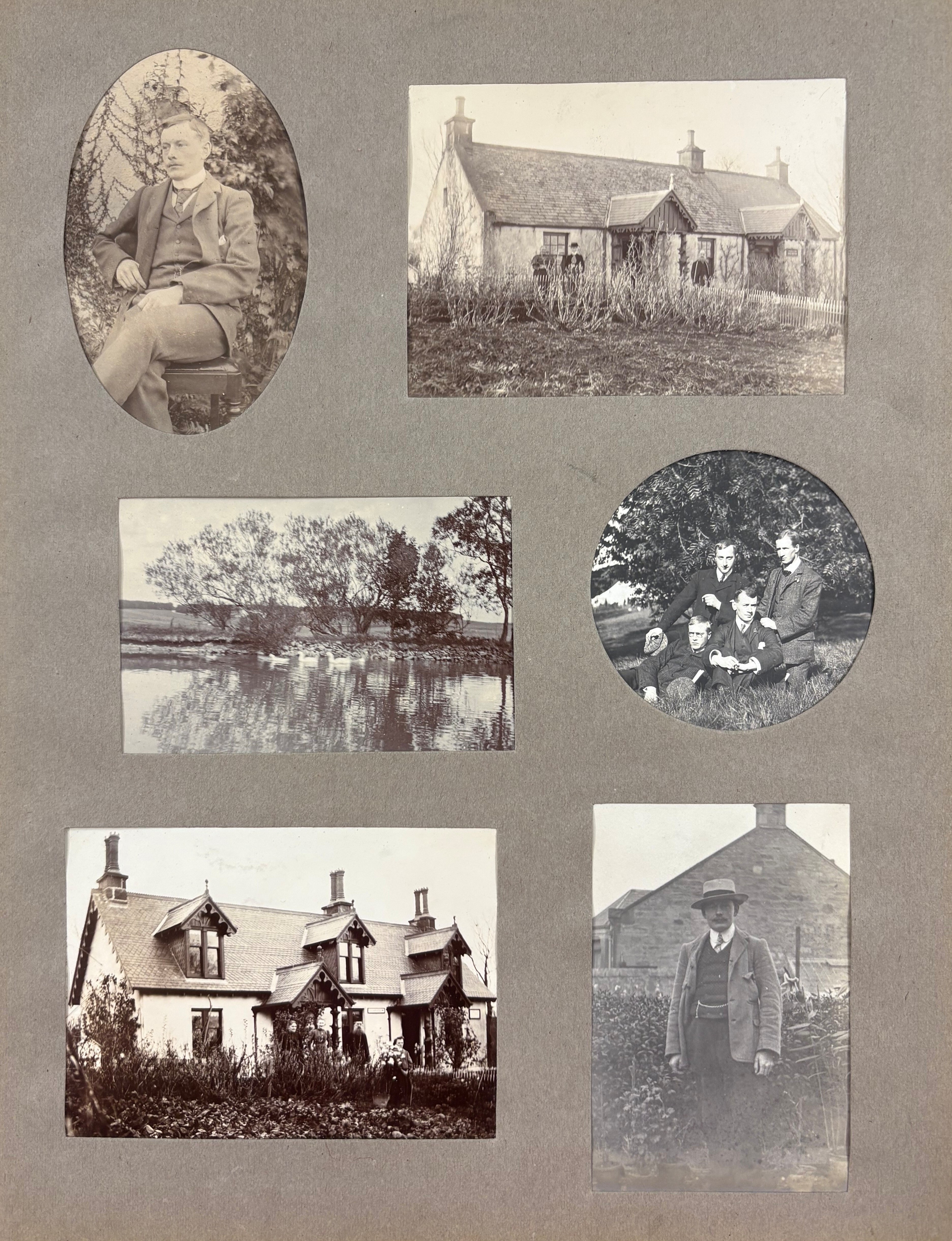
A scrapbook page featuring six black-and-white photographs arranged on a grey background. The images include: an oval portrait of a person seated on a wooden chair wearing a formal suit; a rectangular photo of a stone cottage with a pitched roof surrounded by tall grass; a scenic view of a calm river with trees reflected in the water; a circular photo of a group of five people sitting outdoors under a tree; a photo of a two-story house with dormer windows and a garden in front; and a rectangular photo of a person standing outside near a stone building, dressed in a jacket and hat.

From the J. Anderson photograph album
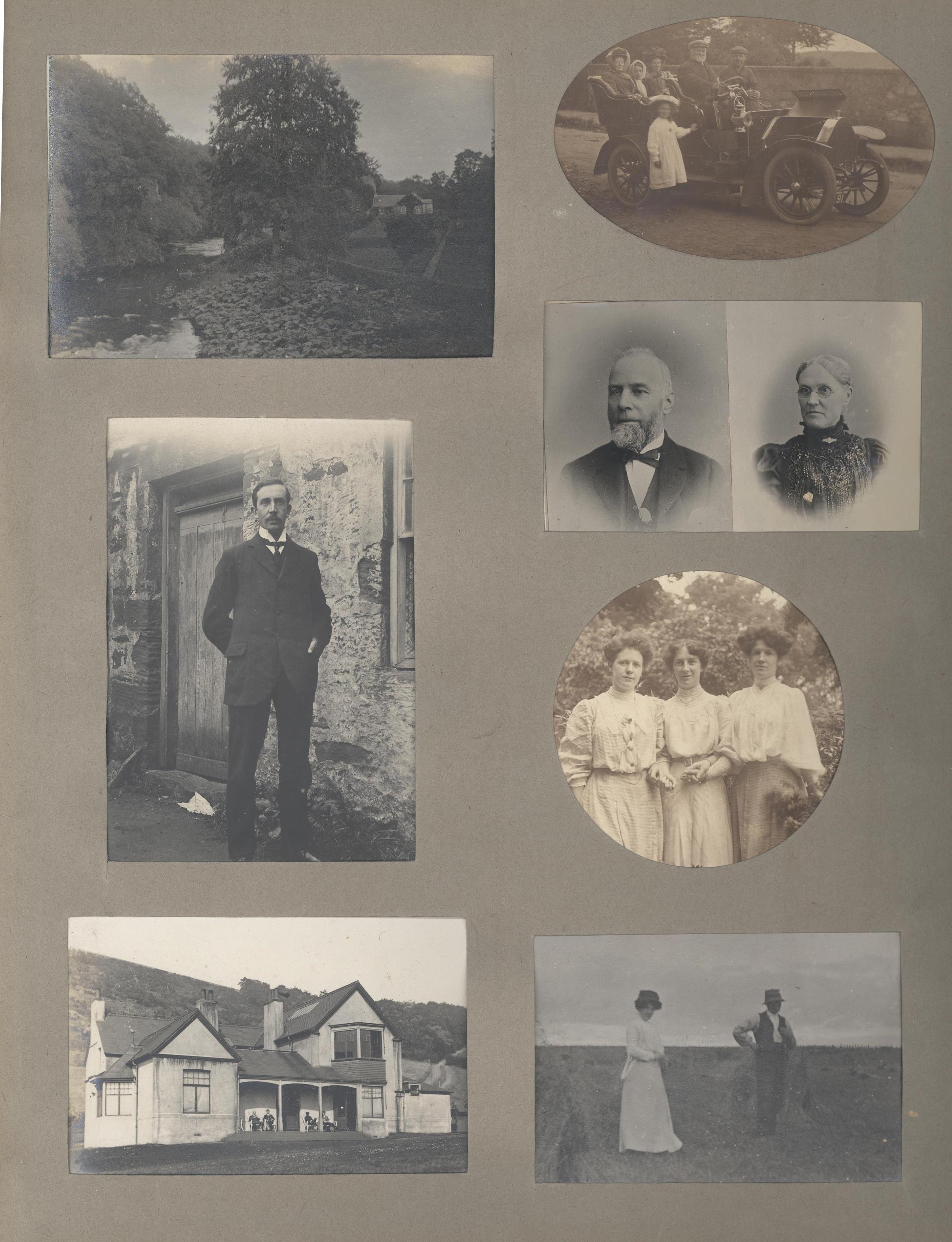
A scrapbook page featuring six black-and-white photographs arranged on a grey background. The images include: a scenic view of a river with trees and a stone wall; an early motor car with several people seated inside and a child standing beside it; a full-length portrait of a person in formal attire standing in front of a stone building; two small head-and-shoulder portraits placed side by side; a circular photo of three people outdoors wearing light-colored dresses; and a rectangular photo of two people standing on open ground near the coast, with one wearing a hat. At the bottom left is a photo of a large house with a veranda set against a hillside.

From the J. Anderson photograph album

Camp Morlich photographs

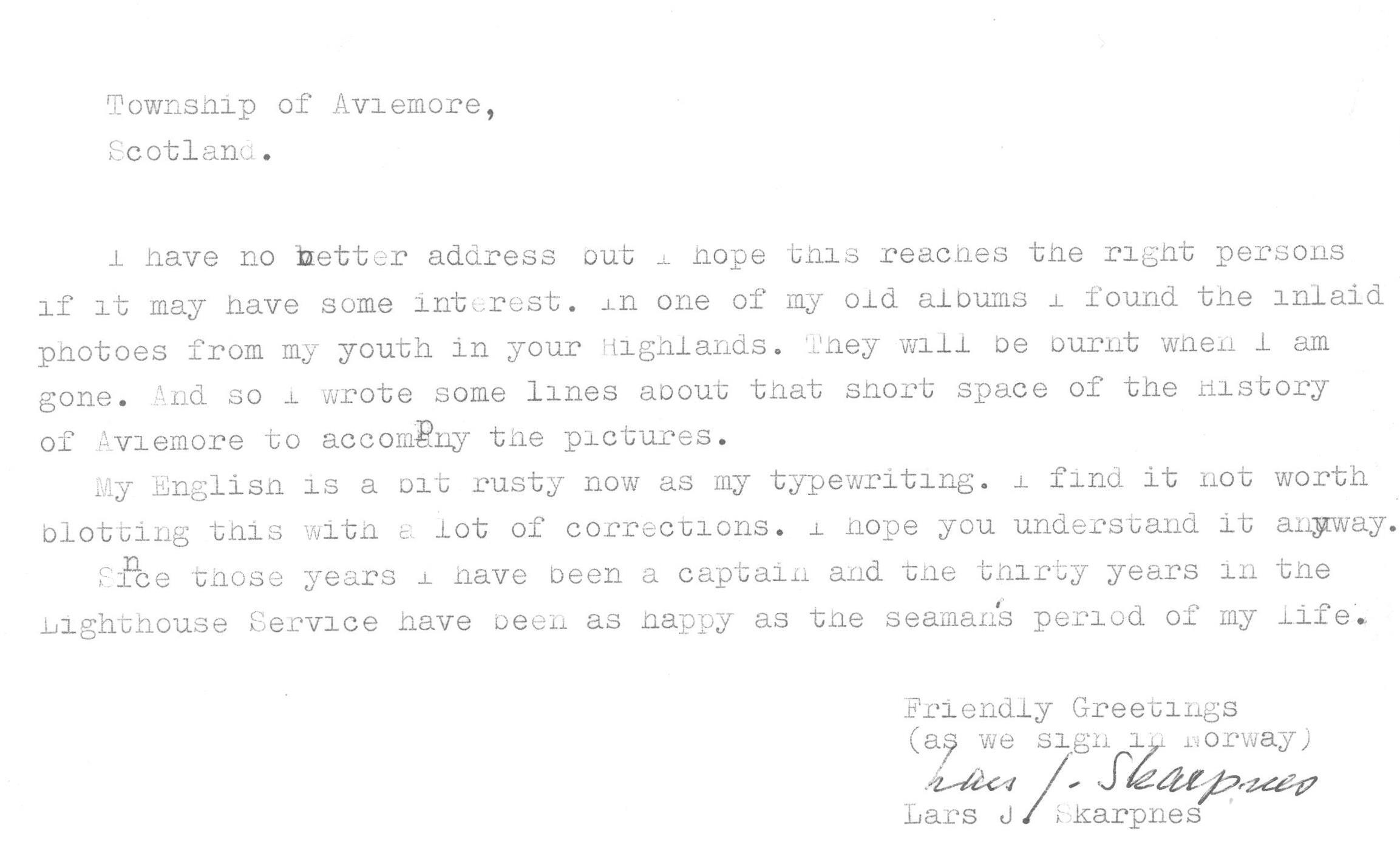
Another much loved and intriguing small collection contains a typed memoir and six photographs. It was originally posted to the ‘Township of Aviemore’ in 1979 before making its way to the Highland Archive Centre. The letter and the memoir were written by Lars J. Skarpnes from Norway and relates to his time working at a timber camp on the shore of Loch Morlich, Aviemore during World War I.

In 1918, Lars Skarpnes was a young sailor, aged 18, from Oslo. On one of his trips, his ship the ‘Sevilla’ was torpedoed on the 25 April whilst sailing in the English Channel en route from Cadiz, Spain to Bergen, Norway. Lars and his fellow survivors made it to shore at Torquay before heading up to London where they ended up in The Scandinavian Sailors Temperance Home which provided them with assistance. It was while he was here that Lars heard that the British Government were hiring Scandinavians to work in the timber industry in Scotland. Having survived two separate torpedo attacks, and not wanting to go back to sea, Lars and three of his fellow crew members signed up in May 1918 as they ‘felt a longing for a holiday ashore’. On arrival in Aviemore and the timber camp, Lars describes the overwhelming sense of chaos and ‘a seemingly planless bustling to and fro of soldiers in worn uniforms. These were Canadian Soldiers who had been wounded in France but now out of the trenches, able to still serve their country in the Highlands of Scotland’.
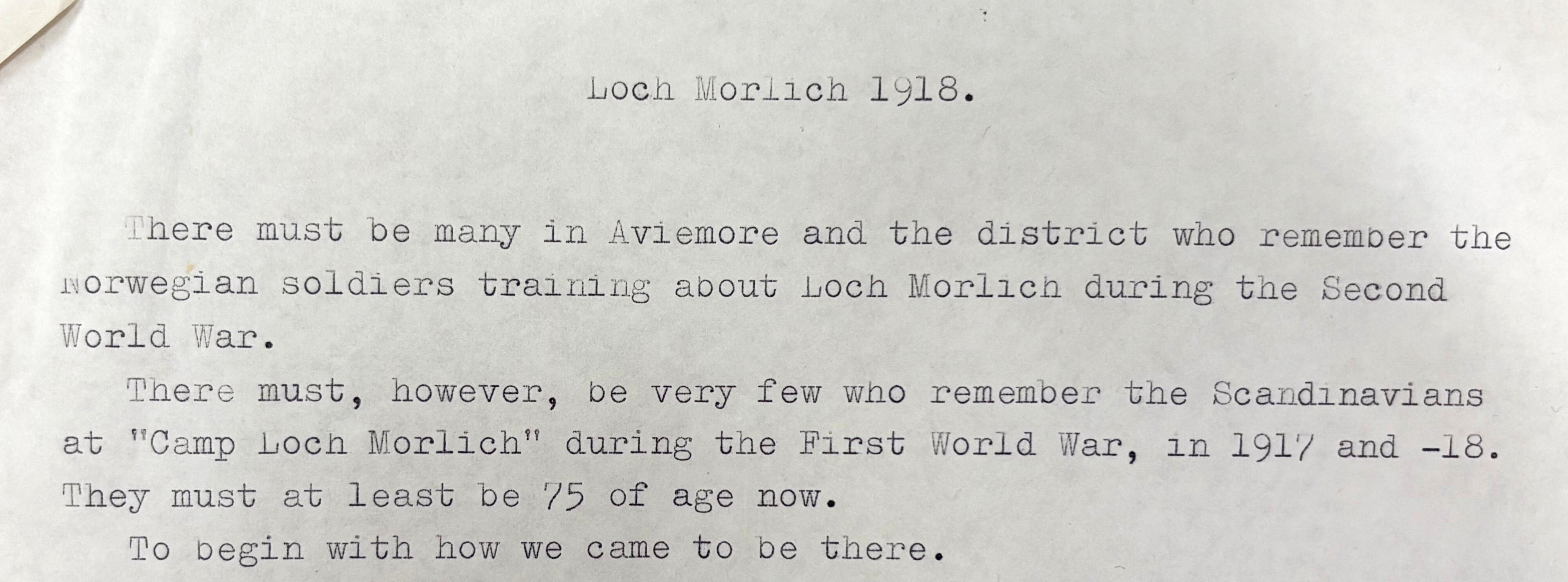
A close-up image of a typed document titled “Loch Morlich 1918.” The text discusses memories of Norwegian soldiers training near Loch Morlich during the Second World War and contrasts this with the fewer people who recall Scandinavian soldiers at “Camp Loch Morlich” during the First World War in 1917 and 1918. It notes that those who remember would now be at least 75 years old and introduces the intention to explain how they came to be there. The document is in black type on white paper, with a slightly aged appearance.
Memories of Norwegian soldiers training near Loch Morlich during the Second World War
A typed letter on white paper with the heading “Township of Aviemore, Scotland.” The text explains that the writer hopes the message reaches the right people and mentions finding old photos from youth in the Highlands, which will be destroyed after the writer is gone. The writer shares a few lines about the history of Aviemore to accompany the pictures and notes that their English and typewriting are rusty, asking for understanding despite corrections. The letter states that since those years, the writer has been a captain and spent thirty years in the Lighthouse Service, describing this period as happy. At the bottom, the letter ends with “Friendly Greetings (as we say in Norway)” followed by a handwritten signature and the typed name Lars J. Skarpnes.
Note sent with donated items by Lars Skarpnes

 In 1917 the British Government established Camp Morlich, on the shores of Loch Morlich, Inverness-shire. Camp Morlich (of around 70-80 workers) consisted of wooden barracks, a YMCA, a pub and shop for cigarettes and general provisions. The workforce came from a range of nationalities including Finnish, Norwegian, Swedish, Argentine, Turkish and Greek and with many different languages spoken Lars commented that ‘there is more difference between a Scot and a Cockney than between the Scandinavian languages’. 
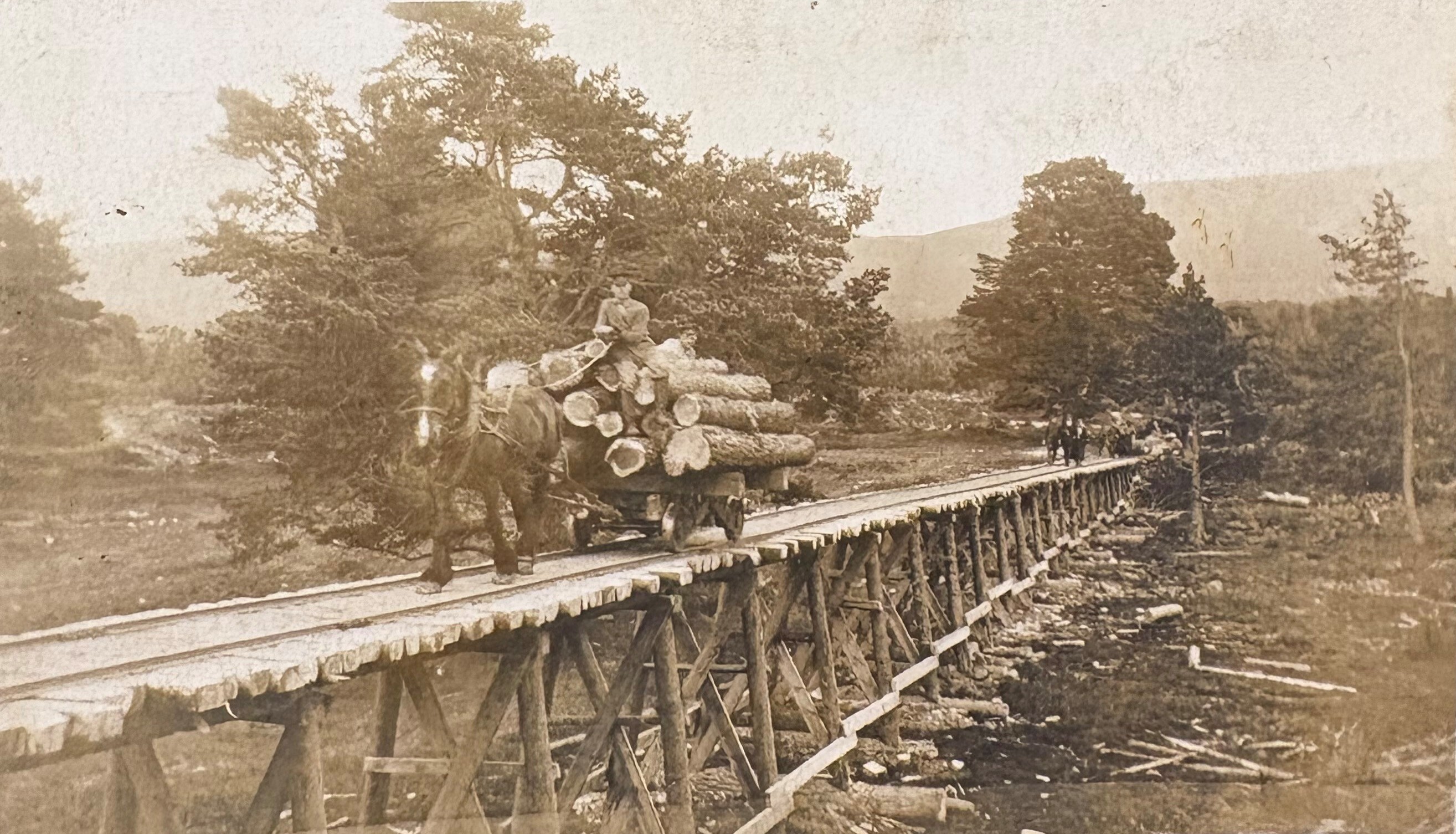
A sepia-toned historical photograph showing a horse pulling a cart loaded with large logs across a wooden trestle bridge. The bridge is constructed from timber beams and spans a rough, forested area with scattered logs on the ground below. A person is seated on top of the log pile on the cart, guiding the horse. In the background, there are trees and distant hills, suggesting a rural or mountainous setting. The image conveys an early 20th-century logging or timber transport scene.

A horse pulling a cart loaded with large logs across a wooden bridge at Camp Morlich, c.1917-1918
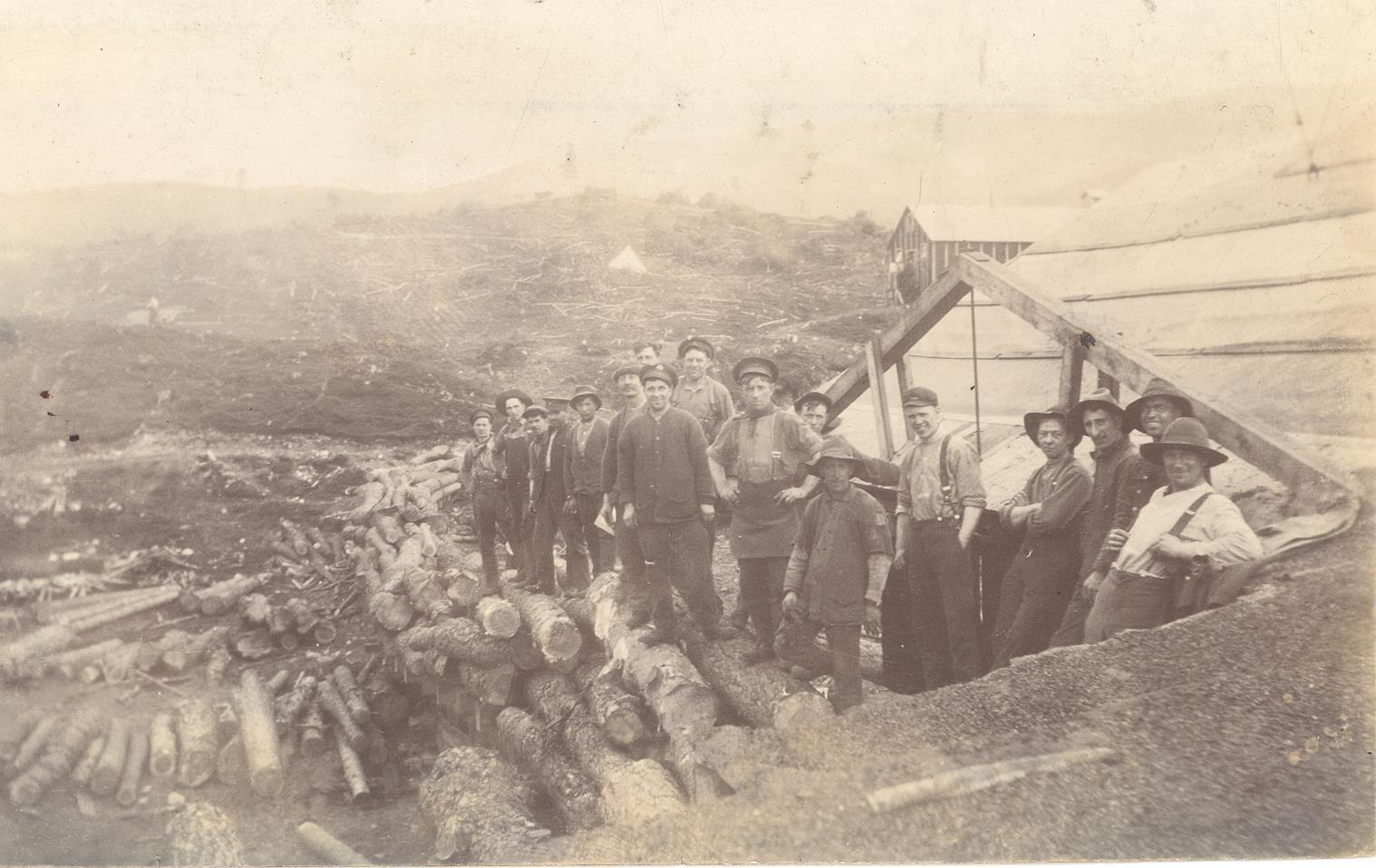
A sepia-toned historical photograph showing a group of people standing outdoors near a wooden structure with a slanted roof. The individuals are dressed in work clothes, including hats and suspenders, suggesting a labor or logging setting. In the foreground, there is a large pile of cut logs arranged along the ground. The background features a rugged, hilly landscape with sparse vegetation and a tent visible in the distance, indicating a remote or rural location. The overall scene conveys a work camp or construction site from an earlier era.

Soldiers at Camp Morlich, c.1917-1918
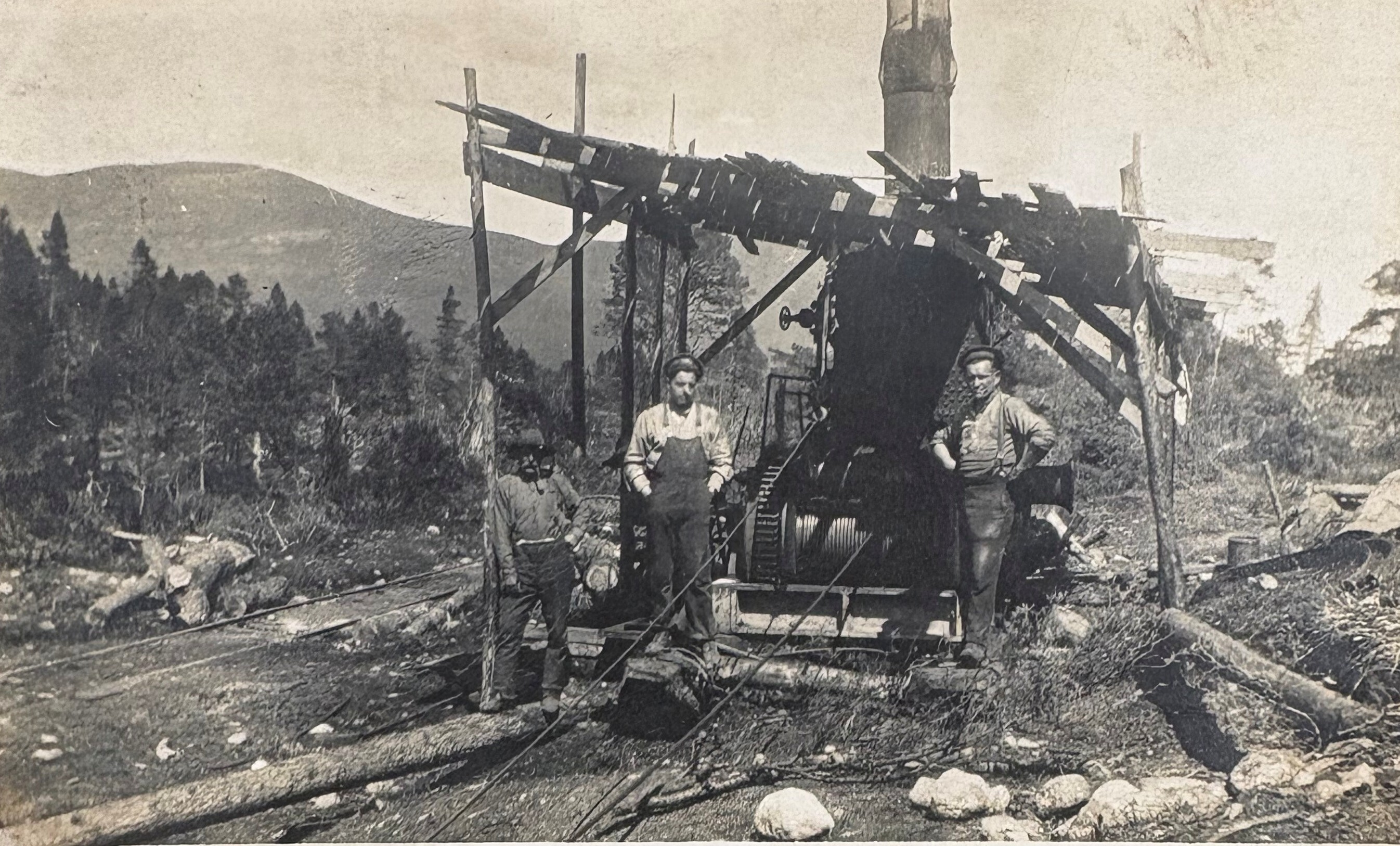
A black-and-white historical photograph showing three individuals standing outdoors beside a large piece of industrial machinery, likely a steam-powered winch or engine, housed under a makeshift wooden shelter with a slanted roof. The machinery has a prominent cylindrical component and a tall chimney extending upward. The ground is rough and scattered with logs, ropes, and stones, suggesting a logging or forestry operation. In the background, there are trees and rolling hills, indicating a remote, mountainous location. The individuals are dressed in work clothes typical of the early 20th century.

Soldiers at Camp Morlich operating machinery, c.1917-1918

On the 2 November 1918, Lars and his fellow crew mates began their journey home. It is not clear where he went initially but the letter he sent in 1979 came from Norway and the only clue as to his life after leaving Aviemore was in the final line of his letter where he mentions that thirty years in the Lighthouse Service were as happy as his time as a sailor.

Material is being handed over to the care of the Highland Archive Centre every week and any material we receive, if it relates to the life of Highland society, will be cared for and looked after for future generations. Discover how to add material to our collections for future generations here or contact us directly. 

Contact us

To discuss donating archival material to Highland Archive Centre contact us at

Donate to our Archives

The Archive Service preserves, conserves and makes accessible over 700 years of Highland history. There is no charge to visit our Archive Centres and access the collections we hold, but High Life Highland is a charity and we rely on your donations.