



Catriona and Mairead Macdonald Collection

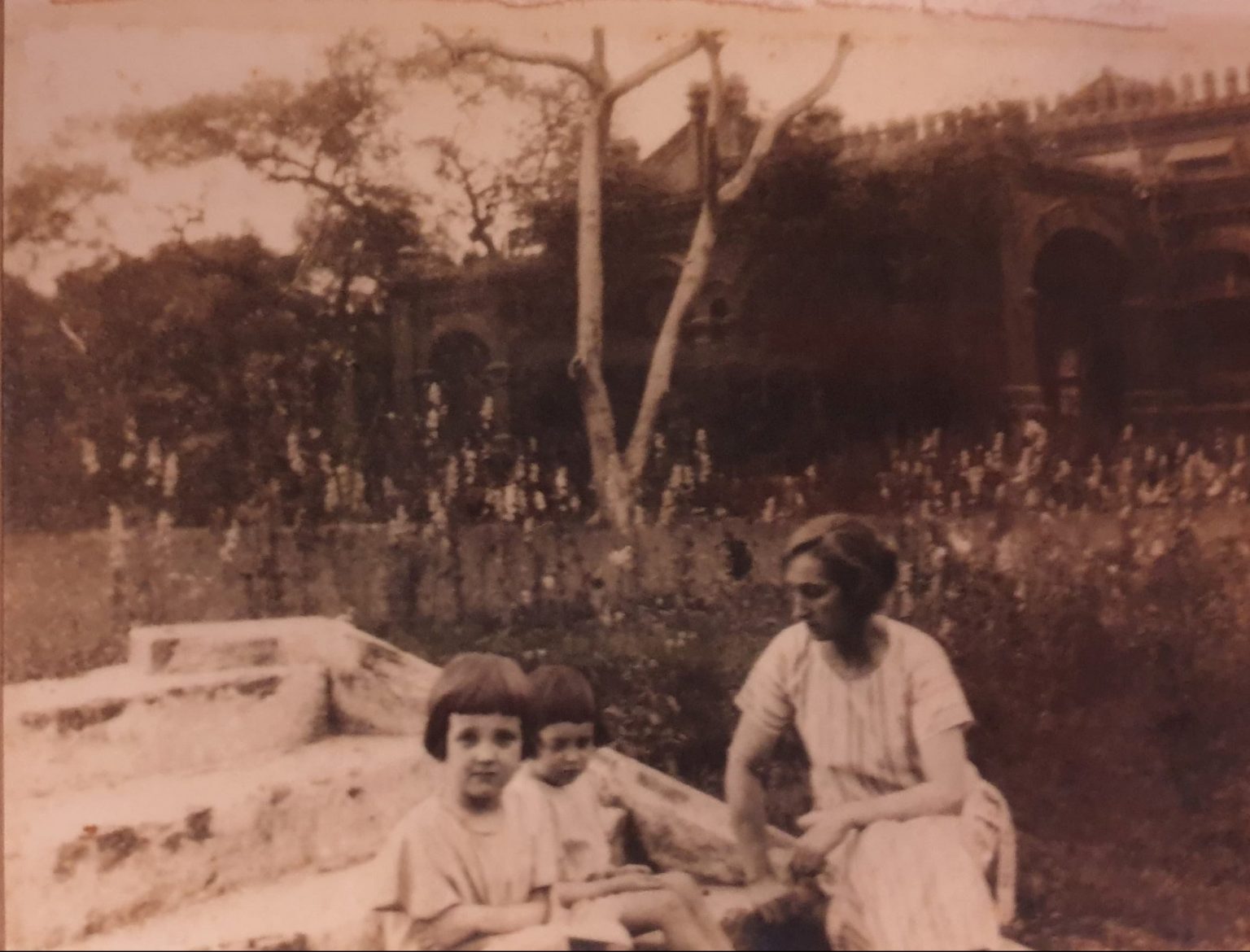
A sepia-toned photograph showing three people sitting outdoors on a stone structure in a garden. Two children are seated on the steps, and an adult is sitting beside them on the ground. Behind them is a large building with arched doorways and decorative architectural details, partially obscured by trees and tall flowering plants. A bare tree trunk stands prominently in the center of the image, adding contrast to the lush vegetation surrounding it. The overall scene suggests an early 20th-century setting in a landscaped garden.
Stories from the archives - Skye and Lochalsh Archive Centre
24th Jun 2022
Last update 22nd Dec 2025
By Catherine MacPhee

Archivist, Skye and Lochalsh Archive Centre

Read more by Catherine MacPhee

This collection is based on the work of Catriona (1920-2006) and Mairead (1921-1990) Macdonald, two sisters whose artistic practices were informed by international travel and Scottish roots. Their parents were from the Isle of Skye: Margaret Macdonald, née Mackinnon, from Staffin and Dugald Macdonald from Portree. Their father was a banker and because of his work, the sisters were born in Karachi which was then part of British-ruled India where they lived until 1929. The photograph above shows Catriona and Mairead with their mother in the garden of their home in Kanpur in 1926 [SL.D188.1.3.7.8]. During their time in Karachi they found an interest in art which would come to be a lifelong occupation for the sisters.
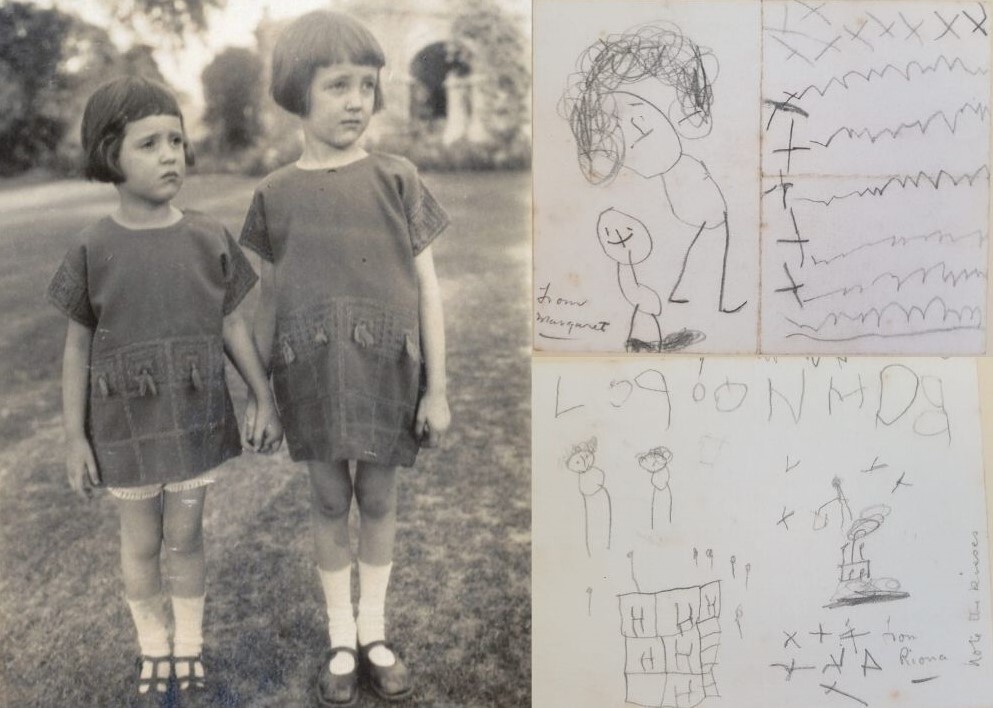
A composite image with three sections. On the left, a black-and-white photograph shows two young girls standing outdoors on grass, holding hands. They are wearing matching short-sleeved dresses with decorative tassels and knee-length socks. In the background, there is a stone structure with an archway and foliage.
On the right, there are four hand-drawn sketches on paper, likely made by children. The drawings include:

A figure with curly hair and another smaller figure, with text that appears to read “From Margaret.”
A page filled with zigzag and cross marks.
A set of stick figures, letters written in reverse or mirrored, and a building-like shape.
A drawing of a person standing on a pedestal or platform, surrounded by crosses and birds, with text that appears to say “At the river.”

The overall image combines a vintage photograph with childhood artwork, suggesting a historical or family archive context.
Catriona and Mairead in Karachi (1920s). Drawings the girls did as children [SL/D188/1/1/9/3]

The family moved to Sudbury in Middlesex from 1929 until 1948. During this time, Catriona and Mairead studied at the Harrow School of Art and were elected as Fellows of the Royal Society for the Encouragement of Arts, Manufacturers and Commerce. The sisters produced a wealth of textile and paper-based art, much of which is held in the Skye and Lochalsh Archive Centre. Their creative processes can be followed from the initial designs through to the finished article. Much of their textile work was hand-printed using the lino-cutting process, where blocks of lino are carved and used in layers to create designs.
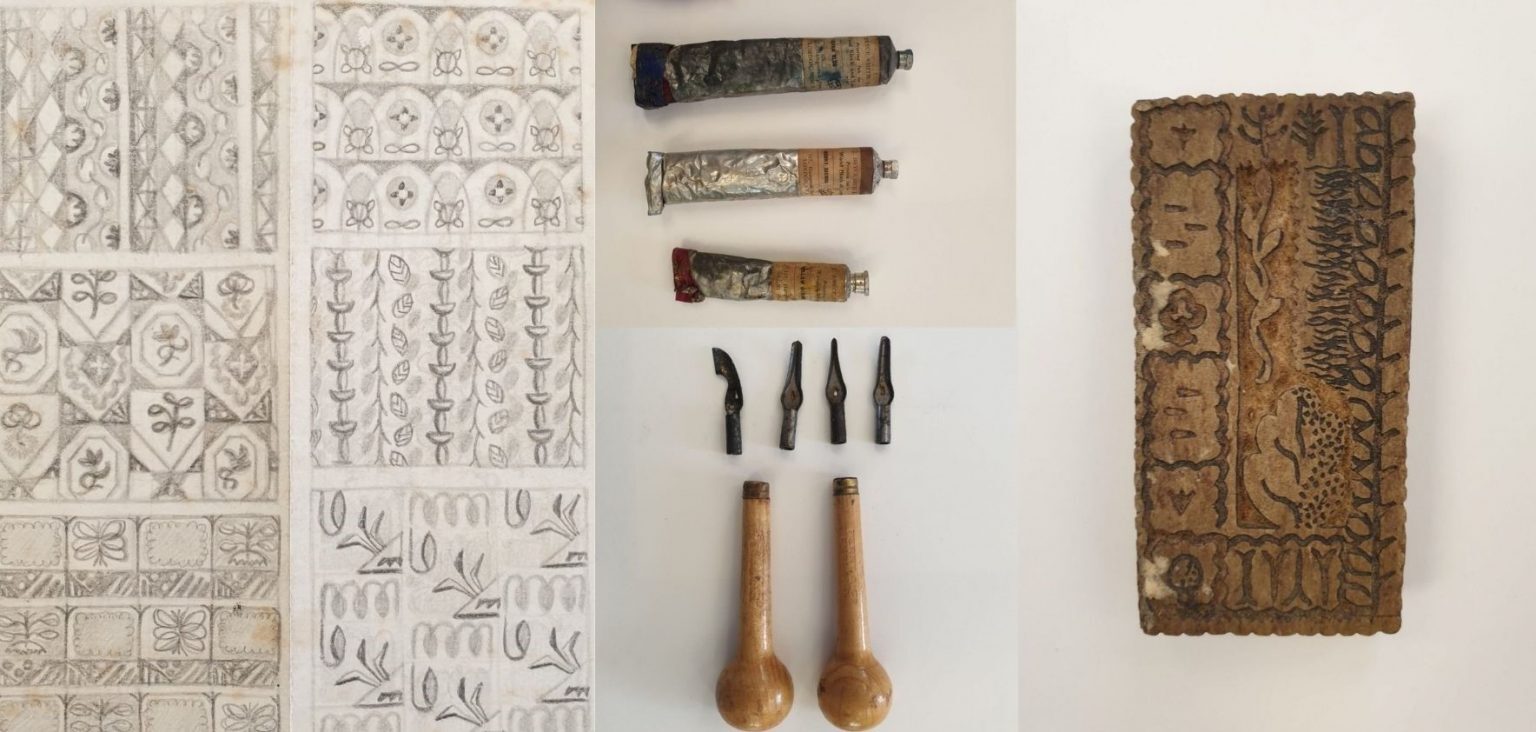
A composite image showing a collection of artistic tools and designs. On the left, there are multiple sheets featuring hand-drawn patterns for printing blocks, including floral motifs, geometric shapes, and decorative borders in pencil or ink. In the center, there are four metal tubes of ink or paint, five interchangeable metal nibs, and two wooden-handled tools arranged neatly. On the right, there is a carved wooden printing block with intricate designs, including floral patterns and a central motif of an animal surrounded by decorative borders. The overall image highlights traditional lino cutting and block printing materials and designs.
Designs for printing blocks [SL/D188/5/4/12], Catriona’s lino cutting tools [SL/D188/7/1/1] and Mairead’s wooden printing block and inks [SL/D118/7/1/2]

The collection contains some of the materials they used and the things they made, including scarves, dresses, and blouses. In some cases, the blocks used in printing can be matched to the finished articles.
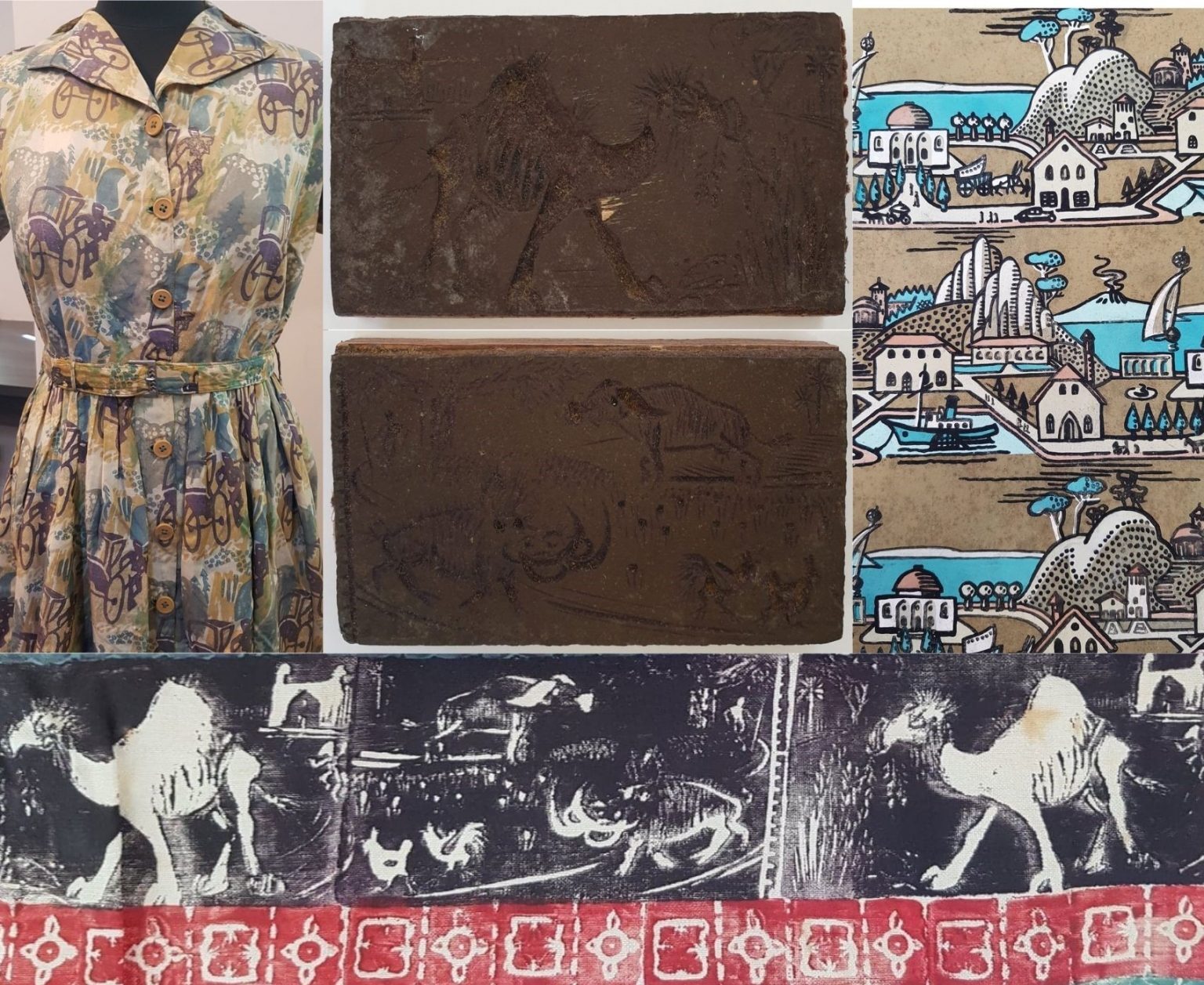
A collage showcasing examples of textile and print work. On the left, there is a patterned dress displayed on a mannequin, featuring a design of stylized carriages in muted tones of blue, purple, and beige. In the center, two rectangular carved printing blocks depict animal figures, including a camel. On the right, there is a piece of fabric with a colorful village scene in blue, white, and brown, showing houses, hills, and boats. Along the bottom, a printed textile strip features white camel motifs and other animals on a dark background with a decorative red border. The overall image highlights traditional block printing and fabric design techniques.
Hand printed dress with rickshaw motif [SL/D188/6/1/1/1]. Printing blocks depicting a camel, chickens, a boar, and a buffalo [SL/D188/7/3/9] that were used to print the scarf [SL/D188/6/1/4/4]. Design for wallpaper or textiles [SL/D188/2/2/26]

After their studies, Catriona and Mairead went on to spend periods of their lives in South Africa (1948-1958) and Malta (1966-1987). Through living abroad, the sisters saw the steady decline of the British Empire first hand: India became independent in 1947, South Africa in 1961, and Malta in 1974. The influence of this can be seen throughout their work, from cartoons exploring political issues of the time to the designs used in the clothing they made.
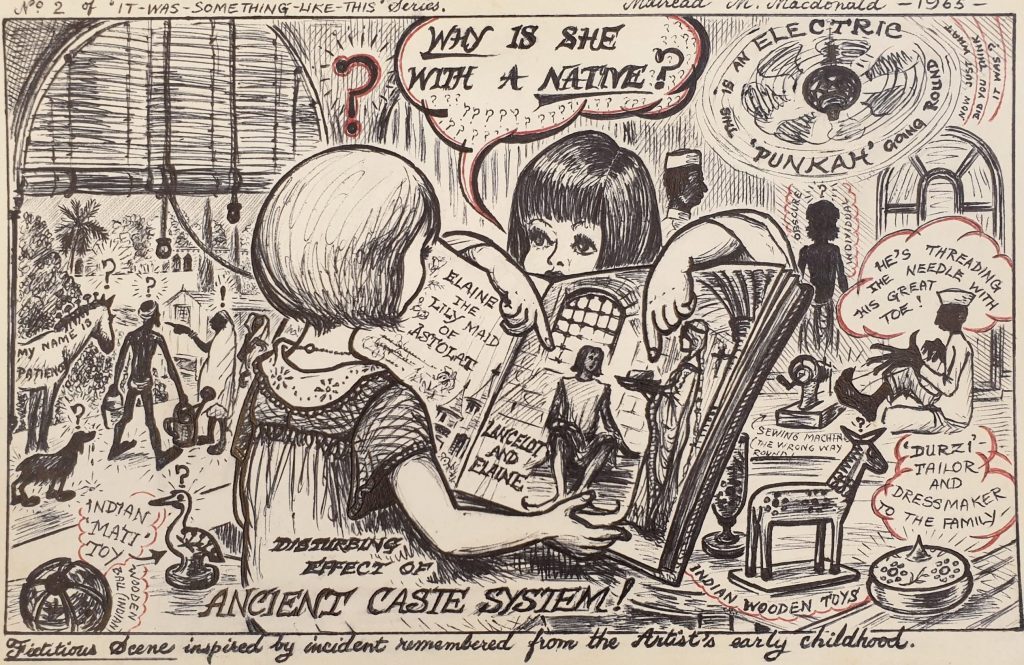
A detailed black-and-white illustration titled “It Was Something Like This” dated 1963, depicting a fictional scene inspired by childhood memories. The central focus is a child looking into a mirror, which reflects another child seated on a chair. Surrounding the mirror are various figures and objects, including people engaged in activities such as sewing and tailoring, and a person carrying water pots. The artwork is filled with handwritten captions and speech bubbles, including phrases like “Why is she with a native?”, “Disturbing effect of ancient caste system!”, and “He’s threading the needle—a great toy!”. Other visible text includes “Indian mat toys”, “My name is Patience”, and “Durzi tailor and dressmaker to the family”. Decorative elements such as an electric punkah fan, wooden toys, and a sewing machine are also illustrated. The composition is dense with cultural references and commentary on social hierarchies.
Cartoon set in India, captioned: “Disturbing effect of ancient caste system! Fictitious scene inspired by incident remembered from the artist’s early childhood”, Mairead Macdonald, 1965. [SL/D188/2/8/26]

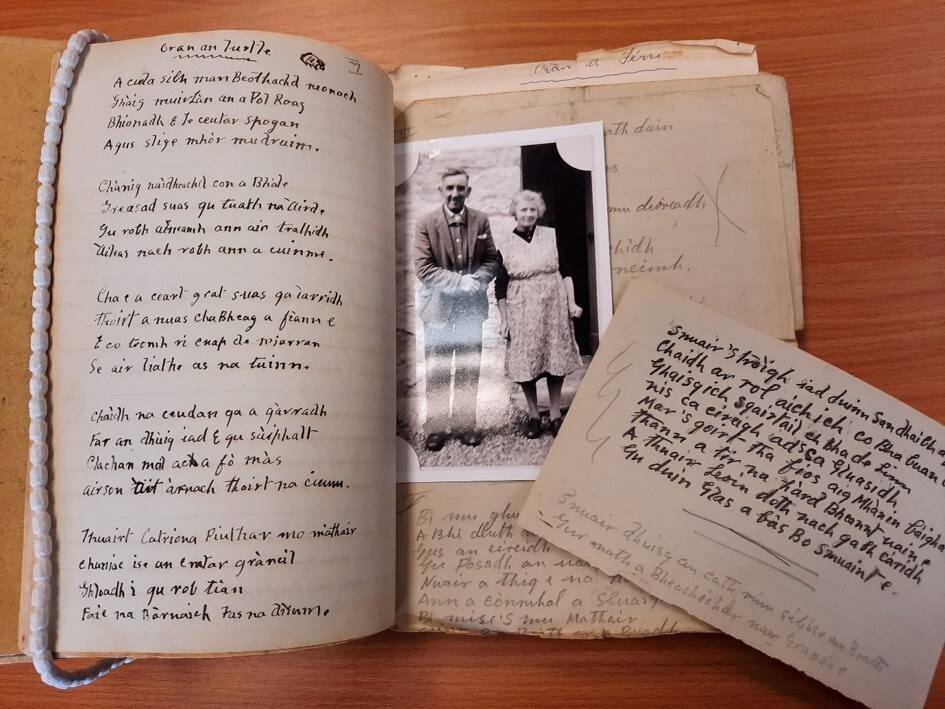
Despite their international childhoods, the sisters had strong links to the Highlands and Islands, and particularly the Isle of Skye, throughout their lives. Their parents taught them Gaelic and they visited often, keeping in close contact with relatives in Uig throughout their lives.
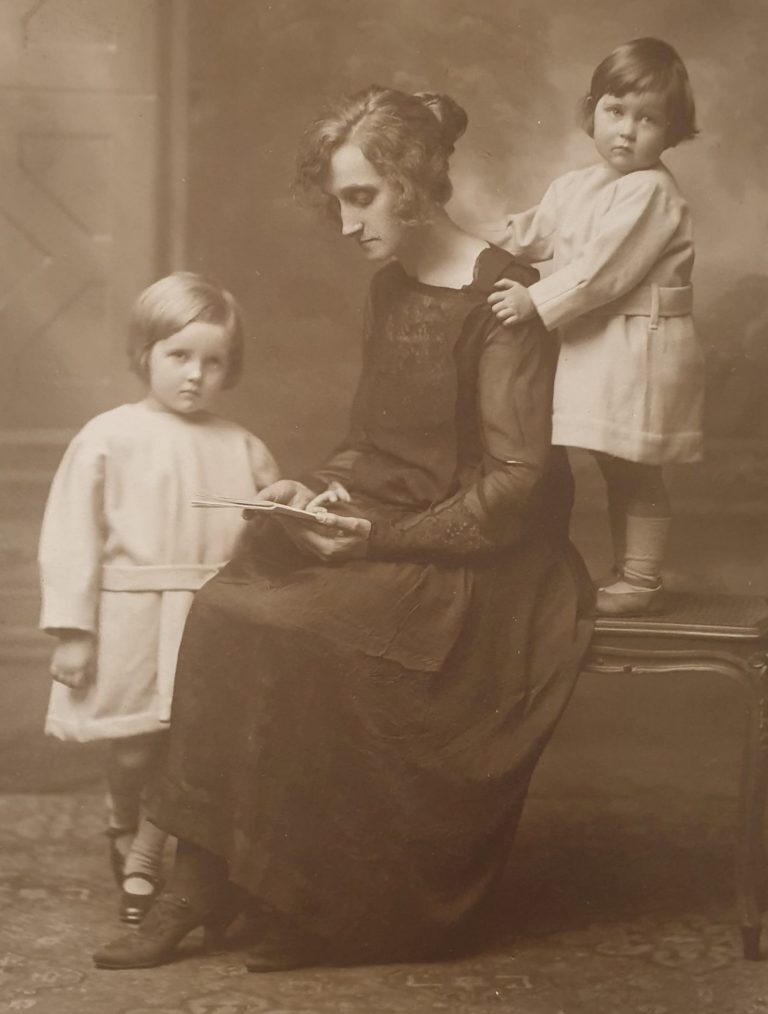
A sepia-toned studio portrait showing an adult seated on a bench holding an open book, with two young children beside them. One child stands to the left wearing a light-colored dress and ankle-strap shoes, while the other stands on the bench to the right, resting a hand on the adult’s shoulder and wearing a similar light outfit with socks and shoes. The adult is dressed in a long dark gown with long sleeves and lace detailing. The background features a painted backdrop and patterned floor, typical of early 20th-century photography.
Portrait of Catriona, Margaret, and Mairead (left to right) taken while on holiday in Inverness from India, 1923 [SL/D188/1/3/1/3]

The archive holds the sisters copy of Dwelly’s Illustrated Gaelic-English dictionary 4th edition. The sisters’ names are inscribed on the book with the year 1941.
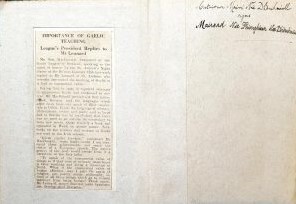
An open book showing two pages. The left page contains a newspaper clipping titled “Importance of Gaelic Teaching” with text discussing language and education. The right page is mostly blank except for handwritten notes at the top, which include names and a date: “Catriona from the Dictionary 1926 Mairead the Macdonalds’ dictionary.” The overall image suggests archival material related to Gaelic language and historical documentation.
The Macdonald sisters dictionary. Ref: SL/D188/1/2/3/4

Their work was heavily influenced by their connections with the Highlands and Islands. For example, Mairead’s “Dream Series” commented on contemporary changes and events in the Highlands and Islands of Scotland. “Dream Series No. 5: Gigglesthwaite Tours” shows a bus tour which is being held up by two Highland cows, with Duntulm Castle, Skye, in the background. The cows, Sòbhrag (Primrose) and Neòinean (Daisy), ask the tourists: “Cò as a h-eirigh sibh?” (“Who did you arise from?”) and “Cò leig a mach sibh?” (“Who let you out?”). 
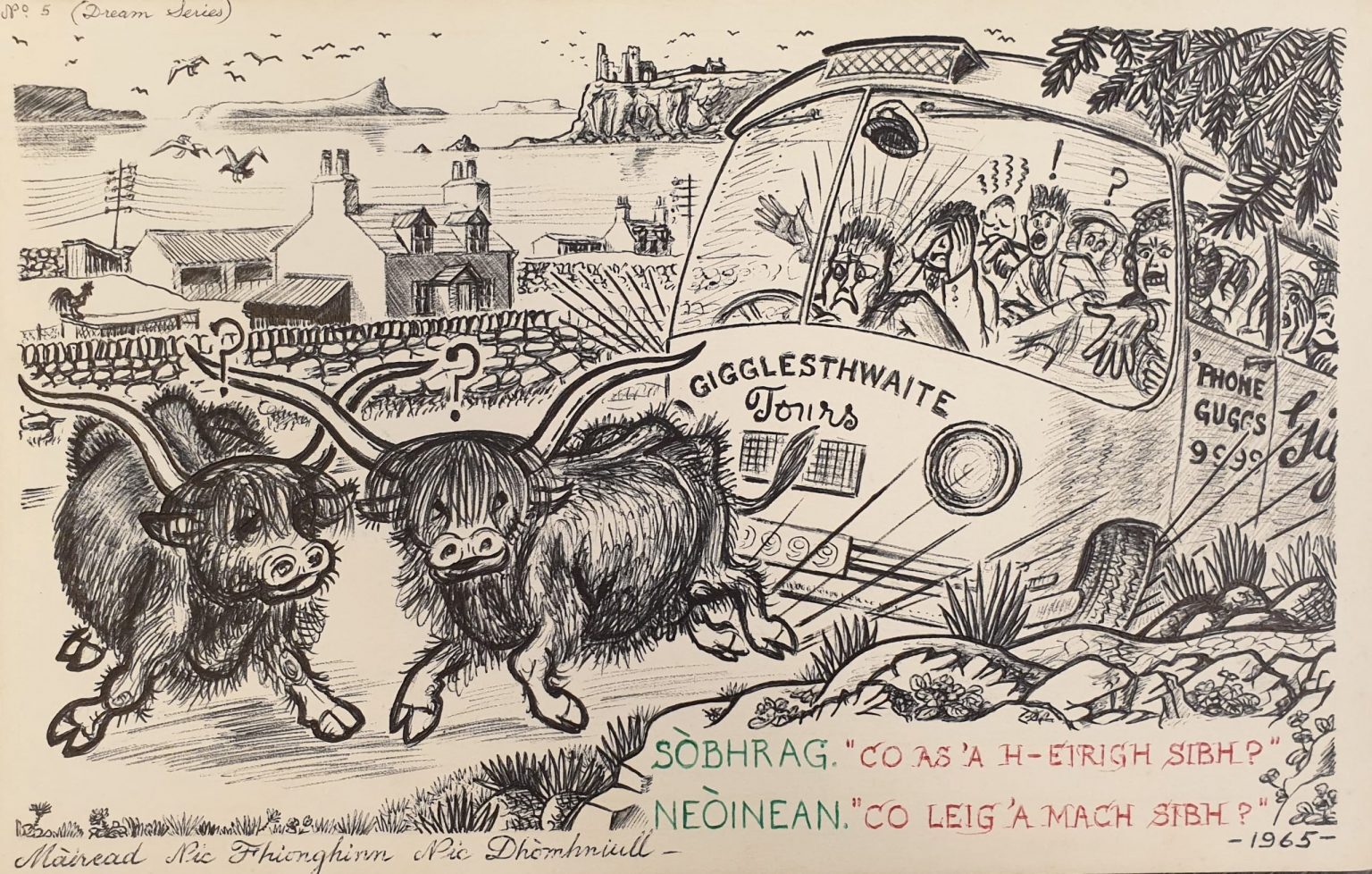
A detailed black-and-white illustration titled “Dream Series No. 5” dated 1965. The scene shows a countryside setting with stone walls, houses, and a distant view of cliffs and the sea. In the foreground, two large Highland cattle with long horns stand on a road, blocking a tour bus labeled “Gigglesthwaite Tours.” Inside the bus, several passengers appear alarmed, with expressive gestures and speech bubbles. The bus also displays a sign reading “Phone Glugs 969.” At the bottom, there is text in Gaelic:
“Sòbhraig: ‘Cò às a h-eiridh sibh?’
Neòinean: ‘Cò leig a-mach sibh?’”
The illustration is filled with humorous details and exaggerated expressions, combining rural imagery with comic-style elements.
“Dream Series No. 5”, Màiread NicFhionghinn NicDhòmhniull (Mairead Mackinnon Macdonald), 1965 [SL/D188/2/7/5]

Mairead’s “Eala Fo Leòn” (“The Injured Swan”) or “The Sacred Wild Swan” is an illustration of a Hebridean legend, with narrations in both English and Gaelic. The reverse side shows Mairead’s commentary on the illustration, showing the sense of humour which is to be found throughout her work.
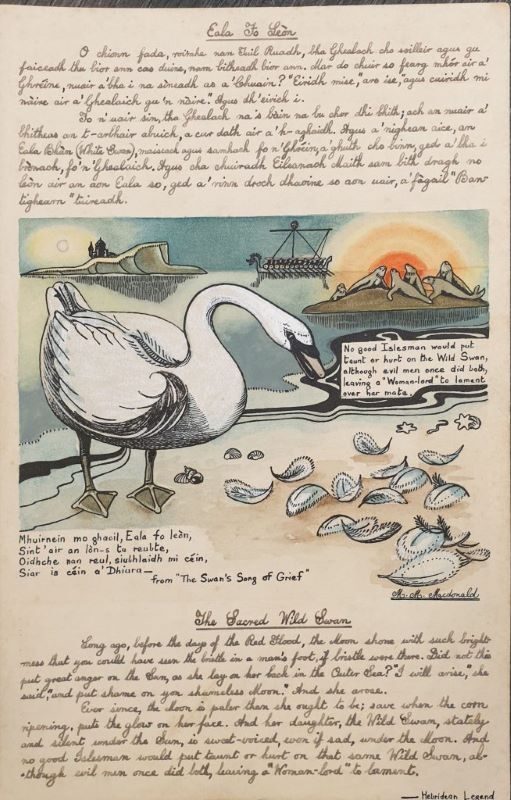
A hand-drawn illustrated page featuring both Gaelic and English text. The illustration shows a large white swan standing on the shore near scattered seashells, with a winding black line resembling water or a path. In the background, there is a stylized sunset over mountains, a Viking-style ship with oars, and two swans flying toward the horizon. The page includes handwritten text at the top and bottom, with a Gaelic poem titled “Eala Bhàn” and an English section titled “The Second Wild Swan.” A small caption near the swan reads: “No good Inisman went out to Ewart but one. The Wild Swan, though out and once did ebb, leaving ‘Wounded’ to lament over her mates.” The artwork is signed “Alasdair Mac Mhaighstir Alasdair” and “Heinrich Leach.”
“Eala Fo Leòn” (“The Injured Swan”) or “The Sacred Wild Swan”, Mairead Mackinnon Macdonald [SL/D188/2/6/1]

Mairead was critical of her own work at times as this note demonstrates. It reads: 

Very inaccurate representation of a swan – especially as it was meant to represent a wild swan!
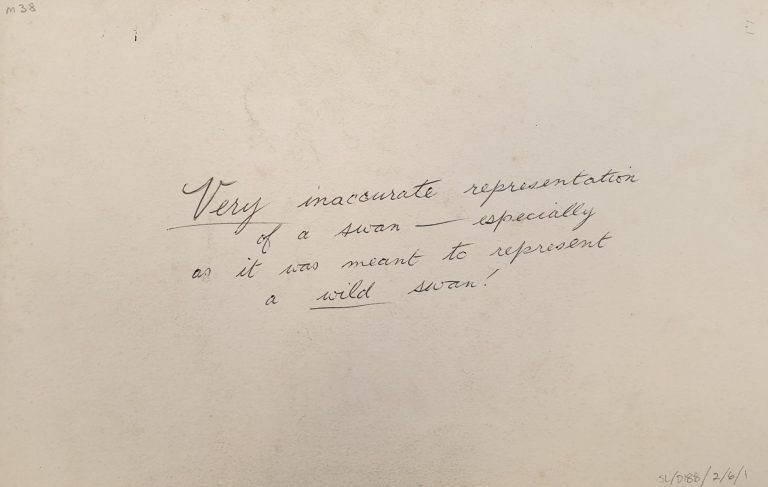
A handwritten note on a plain, slightly aged sheet of paper. The text reads:
"Very inaccurate representation of a swan — especially as it was meant to represent a wild swan!"
The handwriting is in cursive, with the word “Very” and “wild swan” underlined for emphasis.
Mairead's note on her work. Ref: SL/D188/2/6/1

The sisters continued to travel throughout their lives, collecting menus and leaflets, as well as coins dating back as early as 1799. Finally, they settled in Sark, where they kept tortoises and were often visited by relatives and friends. There, Mairead died in 1990. Catriona stayed in Sark until the last year of her life, when she relocated to Uig in the north of Skye.
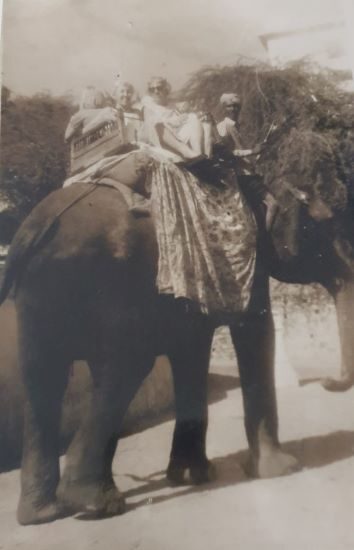
A vintage black-and-white photograph showing an elephant with several people seated on its back. The riders are sitting in a wooden howdah (a carriage-like seat) and appear to be dressed in light-colored clothing, with one person wearing a patterned garment that drapes down the elephant’s side. A handler or guide is seated near the elephant’s head. The background includes trees and a building partially visible, suggesting an outdoor setting in a warm climate.
Catriona (2nd left) and Mairead (3rd left) on a visit to India, 1978. ref: SL/D188/1/3/14/9