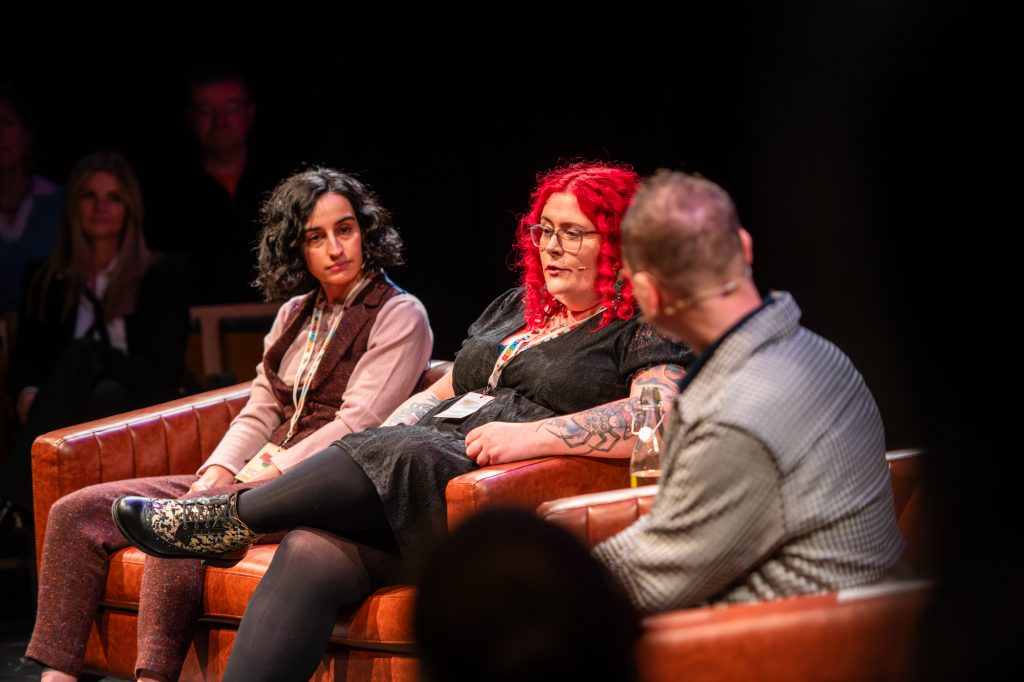
To mark LGBTQ History Month, which runs from the 1 February – 28 February, High Life Highland Archivist Catherine MacPhee has shared her recent experience, appearing at the ‘Out in the Hills’ Festival.
Last month, I joined Dr Ashley Douglas in conversation for ‘Whose History is it Anyway?’ at Pitlochry Festival Theatre for Out in the Hills. Out in the Hills is a brand-new festival that celebrates all those LGBTQIA+, inviting everyone to find new ways to look at the world and each other.
Dr Douglas and I brought different perspectives to the conversation. She is a historian, translator, and author focused on LGBTQ+ history. In contrast, I am a Sgitheanach and Archivist at the Skye and Lochalsh Archive Centre of the Highland Archive Service. This role carries the weight of safeguarding our nearly-eradicated culture; it is both a responsibility and an act of resistance – preserving stories once silenced. I often navigate tensions between institutional systems and ancestral ways of knowing, translating memory into frameworks not built for it. Each act of preservation becomes an act of cultural survival and reclamation. The work is deeply personal and complex.
Our conversation moved gently yet insistently through archives, research, and the queer threads connecting past, present, and future. During this exchange, Ashley Douglas shared her groundbreaking work on Marie Maitland, a little-known 16th-century Scottish poet whose words bear witness to clear, unapologetic love for another woman after the Scottish Reformation. At the core of this work is The Maitland Quarto, which Douglas reclaims as ‘Marie’s Manuscript.’ This book, with Marie’s name inscribed twice on its title page, contains poems of explicit sapphic love, as well as verses by her father and others, including King James VI and I. Long ignored, misread, or attributed to an anonymous male voice, Marie’s poetry now emerges, allowing unexpected traces of queerness to surface. These discoveries invite us to reconsider Scotland’s inherited narratives, revealing a past richer and more varied than history often permits us to see and reminding us that what was hidden can still speak – if we learn to listen.
I reflected on the roles and responsibilities of archival practice. This includes preserving, cataloguing, and making materials accessible to the public. However, there is also a profound responsibility to decide what enters the archive in the first place. This requires attentiveness not only to what has been recorded, but also to what is omitted, silenced, or erased. Thus, we must commit to seeking out and addressing those absences.
In 2022, the Highland Archive Service partnered with Eden Court on the Closing the Queer Gap project. As part of Scotland’s Year of Stories, LGBTQ+ community members were invited to their local Archive Centres to share their lived experiences in the Highlands. Through these gatherings, stories were listened to, recorded, and formally deposited with the Highland Archive Service. As a result, these contributions became the first archival collections to centre Highland LGBTQ+ voices, establishing a legacy and ensuring the preservation of experiences that had long been missing from the historical record.
History often preserves the voices of the ‘winners.’ While working with an artist, I was asked where queer lives might be found in our archives. Days earlier, I found a police record detailing the arrest of a man accused of sodomy. This entry reflects the long criminalisation of male same-sex relationships. That law lasted until 1981 and was only recently addressed through formal pardons. The record notes his appearance, possessions, occupation, and place of work. From my own knowledge, his job placed him in close contact with people of historic wealth and privilege. His lover that night was unrecorded and unnamed. After the arrest, he lost his job and left Skye. What survives is a fragment shaped by power and punishment. What is missing is the fullness of a life, a relationship, and a voice.
Collaborating with artists, researchers, and communities can illuminate such silences. These partnerships enhance our responsibilities as custodians and sharpen our understanding of where and how to look and listen.
During the event in Pitlochry, we listened, laughed, cried, and danced. We celebrated the importance of everyone’s work by attending to what is present, what is absent, and what has been deliberately suppressed. We aimed to unearth, explore, and bring light to queer lives and stories that have always been part of Scotland’s fabric, whether acknowledged or not.
Reflecting on my experience as a panellist at Whose History Is It Anyway? was both humbling and energising. It was a privilege to share the platform with Dr Ashley Douglas and discuss the vital work of uncovering and preserving LGBTQIA+ histories in Scotland. Listening to Ashley speak with care and conviction about Marie Maitland and the careful research that brings her story to light was deeply moving. It sharpened my awareness of archival responsibility – the impact preservation decisions have on collective memory, how absences speak, and how justice can sometimes begin with listening.
Main image: Ashley Douglas (L) with Catherine MacPhee. Photo by Tommy Ga-Ken Wan
Other images by Eilidh Douglas