To celebrate Work Gaelic Week (23 February – 1 March) our Senior Countryside Ranger, Eilidh-Ann Phillips takes us on a wander through the Scottish landscape revealing the meanings behind our much loved places and wildlife…
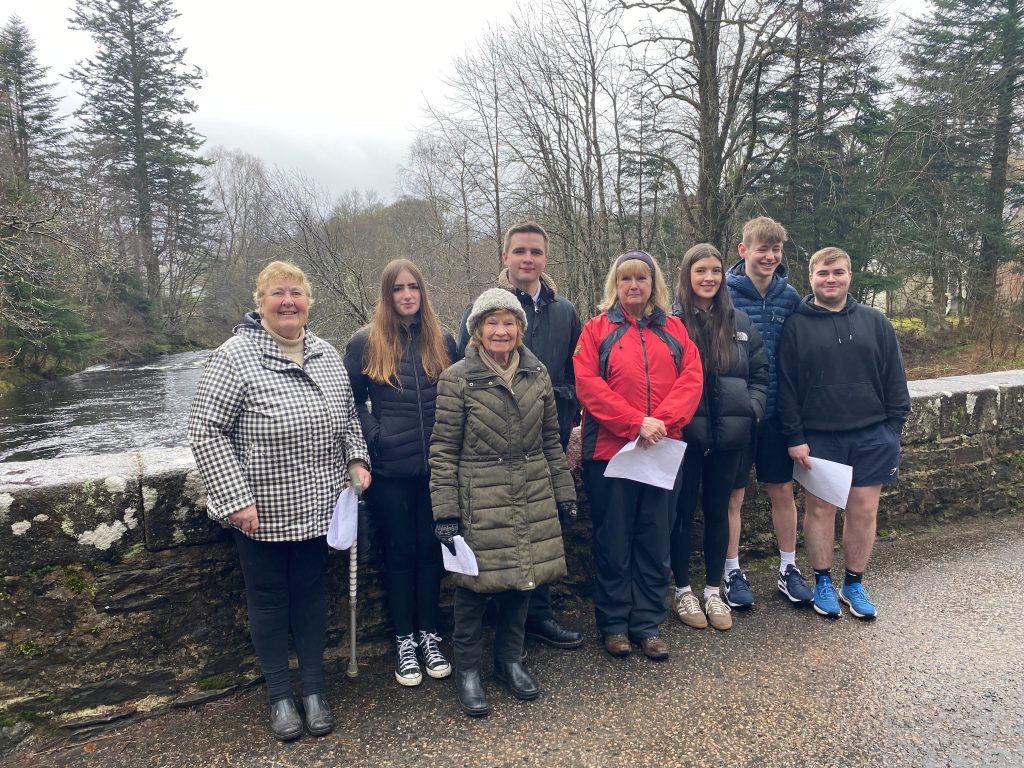
Scottish Gaelic is not simply a language spoken by people – it is a language spoken by the land itself – as we discovered during one of our recent Short Walks into Nature, where we were joined by Gaelic medium pupils from Ardnamurchan High School, who shared their knowledge as well as their musical talents.
Even the 18 letters that make up the Gaelic alphabet reflect the landscape, with each letter relating to a tree name: A = Ailm (Elm), B = Beith (Birch), C = Coll (Hazel)…..
Across the Highlands and Islands, placenames, and descriptions of the terrain create a linguistic map that reveals how generations of Gaelic speakers understood, navigated, and treasured their environment. To move through a Gaelic landscape is to step into layers of story, ecology, and cultural memory woven into every hill, glen, and shoreline.
Open any map of the Highlands, and some words make a regular appearance: gleann (valley), beinn (mountain), allt (burn or stream), coille (forest) and eilean (island). But these are only the broad strokes. Gaelic has multiple terms for different kinds of hills, slopes, and ridges – cnoc, meall, druim, leac, sgùrr – each capturing a subtle variation in shape or position. This richness of words reflects a culture grounded in deep, intimate knowledge of the land — knowledge essential for travel, crofting, and daily survival.
To further describe the landscape around them, the people of the Highlands recognised the colours of each feature, and these words also appear all over our current maps. Dubh (black), glas (grey), gorm (blue), dearg (red), donn (brown) and buidhe (yellow), and these same colours are still so easy to see in the landscape.
And the Gaelic names for our wildlife make lots of appearances on our maps – fiadh (red deer) is a symbol of the Highlands, madadh-ruadh (fox) carries connotations of cunning and agility, one of my favourites dòbhran (otter) takes us on a watery journey from burn to loch, and even flies get a mention (cuileag)! Birds, too, are named on our maps: cuthaig (cuckoo), faoileag (seagull), iolair (eagle), and fitheach (raven). And later land use is reflected in the appearance of words like caorach (sheep), crodh (cattle) and each (horse).
These words do more than label; they encode relationships. When a place is called Sgùrr nan Each (Peak of the horses), Loch nan Eun (loch of the birds), Beinn nan Losgann (Frog Mountain) or Càrn na Nathrach (Snakes Cairn) it tells you something about the animals that once lived there, the people who noticed them, and the stories that grew from those encounters.
Gaelic placenames often preserve ecological information that might otherwise be lost. A hill called Sgùrr an Iubhair (hill of the yew) hints at past vegetation while Creag a’ Chait (Cats Rock), and Meall an Tarmachain (the hill of the Ptarmigan) both lament species that are sadly now in decline.
This deep connection between language and landscape is something that we have lost in more recent years. Many traditional Gaelic placenames don’t even appear on maps – they were known only in the spoken word, passed down through generations as a way to describe sometimes the tiniest of landscape features – a rock at the roadside, or a particular tree on the hill. Words like dùthchas (a sense of belonging to place) and cianalas (a longing for home or homeland) capture emotional relationships with the land that are difficult to translate fully into English.
In a time of ecological change, the Gaelic language can shape how we see and value the natural world. Its vocabulary encourages attentiveness, respect, and curiosity. The landscape becomes not just scenery but a living archive of human and non-human life intertwined.
Open a map and see how many of the words listed above you can see. To learn Gaelic is, in many ways, to learn the land anew. And to preserve Gaelic is to preserve a way of understanding Scotland’s mountains, glens, and wildlife that has endured for centuries – and still speaks today.
If you enjoyed this blog from Eilidh-Ann, you might also be interested in this article by our Countryside Ranger Patti Bremner looking at Gaelic connections in Caithness. To receive regular blogs straight to your inbox from the High Life Highland Countryside Rangers you can sign up here.
Seachdain na Gàidhlig (World Gaelic Week) is a global celebration of Scottish Gaelic and shines a spotlight on the language through community projects, school activities, and a vibrant programme of events.